What's inside
- The direct answer: which Hypertherm-compatible cutters run on 110 volts?
- Head-to-head: 120-volt access versus 240-volt capacity
- Choose by the job, not just the outlet
- What a 120 V circuit changes in real use
- Where thinner-voltage machines reach their limit
- Ownership costs and common mistakes
- Bottom line
- Related Guides
- The direct answer: which Hypertherm-compatible cutters run on 110 volts?
- Head-to-head: 120-volt access versus 240-volt capacity
- Choose by the job, not just the outlet
- What a 120 V circuit changes in real use
- Where thinner-voltage machines reach their limit
- Ownership costs and common mistakes
- Bottom line
- Related Guides
As an Amazon Associate I earn from qualifying purchases. This post may contain affiliate links at no extra cost to you.
What we cover
- The direct answer: which Hypertherm-compatible cutters run on 110 volts?
- Head-to-head: 120-volt access versus 240-volt capacity
- Choose by the job, not just the outlet
- What a 120 V circuit changes in real use
- Where thinner-voltage machines reach their limit
- Ownership costs and common mistakes
- Bottom line
- Related Guides
The direct answer: which Hypertherm-compatible cutters run on 110 volts?
The 110 plasma cutter Hypertherm search usually points to a practical choice between a genuine Hypertherm Powermax30 AIR and lower-cost 120-volt machines made by other brands; Hypertherm’s Powermax30 AIR is the clear option when you want Hypertherm equipment that can use a standard 120-volt supply, while its dependable production cut capacity is limited compared with what a 240-volt circuit can deliver.
“110 volts” is commonly used to describe North American household power, but the actual supply is nominally 120 volts. Check the machine’s nameplate and manual for its allowed input range, plug, circuit and required amperage. A cutter being advertised as “110V compatible” does not mean it can run at full output from any household outlet.
As an Amazon Associate we earn from qualifying purchases at no extra cost to you.


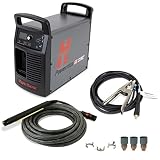
The Powermax30 AIR is a real Hypertherm model, not a generic cutter that is merely compatible with Hypertherm consumables. It includes an air compressor, which makes it portable and avoids needing a separate compressor. If you mainly cut thicker steel, work for long sessions or need better cutting speed and capacity, compare it with a 240-volt Hypertherm such as the Powermax45 SYNC instead of expecting a 120-volt unit to do the same job.
Head-to-head: 120-volt access versus 240-volt capacity
| Model | Input and setup | Published cut-capacity reference | Best fit |
|---|---|---|---|
| Hypertherm Powermax30 AIR | 120/240 V input; integrated air compressor; verify the required circuit and plug for the selected input | At 120 V, rated for cutting up to 10 mm (3/8 in); at 240 V, up to 16 mm (5/8 in). Maximum severance is higher, but slower and less suitable for a clean, repeatable edge. | Portable work, occasional repairs, sheet and modest plate where a 120 V supply matters |
| Hypertherm Powermax45 SYNC | 240 V class; external clean, dry compressed air required | Rated cut capacity 16 mm (5/8 in); maximum severance 29 mm (1 1/8 in) | Regular shop work, thicker material and faster, more consistent cuts when 240 V is available |
| Other-brand 120 V inverter cutter | Varies by model; commonly needs an external compressor and a suitably rated branch circuit | Use the maker’s rated cut figure, not its maximum severance claim; confirm material, output current and duty cycle | Budget-conscious occasional use when local service and consumable availability are acceptable |
Capacity figures are not interchangeable: “rated” or “recommended” cut capacity generally describes a more practical working cut, while maximum severance describes a slower cut that may leave a rough edge. Check the current Hypertherm manual for exact input-current, plug and circuit requirements for your region and operating voltage. Do not infer that a unit can deliver its 240 V output on a 120 V circuit.
Choose by the job, not just the outlet
- You cut sheet, brackets or light plate and need portability: The Powermax30 AIR is the straightforward Hypertherm choice if the 120 V circuit supports the specified setup. Its built-in compressor saves space and reduces the gear you need to transport.
- You routinely cut plate near or above 10 mm (3/8 in): A 120 V setup is a compromise. If you need clean edges, speed or repeated cuts, move to a 240 V machine and plan for the appropriate circuit and air supply.
- You already own an adequate compressor and are comparing purchase cost: A non-Hypertherm 120 V inverter may cost less upfront. Compare the complete setup—not just the cutter—including compressor performance, air filtration, torch consumables and access to replacement parts.
- You weld or fabricate only occasionally in a garage: First check the circuit you actually have. A dedicated, correctly rated circuit may be essential; a convenient outlet on a shared circuit is not automatically suitable just because the plug fits.
What a 120 V circuit changes in real use
At the same cutting output, lower input voltage requires more input current. That is why “runs on 120 V” should be read as a compatibility statement, not a promise of the same performance available on 240 V. On the Powermax30 AIR, Hypertherm publishes different cut-capacity figures for the two input voltages: 10 mm (3/8 in) at 120 V versus 16 mm (5/8 in) at 240 V.
Before buying, check the machine’s manual and the circuit breaker, wiring, receptacle and extension lead. A long or undersized extension cord can cause voltage drop and poor performance; a breaker that trips is not a reason to install a larger breaker without having the wiring checked. For a permanent shop outlet or any uncertainty about circuit capacity, consult a licensed electrician. Follow the manufacturer’s requirements rather than relying on the cutter’s plug shape.
Also account for duty cycle: it specifies how much of a time period a machine can cut at a given output before needing to cool. Frequent long cuts, high settings and hot shop conditions can bring thermal limits into play sooner than occasional short cuts. For production work, compare duty-cycle figures at the output you expect to use, not only the machine’s maximum amperage.
Where thinner-voltage machines reach their limit
A plasma cutter can sometimes sever metal thicker than its rated capacity, but that does not make the result suitable for every job. Near the limit, expect slower travel, a wider or more angled kerf, more dross and less predictable starts. Pierce capacity can also be lower than edge-start capacity because piercing requires the torch to cut through the plate thickness before it can travel.
For a cut that must fit accurately, leave room for cleanup and account for kerf—the material removed by the arc. Make a test cut on scrap of the same material and thickness, then adjust travel speed and torch distance as the manual directs. If the cut is inconsistent, inspect the consumables and air supply before compensating by moving the torch too slowly.
Ownership costs and common mistakes
On an air-compressor-equipped cutter, portability comes with an additional wear item: the internal compressor. Keep the machine’s air intake and cooling vents clear of dust and grinding debris, and follow the service instructions for inspection and cleaning. For models using an external compressor, clean, dry air matters; moisture and oil can shorten consumable life and make the arc unstable. Use the filtration and air-pressure setup specified by the manufacturer.
The torch electrode and nozzle are routine consumables. Their life depends on cutting conditions, starts, air quality and technique. Replace damaged or worn parts as a matched, manufacturer-approved set where required. Frequent piercing at the edge of the machine’s capacity, dragging the torch when the consumable setup is not designed for it, or continuing to cut with a damaged nozzle can worsen cut quality and waste parts.
Budget for consumables and any required air equipment before comparing sticker prices. If you cut only a few times each year, a portable 120 V machine may be worth its capacity trade-off. If you cut plate regularly, the time spent on slow cuts, cleanup and consumables can outweigh the initial savings of staying with a smaller electrical supply.
Bottom line
For someone specifically seeking a Hypertherm-compatible cutter on household power, the Powermax30 AIR is the Hypertherm model to examine first: it supports 120 V input and is rated for cuts up to 10 mm (3/8 in) at that voltage. Choose it for portability and intermittent lighter work, not as a substitute for a 240 V shop cutter. If thicker plate, long cuts or production pace matter more than outlet availability, plan for a 240 V Hypertherm and the supporting electrical and air setup. For any alternative brand, verify its actual input requirements, rated cut capacity, duty cycle and consumable supply before purchasing.