What's inside
As an Amazon Associate I earn from qualifying purchases. This post may contain affiliate links at no extra cost to you.
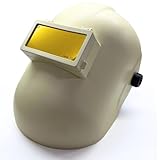
The best sugar scoop welding hood for most overhead and confined-position work is a lightweight fixed-shade or flip-front hood with a 2 × 4¼-inch lens, a deep rear shell, adjustable ratchet headgear, and enough clearance to keep the lens close without touching your chest or workpiece.
A sugar scoop welding hood is valued for its narrow, elongated shell: it gives the wearer more room to look upward and work close to walls, tanks, frames, and pipe. The trade-off is a smaller viewing window and less flexibility than a modern auto-darkening helmet. The right choice depends less on appearance than on lens coverage, shell depth, shade control, and how often you weld in awkward positions.
As an Amazon Associate we earn from qualifying purchases at no extra cost to you.



What we cover
Quick comparison of sugar scoop hood designs
| Hood type | Typical lens | Typical weight | Shade options | Best suited to | Main compromise |
|---|---|---|---|---|---|
| Compact fixed-front sugar scoop | 2 × 4¼ in | 16–24 oz | Shade 10–13 | Pipe, overhead, tight spaces | Small field of view |
| Flip-front sugar scoop | 2 × 4¼ in | 20–30 oz | Shade 10–13, clear cover lens | Frequent inspection and repositioning | More moving parts and bulk |
| Large-window sugar scoop | 2 × 4¼ in or 4½ × 5¼ in | 22–34 oz | Shade 10–13 | Long welds and improved peripheral vision | Less clearance in narrow gaps |
| Passive custom hood with premium headgear | Usually 2 × 4¼ in | 18–28 oz | Interchangeable passive lenses | Daily professional use | Higher initial cost, no automatic shade change |
These are useful buying ranges rather than universal specifications. Individual sugar scoop welding helmets vary by shell material, headgear, lens retainer, and accessories. Confirm the actual weight and window dimensions before ordering.
What makes one sugar scoop hood better than another?
Lens size and practical visibility
The standard 2 × 4¼-inch lens is popular because it fits the long, narrow front of a welding hood sugar scoop. It provides adequate coverage for pipe and structural work while preserving a slim profile. A larger window makes it easier to track a long bead, but it can reduce the clearance advantage that makes the design useful.
For overhead welding, lens position matters as much as lens area. A hood with a deep upper brow and a lens set close to the face can block stray arc light while allowing you to tilt your head less. That reduces the tendency to expose the neck or look under the shell. Always use a correctly rated shade and cover lens; the shell shape is not a substitute for proper eye protection.
Shade choices
Most passive sugar scoop welding hoods accept dark lenses in shades 10 through 13. Shade 10 is common for lower-amperage work, while shade 11 or 12 is often more comfortable as current rises. Shade selection should follow the welding process, amperage, electrode, and applicable safety guidance rather than personal preference alone.
A flip-front model is useful when you repeatedly alternate between welding and inspecting a joint. It is not automatically safer or more comfortable: the hinge, latch, and lens retainer add weight at the front. For a welder who keeps the hood down for long periods, a fixed front can feel more balanced.
Headgear comfort and fit
Headgear is often the first component to determine whether a sugar scoop hood remains comfortable through a full shift. Look for a four- or five-point suspension, a broad sweatband, a smooth ratchet, and independent adjustment for crown depth and circumference. A hood that fits too loosely can swing when you bend over; one that is too tight creates pressure at the forehead and temples.
Measure head circumference around the brow and compare it with the manufacturer’s range. As a practical fit check, the hood should stay in position when you look up and down without requiring maximum ratchet tension. If the lens sits too far from your eyes, the visible work area shrinks; if it sits too close, your nose, respirator, or safety glasses may interfere.
Shell durability
Fiberglass and reinforced thermoplastic shells are common. Fiberglass generally tolerates heat, sparks, and repeated impacts well, while thermoplastic designs can be lighter and less expensive. A leather sugar scoop welding hood can be useful in extremely tight spaces or around surfaces that would scratch a rigid shell, but leather requires closer inspection for burned stitching, stiffened panels, and heat damage.
Do not judge durability by shell thickness alone. Lens retainers, hinges, headgear mounts, and the lower edge usually wear first. A thick shell with fragile mounting hardware can have a shorter useful life than a slightly lighter hood with replaceable parts.
Best choice by welding situation
| Your situation | Recommended configuration | Why it fits |
|---|---|---|
| Occasional hobby welding on a tight budget | Fixed-front, thermoplastic shell, 2 × 4¼ lens | Low cost, low weight, few parts to break |
| Daily pipe or structural welding | Fiberglass shell, premium ratchet, replaceable lens retainer | Better heat resistance and long-term serviceability |
| Frequent overhead work | Deep brow, close-set lens, secure five-point suspension | Improves upward coverage and reduces neck repositioning |
| Very confined position | Compact 2 × 4¼ window and narrow rear shell | Less chance of striking walls, pipe, or fixtures |
| Many weld-inspect-adjust cycles | Flip-front hood with positive latch | Faster inspection without removing the hood |
| Long welds where peripheral vision matters | Larger-window model, if clearance allows | Less head movement while following the joint |
Passive versus auto-darkening sugar scoop welding helmets
Passive hoods remain popular because they are simple, light, and ready whenever a correctly rated lens is installed. They also avoid batteries, electronic failure, and delay concerns. Their limitation is that the wearer must lower the hood before striking the arc, which can make precise starts more difficult.
An auto-darkening insert can improve convenience, but it changes the balance and clearance of the hood. Check the insert’s actual viewing area, reaction time, battery arrangement, low-amperage performance, and certification. Some electronic units are too bulky for a narrow sugar scoop shell, while others leave less room for safety glasses or a respirator.
For occasional work, a passive hood often delivers the best value. For production welding with frequent starts, an appropriately fitted auto-darkening setup may justify its added cost, provided it does not compromise shell coverage or fit.
Ownership costs and maintenance
A realistic budget includes consumables. A passive hood may cost roughly $40–$150, while a more robust custom sugar scoop welding hood with upgraded headgear and materials can range from about $100–$300 or more. Auto-darkening configurations generally cost more. Replacement cover lenses commonly cost a few dollars each; inner lenses, headgear, hinges, and electronic cartridges vary widely.
Consider a welder who uses six cover lenses per year at $4 each and replaces headgear every two years at $25. The first two years of ownership add approximately $98 in consumables: 12 cover lenses ($48) plus one headgear replacement ($25), with the remaining amount allowing for occasional inner lenses or retainers. Cleaning and replacing lenses before they become heavily scratched is usually cheaper than compensating for a distorted view by changing position unsafely.
Simple care routine
- Brush or blow off dry spatter before wiping the shell, so grit does not scratch it.
- Clean cover lenses with mild soap and water or the lens maker’s recommended cleaner.
- Replace a lens with cracks, deep scratches, clouding, or arc burns rather than polishing it.
- Inspect the lens retainer, hinge, and suspension before overhead work.
- Keep the hood away from hot metal after welding; trapped heat can warp plastic and damage headgear.
- Do not paint, drill, or modify the shell unless the manufacturer specifically permits it.
The most common mistake is selecting a hood for its shell alone and overlooking the suspension. The second is using a shade that is too light because it appears brighter. The third is leaving a damaged outer lens in place until the arc becomes difficult to see. These problems reduce comfort and visibility even when the underlying sugar scoop welding hood is well made.
Final buying recommendation
Choose a compact fixed-front model with a 2 × 4¼-inch lens for the best balance of clearance, protection, and value in overhead or confined-position welding. Step up to fiberglass and premium headgear if you weld frequently or work around substantial heat. Choose a flip-front design when inspection speed matters, and choose a larger window only when the extra visibility is worth giving up some maneuvering room.
Before buying, verify the shade range, lens dimensions, shell material, headgear adjustment range, replacement-part availability, and compliance markings such as ANSI Z87.1 or the applicable local standard. The best sugar scoop welding hood is the one that stays stable, keeps the arc fully covered, and lets you reach the joint without forcing your neck or shell into the surrounding work.