What's inside
- Best Budget Multiprocess Welders: Affordable MIG, TIG, and Stick Picks
- Quick comparison of budget multiprocess welders
- Best overall for a serious home shop: Hobart Multi-Handler 200
- Best established-brand alternative: Lincoln Electric POWER MIG 215 MPi
- Best low-cost 240-volt option: YESWELDER MIG-250 PRO
- Best for 120-volt portability: Forney Easy Weld 140 MP
- Choose by situation rather than advertised amperage
- Where cheap multiprocess welders compromise
- Ownership costs and maintenance
- Bottom line
- Best Budget Multiprocess Welders: Affordable MIG, TIG, and Stick Picks
- Quick comparison of budget multiprocess welders
- Best overall for a serious home shop: Hobart Multi-Handler 200
- Best established-brand alternative: Lincoln Electric POWER MIG 215 MPi
- Best low-cost 240-volt option: YESWELDER MIG-250 PRO
- Best for 120-volt portability: Forney Easy Weld 140 MP
- Choose by situation rather than advertised amperage
- Where cheap multiprocess welders compromise
- Ownership costs and maintenance
- Bottom line
As an Amazon Associate I earn from qualifying purchases. This post may contain affiliate links at no extra cost to you.
What we cover
- Best Budget Multiprocess Welders: Affordable MIG, TIG, and Stick Picks
- Quick comparison of budget multiprocess welders
- Best overall for a serious home shop: Hobart Multi-Handler 200
- Best established-brand alternative: Lincoln Electric POWER MIG 215 MPi
- Best low-cost 240-volt option: YESWELDER MIG-250 PRO
- Best for 120-volt portability: Forney Easy Weld 140 MP
- Choose by situation rather than advertised amperage
- Where cheap multiprocess welders compromise
- Ownership costs and maintenance
- Bottom line
Best Budget Multiprocess Welders: Affordable MIG, TIG, and Stick Picks
The best budget multiprocess welder for most home fabricators is a 200-amp inverter with 120/240-volt input, true DC TIG capability, and enough duty cycle for the material you actually weld—not simply the machine with the longest process list.
At the entry level, “multiprocess” can mean very different things. Some welders offer MIG, flux-core, and stick but only lift-start TIG. Others include a TIG torch yet omit the foot pedal, gas regulator, or spool gun. The comparisons below focus on useful process capability, power requirements, duty cycle, and what is included in the box.
As an Amazon Associate we earn from qualifying purchases at no extra cost to you.



Quick comparison of budget multiprocess welders
| Welder | Processes | Input power | Output range | Duty cycle | Typical market range |
|---|---|---|---|---|---|
| Hobart Multi-Handler 200 | MIG, flux-core, DC TIG, stick | 120/240 V | 25–200 A | 30% at 200 A | $900–$1,200 |
| Lincoln Electric POWER MIG 215 MPi | MIG, flux-core, DC TIG, stick | 120/230 V | 20–215 A | 25% at 215 A | $850–$1,150 |
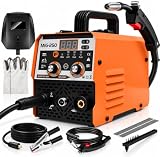
| YESWELDER MIG-250 PRO | MIG, flux-core, lift TIG, stick | 120/240 V | up to 250 A class | varies by input and output | $350–$550 |
| Forney Easy Weld 140 MP | MIG, flux-core, DC TIG, stick | 120 V | 25–140 A | 30% at 90 A | $450–$650 |
Specifications can vary by revision and regional package, so verify the manual before buying. In particular, check whether a quoted maximum amperage is available on 120 volts or only on 240 volts. A small 120-volt circuit is often the limiting factor, not the welder’s headline output.
Best overall for a serious home shop: Hobart Multi-Handler 200
The Hobart Multi-Handler 200 is the balanced choice when you want a recognized service network, 240-volt performance, and a complete four-process platform. It supports MIG, flux-core, DC TIG, and stick, with a 200-amp maximum output and a 30% duty cycle at maximum amperage.
Its meaningful advantage over very cheap machines is not just the brand name. The machine is designed for both 120- and 240-volt operation, so it can handle light repair work from a household circuit and deliver substantially more headroom from a 240-volt outlet. That matters when welding thicker steel or using larger electrodes.
Expect a MIG gun, electrode holder, work clamp, gas regulator, and basic accessories, but inspect the exact package for the TIG torch. A TIG torch and a foot pedal are not interchangeable: the torch is needed to make a TIG arc, while a pedal gives more control over amperage during a weld. This model is DC TIG, so it is suitable for steel and stainless steel, but not the correct choice for serious aluminum TIG work.
Best for
- Frequent home fabrication and equipment repair
- Owners who want 240-volt capability without moving to an industrial machine
- Users who value parts and service support over the lowest purchase price
Best established-brand alternative: Lincoln Electric POWER MIG 215 MPi
The Lincoln Electric POWER MIG 215 MPi is another strong choice for a garage or small fabrication shop. It covers MIG, flux-core, DC TIG, and stick, and its 215-amp class output gives it a small capacity advantage over 200-amp machines. Its published duty cycle is 25% at 215 amps, which means it can weld at full output for 2.5 minutes in a ten-minute period before requiring 7.5 minutes of cooling.
That calculation is important. A 25% duty cycle at maximum output does not mean the welder stops every few minutes during ordinary work. At lower settings—such as welding 1/8-inch steel—the usable duty cycle is typically more generous. Still, long continuous welds, heavy trailer work, or production use call for a larger machine.
The Lincoln is particularly appealing if you expect MIG to be your primary process and want a familiar setup with digital controls. As with the Hobart, check the package contents before budgeting for TIG: entry-level multiprocess bundles may include the torch but not a pedal, consumables, or a TIG gas lens kit.
Best low-cost 240-volt option: YESWELDER MIG-250 PRO
The YESWELDER MIG-250 PRO represents the budget end of the category. It offers MIG, flux-core, lift-start TIG, and stick in a compact inverter package, with dual-voltage operation and a nominal output in the 250-amp class.
The lower price brings compromises. Published output, duty-cycle figures, included accessories, and connector arrangements can differ between package versions. A “250-amp” rating should not be treated as equivalent to a 250-amp industrial welder. Confirm the amperage available at 120 volts, the duty cycle at the output you need, and whether the TIG torch, regulator, and spool-gun connection are supplied.
Lift TIG is functional for occasional steel or stainless-steel welds, but it is less convenient than high-frequency start and usually offers fewer controls. It is best viewed as a useful secondary process rather than the reason to buy this machine. For brackets, gates, small repairs, and hobby fabrication, the value can be excellent if you already own a gas bottle and understand the accessory costs.
Best for 120-volt portability: Forney Easy Weld 140 MP
The Forney Easy Weld 140 MP is the practical pick when a 240-volt circuit is unavailable. It runs on 120 volts and covers MIG, flux-core, DC TIG, and stick. With a 140-amp ceiling, it is aimed at sheet metal, tubing, light equipment repair, and small projects rather than heavy structural fabrication.
The limitation is electrical input. At 120 volts, the machine must draw more current to produce the same welding power, so extension cords, shared circuits, and long cable runs can cause voltage drop or nuisance breaker trips. Use a properly sized circuit and keep the extension cord short and heavy-gauge if one is unavoidable.
A 30% duty cycle at 90 amps means three minutes of arc time in a ten-minute period at that test condition. That is enough for intermittent home projects, but not a substitute for a 200-amp, 240-volt machine when welding thick plate.
Choose by situation rather than advertised amperage
| Your situation | Most sensible choice | Why |
|---|---|---|
| Only 120 V available; mostly 16-gauge to 1/8-inch steel | Forney Easy Weld 140 MP | Portable and adequate for intermittent light fabrication |
| 120/240 V available; weekly repair and fabrication | Hobart Multi-Handler 200 | Balanced output, duty cycle, and support |
| MIG is primary; occasional TIG and stick | Lincoln POWER MIG 215 MPi | Strong MIG-oriented platform with useful secondary processes |
| Lowest purchase price; occasional hobby work | YESWELDER MIG-250 PRO | Broad process coverage, provided accessory omissions are acceptable |
| Frequent long welds or thick material | A larger 240-volt machine | Budget multiprocess units may overheat or require excessive pauses |
Where cheap multiprocess welders compromise
The first compromise is often TIG. Many low-cost machines provide lift-start DC TIG but no high-frequency start, pulse control, or foot-pedal compatibility. That is adequate for occasional steel welds, but it is less forgiving on thin material and does not support aluminum TIG, which generally requires AC output.
The second is the accessory package. A basic MIG gun may be included while a TIG torch, regulator, gas hose, foot pedal, spool gun, or consumable starter kit is not. A realistic budget should include approximately $100–$250 for missing TIG or gas equipment, depending on the process and quality level.
The third is thermal capacity. Duty cycle is a more useful number than maximum amperage. If your work requires 150 amps for long beads, a machine rated at 30% at 200 amps may be more suitable than an inexpensive model that advertises 250 amps without a comparable published test condition.
Ownership costs and maintenance
MIG contact tips and nozzles are usually the first consumables to wear. Keep tips matched to the wire diameter, replace them when the wire starts sticking, and remove spatter from the nozzle before it restricts shielding gas. Flux-core welding adds slag removal and produces more smoke, while solid-wire MIG requires a gas cylinder, regulator, and wind protection.
For TIG, a contaminated tungsten is a common source of poor starts and unstable arcs. Grind it lengthwise, keep the tip clean, and avoid touching the tungsten to the puddle. Replace cracked ceramic cups and inspect the collet and gas lens when shielding becomes inconsistent.
Clean the machine’s ventilation openings periodically with dry, low-pressure air, especially in a grinding-heavy shop. Do not operate an inverter welder on a damp floor, overload a household circuit, or use an undersized extension cord. Let the cooling fan complete its cycle after demanding work.
Bottom line
Choose the Forney Easy Weld 140 MP for genuinely 120-volt, light-duty work; the YESWELDER MIG-250 PRO when minimum cost and broad process coverage matter most; and the Hobart Multi-Handler 200 or Lincoln POWER MIG 215 MPi when you want a more dependable 240-volt home-shop platform. The best budget multiprocess welder is the one whose input power, duty cycle, TIG capability, and included accessories match your actual projects—not the one with the largest number printed on its front panel.