
Key takeaways
- Compare DC TIG welders for equipment repair shops on output, duty cycle, HF start and stick backup for brackets, frames, shafts and stainless repairs.
What's inside
As an Amazon Associate I earn from qualifying purchases. This post may contain affiliate links at no extra cost to you.
As an Amazon Associate, we earn from qualifying purchases.
Equipment repair work is not show-car fabrication. A repair shop TIG welds cracked loader brackets, worn linkage, hydraulic cylinder eyes, exhaust manifolds, stainless tanks and the odd chromoly shaft — usually on steel that has already lived a hard life, often with paint, rust or oil still in the pores nearby. That is exactly the work DC TIG suits. Steel and stainless do not need AC, so a DC-only machine puts its money into output, duty cycle and arc control instead of an AC inverter you will rarely switch on.
The catch is repair variety. One hour you are feathering 40 amps into a thin stainless guard, the next you are running near full output on a thick mild-steel lug, and after that you are stick welding a dirty bracket outdoors where TIG shielding gas would blow away. So the machines below were chosen on repair-relevant grounds: DC TIG output and low-end control, high-frequency start so you are not scratch-starting on finished surfaces, a stick mode for rough work, and published duty cycle figures that tell you how long the machine can keep going on a big repair.
What we cover
Quick Picks
| Product | Best for | Key spec |
|---|---|---|
| YESWELDER TIG-205DS | Repair shops wanting a foot pedal in the box | 205A DC TIG/Stick, 110/220V, HF start — ASIN B08882MFWP |
| YESWELDER TIG-205P | Thin stainless and heat-sensitive repairs | 200A DC TIG with pulse, 110/220V — ASIN B0BVYHBQZ6 |
| ARCCAPTAIN TIG200 | Light, portable DC TIG for call-out repairs | 200A DC TIG/Stick, 110/220V, HF start — ASIN B0B5N69BDZ |
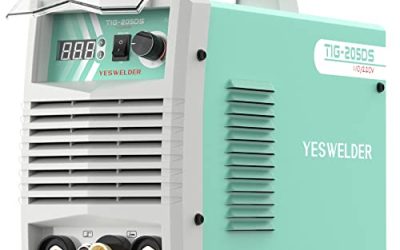
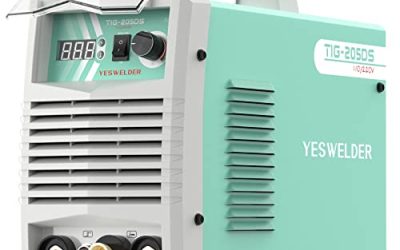
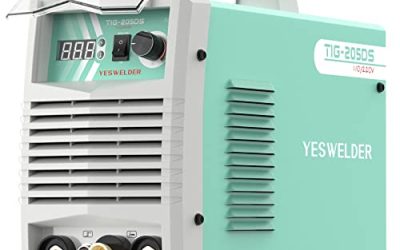
YESWELDER TIG-205DS
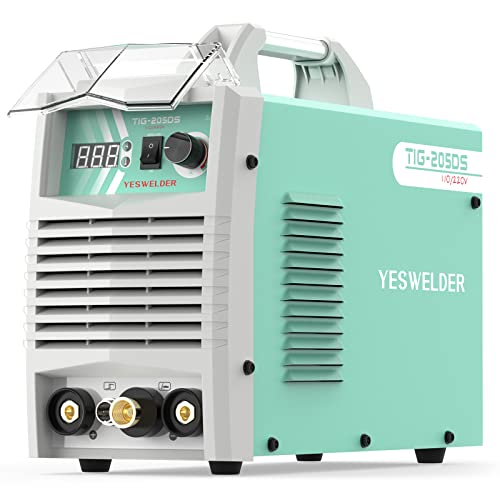
The TIG-205DS is a 205-amp HF TIG and stick machine that fits the repair-shop pattern well: DC TIG for the controlled work, stick for the rough work, and a foot pedal included in the listing title so amperage can be backed off as a crack repair reaches thin, heat-soaked metal at the end of a seam. High-frequency start matters in repair work because scratch starting on a machined face or a sealing surface leaves marks and contaminates the tungsten.
For a shop that repairs a bit of everything, the useful detail is range. The listing describes up to 205 amps with a 60% duty cycle, which covers common bracket and frame thicknesses in steel, while the low end allows careful work on thinner stainless covers and guards. The dual-voltage input is a bonus rather than the headline here: run it on the shop supply for full output, or on a lighter supply for a small job in another building.
- Model: YESWELDER TIG-205DS
- Processes: HF DC TIG, Stick/Arc
- Output: Up to 205A
- Input: 110V/220V dual voltage
- Duty cycle: 60% as stated in the listing
- Foot pedal: Included, per the listing title
- Amazon: https://www.amazon.com/dp/B08882MFWP
Pros
- Foot pedal included, which helps when tapering heat at the end of a crack repair
- HF start avoids scratch marks on finished or machined surfaces
- Stick mode covers dirty, painted or outdoor repairs where TIG is impractical
Cons
- DC only, so it cannot TIG weld aluminum
- Repair shops welding thick sections all day should still check the duty cycle at their working amperage
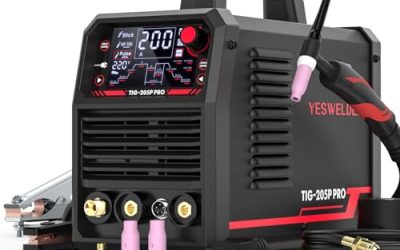
YESWELDER TIG-205P

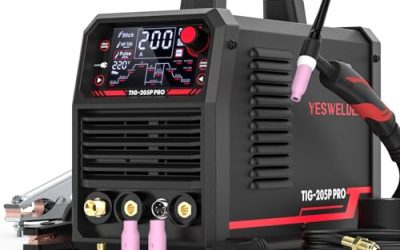
The TIG-205P adds pulse to the same basic repair idea. Its listing describes three processes — Stick, DC TIG and Pulse TIG — with a large LED display and 110/220V dual-voltage input. Pulse is genuinely useful in a repair shop, not just on fabrication benches: pulsing between a peak and a background current limits total heat input, which helps on thin stainless shields, exhaust parts and heat-sensitive assemblies where a steady arc would warp the part or blow through a worn, thinned edge.
Published figures from the manual and listing coverage put DC TIG output at 10–200A on 220V and 10–160A on 110V, with pulse frequency adjustable from 0.5 to 200 Hz. The machine is also notably light at about 10.7 pounds, so it can ride on a service cart or be carried to a machine that cannot come to the bench. Note the pedal position accurately: sources describe a 5-pin foot pedal port, with the pedal sold separately, so budget for it if hands-free amperage control is part of your repair routine.
- Model: YESWELDER TIG-205P
- Processes: Stick, DC TIG, Pulse DC TIG
- Output: Up to 200A on 220V, as stated in listing coverage
- Input: 110V/220V dual voltage
- Pulse: 0.5–200 Hz, per the manufacturer manual figures
- Foot pedal: Compatible via 5-pin port; sold separately
- Amazon: https://www.amazon.com/dp/B0BVYHBQZ6
Pros
- Pulse mode helps control heat on thin or worn repair edges
- Very light for a 200-amp class machine, so it moves easily around a busy shop
- HF start and LED display suit repeatable repair settings
Cons
- DC only, so no aluminum TIG repairs
- Foot pedal is an extra purchase, not part of the standard listing
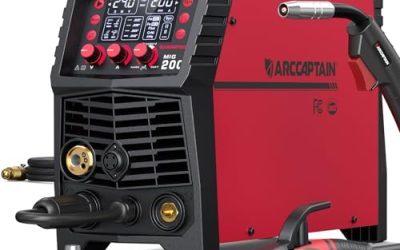
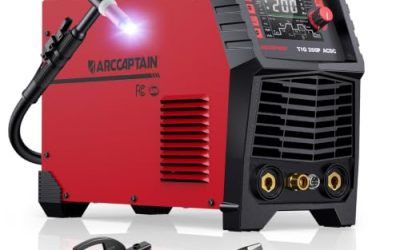
ARCCAPTAIN TIG200

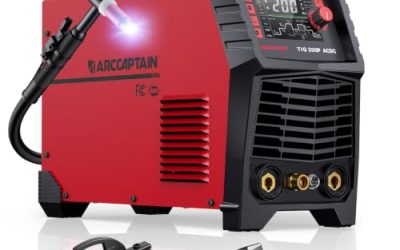
The ARCCAPTAIN TIG200 is a 200-amp, 2-in-1 DC TIG and stick machine with high-frequency start, a large LED display and adjustable post-gas and down-slope settings listed for it. Those last two controls are repair-friendly: post-flow protects a hot tungsten and the end of a repair bead, and down-slope lets the arc taper instead of snapping off and leaving a crater crack at the end of a seam — a common failure point when a repaired bracket goes back into service.
Listing specifications give the model number as ARCCAPTAIN TIG200 and describe dual-voltage 110V/220V operation. At under 12 pounds in published descriptions, it is the carry-to-the-job option in this group: useful when a gate hinge, trailer coupling or fixed machine frame has to be TIG welded where it sits rather than on your bench. The listing Q&A notes compatibility with a 5-pin foot pedal, but a pedal is not described as included, so treat it as an optional extra.
- Model: ARCCAPTAIN TIG200
- Processes: DC TIG, Stick
- Output: Up to 200A
- Input: 110V/220V dual voltage
- Start: High-frequency start
- Foot pedal: 5-pin pedal compatible, per listing Q&A; not stated as included
- Amazon: https://www.amazon.com/dp/B0B5N69BDZ
Pros
- Compact and light for repairs away from the main bench
- Post-gas and down-slope controls help finish repair beads cleanly
- DC TIG plus stick covers both precision and rough repair work
Cons
- DC only, so aluminum work needs a different machine
- Output on 110V is limited compared with 220V operation
How to Choose a DC TIG Welder for an Equipment Repair Shop
Start with the metals you actually repair. If your TIG work is mild steel, stainless, chromoly and cast steel, DC covers it and an AC/DC machine adds cost and complexity you may not use. If aluminum housings and radiators are a regular part of your intake, none of these DC-only machines will TIG them — that is a separate buying decision.
Match duty cycle to your longest repairs. A bracket tack is seconds of arc time; rebuilding a worn bore or running a long frame crack is minutes. Compare the duty cycle at the amperage you will actually use, not just the headline maximum output.
Value HF start and a tidy arc finish. High-frequency start protects finished surfaces and tungsten life. Down-slope and post-flow controls reduce crater cracking and tungsten oxidation, both of which matter more on parts going back into load-bearing service than on practice coupons.
Keep stick mode in the picture. Repair shops earn money on dirty metal too. A machine that switches to stick handles rusty, painted or outdoor work without tying up a second welder.
Check pedal and torch details before ordering. Pedals may be included, optional or merely compatible, and connector types differ. Confirm what the exact listing includes so the machine is ready to work the day it arrives.
FAQs
Can a DC TIG welder repair aluminum equipment parts?
No. Aluminum TIG welding needs AC output to break up the oxide layer. These DC machines suit steel, stainless and similar ferrous repairs; aluminum work requires an AC/DC TIG welder.
Why does duty cycle matter more in repair work than in hobby use?
Repairs often involve long, continuous seams on thick sections — frame cracks, wear build-up and heavy lugs. A higher duty cycle at your working amperage means fewer thermal cut-outs mid-repair.
Is stick mode worth having on a repair-shop TIG machine?
Yes, for many shops. Stick handles dirty, rusty or outdoor repairs where TIG shielding gas is impractical, so one machine can cover both the precision bench work and the rough yard work.
Do I need a foot pedal for equipment repairs?
It helps on heat-sensitive repairs, thin sections and crack repairs where you want to taper current as the part heats up. Check each listing: on some machines here the pedal is included, on others it is an optional extra.
What amperage do most steel equipment repairs need?
Common bracket, frame and linkage repairs in mild steel typically fall well inside a 200-amp class machine’s range, especially on higher-voltage input. Thicker sections and long runs are where duty cycle, rather than peak amps, becomes the limit.
Conclusion
For most equipment repair shops, the YESWELDER TIG-205DS is the straightforward pick: 205-amp DC TIG and stick, HF start and a foot pedal in the listing. Choose the YESWELDER TIG-205P if thin stainless and heat-sensitive repairs dominate and you want pulse control in a very light machine, accepting that the pedal is separate. Pick the ARCCAPTAIN TIG200 when portability to the job matters most. All three keep the focus where repair work needs it — controlled DC arcs on steel, a stick fallback for rough metal, and settings that help a repaired part go back into service with a sound, cleanly finished weld.
Related guides
More from Amazon
Programs that pair well with the guide above. Offers and eligibility are set by Amazon and may change.
A free business account with business pricing and bulk-buying tools for work, shop or home office.
Create a business accountFree shipping on eligible items, Prime Video and more. Eligible new members can start with a free trial.
Start a Prime free trialAudiobooks and podcasts to listen to on the go. Eligible new members can start with a free trial.
Try Audible freeAd-free music streaming. Eligible new subscribers can start with a free trial.
Try Music Unlimited freeAs an Amazon Associate we earn from qualifying purchases.
Write Your Review
No reviews yet. Be the first to share your experience!