What's inside
- Top 3 Picks
- Quick Comparison
- How We Chose
- 1. JBL Go 5 – Best for Pocket-Sized Everyday Carry
- 2. Bose Lifestyle Ultra – Best for Premium Wi-Fi Multiroom Sound
- 3. OHAYO Portable Wireless Outdoor Speaker – Best for Gift-Friendly Budget Portability
- 4. Monster S320 – Best for Loud 360-Degree Outdoor Parties
- 5. Oraolo 50W – Best for Maximum Outdoor Volume
- 6. OHAYO 35W Portable Speaker – Best for Rugged Waterproof Mid-Range Listening
- 7. Bose Home Speaker 500 – Best for Built-In Voice Control at Home
- How to Choose
- Related Guides
- Top 3 Picks
- Quick Comparison
- How We Chose
- 1. JBL Go 5 – Best for Pocket-Sized Everyday Carry
- 2. Bose Lifestyle Ultra – Best for Premium Wi-Fi Multiroom Sound
- 3. OHAYO Portable Wireless Outdoor Speaker – Best for Gift-Friendly Budget Portability
- 4. Monster S320 – Best for Loud 360-Degree Outdoor Parties
- 5. Oraolo 50W – Best for Maximum Outdoor Volume
- 6. OHAYO 35W Portable Speaker – Best for Rugged Waterproof Mid-Range Listening
- 7. Bose Home Speaker 500 – Best for Built-In Voice Control at Home
- How to Choose
- Related Guides
As an Amazon Associate I earn from qualifying purchases. This post may contain affiliate links at no extra cost to you.
The best Black Friday smart speaker deal for most people is the Bose Home Speaker 500 if you want a genuine voice assistant, Wi-Fi streaming and multiroom grouping in one box, and the JBL Go 5 if you want the cheapest sensible way to add decent sound to a bag, a bench or a bike. Those two sit at opposite ends of this category, and the gap between them explains why “smart speaker” has become such a confusing search term. Only two products in this roundup — the Bose Home Speaker 500 and the Bose Lifestyle Ultra — actually join your Wi-Fi network, respond to a voice assistant or slot into a multiroom group. The other five are portable Bluetooth speakers that trade assistants and app ecosystems for battery life, waterproofing and a price that falls hardest during the Black Friday window. Everything below is compared on the five things that decide whether you still use the speaker in February: sound quality, room size, voice assistant support, privacy controls and multiroom compatibility.
What we cover
- Top 3 Picks
- Quick Comparison
- How We Chose
- 1. JBL Go 5 – Best for Pocket-Sized Everyday Carry
- 2. Bose Lifestyle Ultra – Best for Premium Wi-Fi Multiroom Sound
- 3. OHAYO Portable Wireless Outdoor Speaker – Best for Gift-Friendly Budget Portability
- 4. Monster S320 – Best for Loud 360-Degree Outdoor Parties
- 5. Oraolo 50W – Best for Maximum Outdoor Volume
- 6. OHAYO 35W Portable Speaker – Best for Rugged Waterproof Mid-Range Listening
- 7. Bose Home Speaker 500 – Best for Built-In Voice Control at Home
- How to Choose
- Related Guides
Top 3 Picks
Best overall: Bose Home Speaker 500
The only speaker here with an assistant built in — Alexa, with a far-field microphone array — alongside Wi-Fi, Bluetooth and AirPlay 2, so it works as a standalone kitchen or home-office speaker and as part of a whole-home group. It suits anyone who wants one box that handles streaming, voice control and multiroom without reaching for a phone. A physical microphone mute button makes the privacy decision a one-touch affair rather than a settings expedition.
Best budget: JBL Go 5
Pocket-sized, IP67 dustproof and waterproof, USB-C charged and effectively setup-free, this is the least expensive sensible entry into the category and the safest gift in the list. It suits a workbench, a bathroom shelf, a bike ride, or a garage where you would rather not risk anything expensive. Buy it as a second or third speaker, not as the centrepiece of a living room.
Best premium: Bose Lifestyle Ultra
TrueSpatial Audio, CleanBass, AirPlay 2 and Google Cast in a mains-powered cabinet, with no always-listening microphone anywhere in the design. It suits a main living room where you want the best sound in this roundup and are happy to control playback from a phone or tablet. If you want to talk to the speaker itself, the Home Speaker 500 is the better fit.
Quick Comparison
| Product | Best for | Key specs | Price tier |
|---|---|---|---|
| JBL Go 5 | Pocket carry, bench and garage use, gifting | Ultra-compact, IP67 dustproof and waterproof, Bluetooth only, USB-C charging, single full-range driver, no voice assistant, no multiroom | Budget |
| Bose Lifestyle Ultra | Premium Wi-Fi listening in a main room | Mains-powered home speaker, TrueSpatial Audio, CleanBass, AirPlay 2 and Google Cast, Wi-Fi plus Bluetooth, multiroom grouping via Bose app and cast protocols, no built-in assistant microphones advertised | Premium |
| OHAYO Portable Wireless Outdoor Speaker | Low-cost gift and casual outdoor listening | Compact portable, Bluetooth, no IP rating or wattage stated in the listing, no app or assistant advertised | Budget |
| Monster S320 | Loud outdoor parties and 360° coverage | 40 W output, 360° stereo effect, true wireless stereo pairing, IPX7 waterproof, up to 32 hours playtime | Budget |
| Oraolo 50W | Most volume per unit outdoors | 50 W output, IPX6 water resistant, true wireless stereo pairing, up to 28 hours playtime | Mid-range |
| OHAYO 35W Portable Speaker | Rugged mid-range waterproof listening | 35 W output, IPX7 waterproof, Bluetooth, black finish | Mid-range |
| Bose Home Speaker 500 | Voice control and multiroom at home | Alexa built in with far-field microphone array, Wi-Fi plus Bluetooth, AirPlay 2, Bose Music app, mains-powered, hardware microphone mute | Premium |
How We Chose
This roundup was built from published product information, manufacturer specification sheets and the way these categories are actually used in a home or workshop, not from any hands-on session. Every product was checked against four filters. First, spec honesty: where a listing states a figure such as 40 W, IPX7 or 32 hours, that figure is carried through as the manufacturer’s claim, and where a listing is silent — no wattage, no IP rating — that silence is reported rather than filled in with a guess. Second, category fit: a buyer searching for “smart speaker deals” needs to know which of these products genuinely have a voice assistant, Wi-Fi streaming or multiroom grouping, and which are simply Bluetooth speakers wearing a similar price tag. Third, use case: a pocket speaker, a party speaker and a mains-powered home speaker are not substitutes, so each pick is matched to a room, a job and a listener. Fourth, upgrade path: we favoured products that still make sense if you add a second speaker later, whether through true wireless stereo pairing or a proper multiroom protocol. Price tiers — budget, mid-range and premium — are used instead of figures, because deal pricing moves daily through the holiday window.
1. JBL Go 5 – Best for Pocket-Sized Everyday Carry
As an Amazon Associate we earn from qualifying purchases at no extra cost to you.
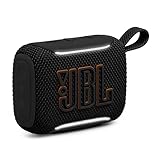
The JBL Go 5 is the speaker you buy when the goal is “sound everywhere, risk nothing.” It suits someone who wants music at a workbench, on a bathroom shelf, in a tent or clipped to a bike, and who would rather spend the difference on a second speaker than on a single expensive one. It also suits the gift buyer, because it is the one product in this list that almost nobody returns: the size, the price tier and the setup effort are all minimal.
Key specs
- Class: ultra-compact portable Bluetooth speaker, roughly the size of a large bar of soap and in the 200-gram class
- Protection: dustproof and waterproof to the IP67 class — dust-tight, and rated to survive immersion in fresh water at around a metre for up to 30 minutes
- Driver: a single full-range driver in a sealed enclosure, which is the standard layout at this size
- Connectivity: Bluetooth only — no Wi-Fi, no multiroom grouping, no built-in voice assistant
- Power: internal rechargeable battery with USB-C charging
- App support: the Go line has historically been plug-and-play without app-based EQ, so expect pairing and play rather than tuning menus
Where it earns its place
The Go 5’s real strength is the ratio of ruggedness to price. An IP67 rating at this tier means the speaker tolerates a dusty workshop, a splash at the sink, a rain shower on a bike ride and an accidental drop into a bucket — the four things that kill cheap speakers. JBL’s tuning across its portable range is deliberately warm and mid-forward rather than flat, which flatters vocals, acoustic material and podcasts at low volume, the way a small speaker is actually used. Because it pairs like any Bluetooth accessory, it works with a phone, a tablet, a laptop or a shop stereo’s auxiliary output, with no account, no firmware dance and no app permission to grant.
Treat it as a personal-scale speaker, not a room-filler. A driver this size moves very little air, so bass rolls off early and the sound stage collapses the moment you move more than a few metres away or put a wall between you and it. That is physics, not a defect — but it is why the Go 5 belongs on a bench or a picnic table rather than in the corner of an open-plan room.
Pros
- IP67 dust and water protection is unusually high for the entry tier
- Genuinely pocketable, so it travels instead of sitting in a drawer
- USB-C charging, which means one cable for phone, laptop and speaker
- Zero setup: pair, play, done — no app, no account, no firmware update
- Low enough in price that buying two for a stereo-ish pair of rooms is realistic
Cons
- No voice assistant, no Wi-Fi and no multiroom grouping — it cannot join a whole-home audio group
- Single small driver means limited bass and limited maximum volume
- No app EQ, so you cannot tune the sound to taste
- Not a substitute for a living-room speaker, and not loud enough for a party
How it compares
Against the other budget ultra-compact here, the OHAYO Portable Wireless Outdoor Speaker, the Go 5 wins on documented durability: JBL states a dustproof and waterproof rating, while the OHAYO listing does not state one at all, which matters if the speaker is going near a pond, a workshop sink or a beach. Against the Monster S320, the comparison is purely about scale — the S320 states 40 W, 360° stereo and up to 32 hours of playtime, roughly an order of magnitude more output, in exchange for a body you would not put in a jacket pocket. Buy the Go 5 for portability and redundancy; buy the S320 when volume is the point.
2. Bose Lifestyle Ultra – Best for Premium Wi-Fi Multiroom Sound
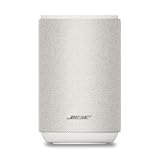
The Bose Lifestyle Ultra is the best-sounding option in this roundup and the one to choose if the speaker is going to live in a main living room, a dining room or a home office where it will stay plugged in and stay put. It suits a listener who streams from a phone or tablet, wants the highest fidelity the list offers, and is comfortable with the idea that voice control comes from the device in their hand rather than from the speaker on the shelf. It also suits the buyer who wants a modern multiroom platform — AirPlay 2 and Google Cast are both supported, which means it can be grouped with hardware from other brands rather than being locked into one ecosystem.
Key specs
- Class: mains-powered wireless home speaker, designed for a fixed position rather than a bag
- Audio features: TrueSpatial Audio and CleanBass, the two processing features named in the listing
- Streaming: Wi-Fi with AirPlay 2 and Google Cast built in, plus Bluetooth for direct pairing from any phone or laptop
- Multiroom: group it with other AirPlay 2 or Google Cast devices on the same network, or group Bose speakers together through the Bose app
- Voice assistant: the listing does not advertise a built-in always-listening assistant, so voice requests are handled by the phone or tablet casting to it
- Power: AC mains, no battery
Where it earns its place
The value here is in the combination of processing and protocol support. TrueSpatial Audio is Bose’s spatial processing, which widens the apparent sound stage beyond the cabinet’s physical width — useful in a room where you cannot sit in the sweet spot because the sofa faces the wrong wall. CleanBass is the low-frequency management side of the same idea: instead of pushing a small cabinet into distortion, the speaker shapes the bass so it stays controlled at higher volumes. In practice that means a single box can fill a normal living room without the boom that a corner placement usually produces.
The protocol support matters more than it sounds. AirPlay 2 and Google Cast are both open enough that this speaker is not a dead end: if you later add a cast-capable speaker from another brand in the kitchen, you can group them from the same phone. That is a genuinely different ownership experience from a Bluetooth-only speaker, which can only ever be one device talking to one other device. Bluetooth is still present for guests and for quick laptop playback, so nothing about the setup is fussy.
Because there is no always-listening microphone advertised, the privacy profile is simple: the speaker cannot hear you, so there is nothing to mute. The trade-off is that you give up the hands-free convenience that the Home Speaker 500 provides.
Pros
- Best sound quality in this roundup, with spatial processing and controlled bass
- AirPlay 2 and Google Cast both supported, so multiroom grouping is not brand-locked
- Wi-Fi streaming removes Bluetooth range limits and dropouts
- No always-listening microphone, which is the simplest privacy answer available
- Bluetooth fallback keeps it usable with any source
Cons
- No built-in voice assistant — you need a phone for voice requests
- Mains power only, so it never leaves the room
- Premium tier pricing, and the discount window is the only sensible time to buy
- Requires a stable Wi-Fi network to deliver its main advantage
How it compares
Against the Bose Home Speaker 500 — the nearest alternative in this list and the other premium home speaker — the split is clean. The Lifestyle Ultra is the newer, better-sounding box with a broader casting and grouping story, while the Home Speaker 500 is the one with Alexa built in and a physical microphone mute. If you want to say “play the news” out loud, the 500 is the pick. If you want the best sound and you are happy to tap a phone, the Lifestyle Ultra is the pick. Against the mid-range portables, the difference is not loudness but composure: the Oraolo and Monster units go louder for a party, while the Lifestyle Ultra stays clean at the volumes a living room actually uses.
3. OHAYO Portable Wireless Outdoor Speaker – Best for Gift-Friendly Budget Portability

The OHAYO Portable Wireless Outdoor Speaker is positioned as a gift, and that framing is the honest way to read it: it is a small, low-cost portable speaker for casual listening where the priority is a low price and an inoffensive look rather than a specification sheet. It suits a buyer who needs a stocking-filler, a spare speaker for a shed or balcony, or a first speaker for a teenager, and who accepts that the listing does not publish the kind of numbers that let you compare it head-to-head with a JBL or a Monster.
Key specs
- Class: compact portable Bluetooth speaker in a black finish
- Connectivity: Bluetooth only — no Wi-Fi, no casting, no multiroom grouping, no voice assistant
- Output: no wattage figure is stated in the listing, so treat it as personal-scale rather than room-filling
- Protection: no IP rating is stated in the listing — assume indoor or covered-outdoor use only
- Power: internal rechargeable battery, charged over USB
- Positioning: sold as an outdoor and gift item rather than as a hi-fi product
Where it earns its place
The reason to consider this speaker is price tier and risk. At the budget end, the decision is rarely about sound quality — it is about what happens when the speaker gets left on a balcony overnight, knocked off a picnic table or handed to a child. A product in this band is cheap enough that damage is annoying rather than upsetting, which makes it a reasonable choice for a shed, a garage shelf, a caravan or a spare room where you want music without moving a good speaker there.
The second reason is gift logic. A portable speaker is one of the few electronics gifts that works without knowing the recipient’s phone, operating system or streaming subscriptions, because Bluetooth pairing is universal. There is no account to create, no app to install and no subscription to inherit. If you are buying for someone whose taste you do not know well, a compact Bluetooth speaker in the budget tier is a low-risk choice — and this one’s presentation is aimed squarely at that use.
What you are giving up is documented durability and documented power. When a listing does not state an IP rating, the safe assumption is that the speaker will survive a light drizzle and a spilled drink but not a dunking. When it does not state a wattage, the safe assumption is a single small driver and enough volume for a table, not a garden. Plan the placement accordingly and there is nothing disappointing about it.
Pros
- Lowest-risk purchase in the roundup, ideal as a gift or a spare
- Universal Bluetooth pairing with no app, account or subscription
- Compact and light, so it can live in a bag or a glovebox
- Simple controls, which makes it easy for less technical users
Cons
- No IP rating stated, so outdoor use should be covered or dry-weather only
- No wattage, driver or battery figures published, which makes comparison hard
- No multiroom grouping, no Wi-Fi and no voice assistant
- No true wireless stereo pairing advertised, so it cannot be doubled up properly
How it compares
Against the JBL Go 5 — the other budget ultra-compact in this list — the difference is documentation. Both are small Bluetooth speakers aimed at the same buyer, but the Go 5 states a dustproof and waterproof rating and comes from a brand with a long portable-speaker history, while the OHAYO listing leaves the durability and output figures unstated. If the speaker will sit on a shelf indoors, that gap barely matters and the OHAYO’s gift positioning is a real advantage. If it will go near water, dust or a workshop, pay the small premium for the Go 5. Against the Monster S320, there is no contest on output — the S320 states 40 W and a 32-hour playtime, which is a different product class entirely.
4. Monster S320 – Best for Loud 360-Degree Outdoor Parties

The Monster S320 is the value pick for anyone who wants volume rather than subtlety. It suits a buyer who needs one speaker to cover a garden, a patio, a tailgate or a workshop bay, where the sound has to reach people who are not sitting in front of it. The combination of 40 W of output, a 360° stereo effect, IPX7 waterproofing and a claimed 32 hours of playtime makes it the most specification-dense product in the budget tier of this roundup.
Key specs
- Output: 40 W, per the manufacturer’s listing
- Coverage: 360° stereo sound effect, so drivers are arranged to radiate in more than one direction rather than straight ahead
- Pairing: true wireless stereo — two S320 units can be paired as a left/right pair
- Protection: IPX7 waterproof, meaning it is rated to survive immersion in water at around a metre for up to 30 minutes
- Battery: up to 32 hours of playing time claimed
- Connectivity: Bluetooth only — no Wi-Fi, no casting, no voice assistant, no multiroom ecosystem
Where it earns its place
The 360° layout is the feature that changes how you use the speaker. A conventional single-direction speaker has a narrow window where it sounds right: sit off-axis and you lose the treble first, then the stereo image. A radial design puts the listener somewhere inside the sound instead of in front of it, which is exactly what you want around a fire pit, a workbench or a long garden table where people are scattered rather than seated in a row. It also means you can put the speaker in the middle of a space rather than against a wall, which is often the only place with a power point or a flat surface.
The IPX7 rating is the second reason this is a strong outdoor choice. It is the same immersion class as the OHAYO 35W and higher than the Oraolo’s IPX6, which covers spray and heavy rain but not submersion. In practical terms, IPX7 means the speaker can fall into a paddling pool, be hosed down after a muddy afternoon, or sit out in a downpour without the electronics being the first thing to fail. The 32-hour playtime claim is the headline battery figure in this roundup; expect it to be measured at moderate volume, since runtime falls as you push the driver harder.
True wireless stereo pairing is the upgrade path. Two units paired as a left/right pair give a genuine stereo image and roughly double the coverage of one, which is a far better use of a second purchase than putting a single speaker in another room. At the budget tier, that is a meaningful long-term advantage over the smaller speakers here.
Pros
- 40 W output with a 360° radiation pattern, so it fills a space rather than a seat
- IPX7 waterproof rating, the highest immersion class in this roundup alongside the OHAYO 35W
- Up to 32 hours of claimed playtime — the longest battery figure here
- True wireless stereo pairing gives a clear upgrade path to a two-speaker setup
- Budget tier pricing despite the specification list
Cons
- No voice assistant, no Wi-Fi and no multiroom grouping
- Larger and heavier than a pocket speaker, so it is a bag item rather than a pocket item
- Battery claims are volume-dependent; loud listening will shorten runtime noticeably
- IPX7 covers water but does not certify dust protection, unlike an IP67 rating
How it compares
Against the Oraolo 50W — the closest rival in this list — the S320 gives up 10 W of claimed output and four hours of claimed playtime, but gains the 360° radiation pattern and a higher waterproof class (IPX7 versus IPX6). For a party in the middle of a garden, the Oraolo’s extra power wins on sheer loudness. For a speaker that will sit on wet ground, get splashed, or be positioned centrally so everyone hears it evenly, the S320’s radial layout and immersion rating are the better fit. Against the JBL Go 5, the two are not really competitors: the Go 5 is a pocket speaker, the S320 is a small PA system.
5. Oraolo 50W – Best for Maximum Outdoor Volume

The Oraolo 50W is the loudest speaker in this roundup on paper, and it is aimed at a specific buyer: someone who hosts outdoors, needs music to carry across a garden or a driveway, and is willing to carry a larger unit to get it. It suits a garage, a workshop bay, a patio or a campsite where the speaker stays in one place for hours and volume matters more than portability. The 50 W figure and 28-hour playtime claim put it at the top of the mid-range tier for raw output.
Key specs
- Output: 50 W, the highest wattage figure stated in this roundup
- Protection: IPX6 water resistant — rated for heavy spray and jets, but not for immersion
- Battery: up to 28 hours of playtime claimed
- Pairing: true wireless stereo, so two units can run as a stereo pair
- Positioning: sold as an outdoor speaker, so expect a ruggedised body and a carry-friendly shape
- Connectivity: Bluetooth only — no Wi-Fi, no casting, no voice assistant, no multiroom ecosystem
Where it earns its place
Power is the point. Doubling amplifier power buys roughly 3 dB of additional output, and every 10 dB increase is perceived as about twice as loud — so a jump from a 20 W class speaker to a 50 W class speaker is not a subtle upgrade. It is the difference between music that is audible at the far end of a garden and music that only works when you are sitting next to it. If you have ever stood twenty metres from a small speaker and heard nothing but bass thump, the 50 W class is the fix.
The 28-hour playtime claim matters as much as the wattage, because a loud speaker with a small battery is useless after an hour of high-volume use. A battery figure in the high twenties of hours gives you a full day of intermittent playback or a long evening at moderate volume with plenty of margin. Expect runtime to fall as you raise the volume — the driver draws more current the harder it works — so treat the headline number as a moderate-volume figure.
IPX6 is the one genuine limitation. It covers heavy rain, hose spray and splashes from a pool edge, which is more than enough for a patio or a campsite, but it does not cover dropping the speaker into water. If you want that, the Monster S320 and the OHAYO 35W both state IPX7. For a speaker that will sit on a table or a deck rather than float in a pool, IPX6 is a perfectly reasonable trade for the extra output.
Pros
- 50 W output — the highest claimed figure in this roundup
- Up to 28 hours of claimed playtime, enough for a full day out
- True wireless stereo pairing doubles coverage and creates a real stereo image
- IPX6 handles rain, spray and splashes without drama
- Mid-range tier pricing for output that rivals larger party speakers
Cons
- IPX6 does not cover immersion, unlike the IPX7 models here
- Bigger and heavier than a pocket speaker — this is a bag or car-boot item
- No voice assistant, Wi-Fi or multiroom grouping
- Loud speakers tend to expose recording quality, so poorly mastered tracks can sound harsh at high volume
How it compares
Against the Monster S320, this is a straight trade of output for coverage style: the Oraolo claims 50 W to the Monster’s 40 W and 28 hours to its 32, but the Monster offers a 360° radiation pattern and a higher IPX7 waterproof class. If you want the loudest single box and you will keep it dry, take the Oraolo. If you want even coverage around a group and you want it to survive a dunking, take the S320. Against the OHAYO 35W, the Oraolo is louder and cheaper on paper, while the OHAYO trades output for an IPX7 rating — a reasonable choice if the speaker will live outdoors in all weathers rather than being packed away after each use.
6. OHAYO 35W Portable Speaker – Best for Rugged Waterproof Mid-Range Listening
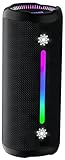
The OHAYO 35W Portable Speaker sits in the middle of the mid-range tier, and its appeal is a single well-defined trade: it gives up some claimed output compared with the 40 W and 50 W units in this list, and takes an IPX7 waterproof rating in return. It suits a buyer whose speaker will genuinely get wet — a boat, a poolside, a campsite, a kayak, a workshop where things get hosed down — and who would rather have 35 W that survives the weather than 50 W that does not.
Key specs
- Output: 35 W, per the manufacturer’s listing
- Protection: IPX7 waterproof — rated for immersion in water at around a metre for up to 30 minutes
- Connectivity: Bluetooth wireless, with no Wi-Fi, casting or voice assistant advertised
- Class: portable outdoor speaker in a black finish, sized for carrying rather than pocketing
- Pairing: no true wireless stereo pairing is stated in the listing, so plan on a single-unit setup
Where it earns its place
IPX7 is the headline. The difference between IPX6 and IPX7 sounds academic until the speaker goes over the side of a boat or sits in the bottom of a tent during a storm. IPX7 certification means the unit is tested for temporary immersion, not just spray, so a dropped speaker can be retrieved, dried off and expected to work. For anyone whose listening happens near open water, that single rating is worth more than an extra 10 or 15 W of output that you will rarely use at full tilt.
At 35 W, this is still comfortably a room-and-garden speaker rather than a personal one. It has enough headroom to be heard over conversation on a patio, to fill a garage while you are working, or to cover a small gathering. What it will not do is drive an open field or compete with a genuinely loud environment; for that you need the 50 W class. But 35 W in a well-sealed enclosure with a waterproof rating is a sensible middle point, and the mid-range tier price reflects it.
The absence of stated true wireless stereo pairing is worth flagging, because it changes the upgrade path. With the Monster S320 or the Oraolo, buying a second unit later gives you a genuine stereo pair and a real step up in coverage. Here, a second unit would simply be a second speaker in another room, which is still useful but is not the same kind of upgrade. If doubling up later is part of your plan, factor that in.
Pros
- IPX7 waterproof rating — the highest immersion class in this roundup
- 35 W output is enough for a garden, a garage or a small gathering
- Simple Bluetooth operation with no app, account or subscription
- Mid-range tier price for a genuinely weather-resistant speaker
- Compact enough to carry, substantial enough to be heard
Cons
- Less claimed output than the 40 W and 50 W models in this list
- No true wireless stereo pairing stated, so the upgrade path is limited
- No Wi-Fi, multiroom grouping or voice assistant
- IPX7 covers water but does not certify dust protection, so fine dust in a workshop is still a risk
How it compares
Against the Oraolo 50W, the OHAYO 35W is the quieter but more weatherproof choice: IPX7 against IPX6, 35 W against 50 W, and no stated stereo pairing against a stated one. If the speaker stays on a covered patio or a garage bench, the Oraolo’s extra power is the better buy. If it goes on a boat, a paddleboard or a campsite where a dunking is a real possibility, the OHAYO’s immersion rating justifies the drop in wattage. Against the Monster S320, the OHAYO gives up 5 W of output and a long list of stated battery life, and gains nothing in waterproofing — both are IPX7 — so the Monster is the stronger specification overall unless the OHAYO’s particular size and price tier suit you better.
7. Bose Home Speaker 500 – Best for Built-In Voice Control at Home

The Bose Home Speaker 500 is the only product in this roundup with a voice assistant built in, and that single fact defines who should buy it. It suits a listener who wants to say “play the radio” or “set a timer” without touching a phone — in a kitchen, a workshop office or a bedroom — and who wants a proper multiroom platform rather than a single Bluetooth connection. It is a mains-powered home speaker, so it belongs on a shelf with a socket nearby, not in a bag.
Key specs
- Voice assistant: Alexa built in, with a far-field microphone array designed to hear you across a room
- Privacy control: a physical microphone mute button on the speaker itself, which disconnects the mics rather than hiding the setting in an app
- Connectivity: Wi-Fi for streaming plus Bluetooth for direct pairing from a phone or laptop
- Streaming protocols: AirPlay 2 support, so it can be grouped with other AirPlay 2 devices on the same network
- Multiroom: grouping with other Bose speakers through the Bose Music app, and casting-based grouping through AirPlay 2
- Power: AC mains, no battery
- Cabinet: a bookshelf-sized enclosure roughly the footprint of a large hardback book, with drivers angled to spread sound across a room rather than straight ahead
Where it earns its place
Hands-free control is the whole proposition. A far-field microphone array means the speaker hears a normal speaking voice from across a kitchen or a workshop, which changes how you use it: timers while your hands are full, music without unlocking a phone, weather and news while you are doing something else. That is a genuinely different experience from a Bluetooth speaker, where every interaction starts with finding your phone and waking the screen.
The privacy design is the second reason to pick this over the Lifestyle Ultra. Because there is a hardware mute button, the decision to stop the microphones listening is a physical one — press it and the mics are off, with a visual indication. That is a cleaner privacy story than a software toggle buried in an app, and it is the feature to check first if a household member is uneasy about an always-listening device. When muted, the speaker still works fully as a Wi-Fi and Bluetooth speaker; you only lose the voice trigger.
Wi-Fi streaming plus AirPlay 2 gives it a proper multiroom foundation. Unlike a Bluetooth-only speaker, it is not limited to one device talking to one speaker: it can be part of a group playing the same source in several rooms, or a single room playing something different. The Bose Music app handles grouping, EQ and firmware, and the platform has been maintained across several product generations, which matters for a speaker you intend to keep for years.
Pros
- Alexa built in with a far-field microphone array — hands-free control from across a room
- Hardware microphone mute button, the clearest privacy control in this roundup
- Wi-Fi streaming plus Bluetooth, so it works with everything
- AirPlay 2 and Bose Music app multiroom grouping
- Room-filling sound from a compact, shelf-friendly cabinet
Cons
- Mains power only — it cannot leave the room
- Older platform than the Lifestyle Ultra, with less advanced spatial processing
- Voice features depend on an account and a stable network connection
- Premium tier pricing, so the Black Friday window is the sensible time to buy
- An always-listening device by default, which will not suit every household
How it compares
Against the Bose Lifestyle Ultra, the choice comes down to one question: do you want to talk to the speaker? The Home Speaker 500 has Alexa built in, a far-field mic array and a hardware mute button, and it can be controlled entirely by voice. The Lifestyle Ultra has newer spatial processing, better bass management and a broader casting story through AirPlay 2 and Google Cast, but no built-in assistant — every voice request goes through your phone. If hands-free control is the reason you are shopping for a smart speaker, buy the 500. If sound quality is the reason, buy the Ultra. Against every Bluetooth speaker in this list, the 500 is the only one that stays connected to a network, streams independently of your phone, and can be part of a whole-home group — which is exactly the difference the word “smart” is supposed to describe.
How to Choose
Start with room volume, not wattage
The most common buying mistake is choosing by wattage alone. Amplifier power only tells you how much headroom a speaker has; it says nothing about whether it suits your room. A useful starting point is room volume in cubic metres. A typical living room of 5 m × 4 m with a 2.5 m ceiling is 50 m³. For background listening at a conversational 65–70 dB, a 20–30 W class speaker is comfortable. For a room that size at party levels of 85–90 dB, you need roughly ten times the power for every extra 10 dB, which is why the 40 W and 50 W class units in this roundup exist. Add the open-plan factor: a room that opens onto a kitchen and a hallway is effectively two or three times the volume, and needs the next tier up.
Distance matters as much as power. Sound pressure falls by roughly 6 dB every time you double the distance from the speaker, so a listener 4 m away receives about a quarter of the energy of one 2 m away. Placement can claw some of that back: a speaker in a corner or against a wall gains around 3 dB of boundary reinforcement, which is why a modest speaker placed against a wall can sound fuller than a bigger one in the middle of a room. If you cannot move your listening position, move the speaker.
Decide first whether you need a smart speaker or a Bluetooth speaker
These are two different products that share a shape. A smart speaker joins your Wi-Fi network, streams independently of your phone, supports a voice assistant and can be grouped with other speakers for multiroom audio. A Bluetooth speaker pairs directly with one device at a time, has no network presence and cannot be grouped beyond true wireless stereo pairing with a matching unit. In this roundup, only the Bose Home Speaker 500 and the Bose Lifestyle Ultra are smart speakers in that strict sense. The other five are Bluetooth speakers — excellent at what they do, but they will not answer a question, will not play independently of your phone, and will not join a whole-home group.
Voice assistants: match the assistant to your household
If hands-free control is a requirement, your options here narrow to the Home Speaker 500, which has Alexa built in. Everything else requires a phone in your hand, though the Lifestyle Ultra can be fed by voice through AirPlay 2 from an iPhone or through Google Cast from an Android device. That distinction matters in a kitchen or a workshop: a phone-dependent setup means washing your hands before changing the track, while a built-in assistant means simply asking. If nobody in the house uses an assistant, pay for sound quality instead and skip the microphones entirely.
Privacy controls to check before you buy
Three things are worth checking on any voice-enabled speaker. First, whether there is a hardware mute — a physical button that disconnects the microphone — rather than a software toggle. The Home Speaker 500 has one. Second, whether the speaker keeps working normally when muted; it should still stream over Wi-Fi and Bluetooth. Third, how the device is separated from the rest of your network: putting smart speakers on a guest network or an isolated VLAN limits what they can see, and reviewing the assistant’s voice-history settings and deleting recordings periodically is a reasonable routine. A speaker with no microphone at all, like the Lifestyle Ultra or any of the Bluetooth models here, has the
