What's inside
- Top 3 Picks
- Quick Comparison
- How We Chose
- 1. ASUS TUF Gaming A18 – Best for Big-Screen Value
- 2. Dell Alienware 16X Aurora – Best for Premium CPU and Display
- 3. iCarp MSI Cyborg 15 – Best for the Cheapest Route to 144Hz
- 4. HP Omen 16 – Best for Color Work and 240Hz Gaming
- 5. HP OmniBook 5 16″ – Best for Everyday Work With Light Gaming
- 6. ASUS TUF Gaming A16 – Best for Budget Gaming Performance
- 7. Lenovo Legion 5 5070 OLED – Best Overall
- How to Choose
- Frequently Asked Questions
- Top 3 Picks
- Quick Comparison
- How We Chose
- 1. ASUS TUF Gaming A18 – Best for Big-Screen Value
- 2. Dell Alienware 16X Aurora – Best for Premium CPU and Display
- 3. iCarp MSI Cyborg 15 – Best for the Cheapest Route to 144Hz
- 4. HP Omen 16 – Best for Color Work and 240Hz Gaming
- 5. HP OmniBook 5 16″ – Best for Everyday Work With Light Gaming
- 6. ASUS TUF Gaming A16 – Best for Budget Gaming Performance
- 7. Lenovo Legion 5 5070 OLED – Best Overall
- How to Choose
- Frequently Asked Questions
As an Amazon Associate I earn from qualifying purchases. This post may contain affiliate links at no extra cost to you.
The best Cyber Monday gaming laptop deal in this roundup is the Lenovo Legion 5 5070 OLED, an RTX 5070 machine with a 15.1-inch QHD+ OLED panel running at 165Hz and 1000 nits, paired with an Intel Core i9-14900HX. It suits players who want one laptop that covers high-refresh 1440p-class gaming, color-accurate creative work, and enough CPU headroom to stay useful for years without moving into the heaviest desktop-replacement class. If your budget is tighter, the ASUS TUF Gaming A16 with an RTX 4050 is the value pick for 1080p play. If you want the biggest screen and the most comfortable chassis, the 18-inch ASUS TUF Gaming A18 is the mid-range standout. If you want maximum CPU cores and a wide-gamut 240Hz panel, the Dell Alienware 16X Aurora is the premium option. Cyber Monday laptop pricing shifts daily, and the configuration names on these listings are long for a reason: GPU, memory, and storage tiers frequently change inside a single product page. This guide sorts the offers by what actually determines how a laptop plays, namely GPU class, display refresh rate, memory, thermals, and the games each price tier can realistically hold at its native resolution.
What we cover
- Top 3 Picks
- Quick Comparison
- How We Chose
- 1. ASUS TUF Gaming A18 – Best for Big-Screen Value
- 2. Dell Alienware 16X Aurora – Best for Premium CPU and Display
- 3. iCarp MSI Cyborg 15 – Best for the Cheapest Route to 144Hz
- 4. HP Omen 16 – Best for Color Work and 240Hz Gaming
- 5. HP OmniBook 5 16″ – Best for Everyday Work With Light Gaming
- 6. ASUS TUF Gaming A16 – Best for Budget Gaming Performance
- 7. Lenovo Legion 5 5070 OLED – Best Overall
- How to Choose
- Frequently Asked Questions
Top 3 Picks
Best overall: Lenovo Legion 5 5070 OLED. The combination of an RTX 5070, a QHD+ OLED panel at 165Hz with 1000 nits of peak brightness, and a Core i9-14900HX covers the widest range of uses in this list. It is the machine to buy if you want one laptop for both high-refresh gaming and color-sensitive work, and you are willing to pay premium-tier pricing to get there.
Best budget: ASUS TUF Gaming A16. An RTX 4050, a Ryzen 5 7535HS, 16GB of DDR5, and a 512GB PCIe SSD is the classic budget gaming formula. It is not built for high frame rates at 1440p, but at 1080p-class settings it handles current titles, and it leaves you money for a monitor, a mouse, and a game or two.
Best premium: Dell Alienware 16X Aurora. A 24-core Intel Core Ultra 9 275HX and 32GB of memory behind a 16-inch WQXGA 240Hz panel with full DCI-P3 coverage is the configuration for people who care about CPU-heavy work, wide-gamut color, and a high refresh ceiling more than they care about price.
Quick Comparison
| Product | Best for | Key specs as listed | Price tier |
|---|---|---|---|
| ASUS TUF Gaming A18 | Big-screen mid-range value | 18″ WUXGA IPS 144Hz, 100% sRGB, G-SYNC; AMD Ryzen 7 260 (8-core); 16GB RAM; 1TB SSD; discrete GPU designation truncated in listing title | Mid-range |
| Dell Alienware 16X Aurora | Premium CPU and 240Hz wide-gamut panel | 16″ WQXGA 240Hz, 100% DCI-P3; Intel 24-core Ultra 9 275HX; 32GB RAM; GPU not stated in title | Premium |
| iCarp MSI Cyborg 15 | Cheapest route to 144Hz and RAM headroom | 15.6″ FHD 144Hz; AMD Ryzen 9 270 (8-core); 16GB / 32GB / 64GB RAM options; 512GB-class SSD; GPU not stated in title | Budget |
| HP Omen 16 | Color work plus 240Hz gaming in one machine | 16″ WQXGA 240Hz, 500 nits, 100% sRGB; AMD Ryzen AI 9 365 (10-core, up to 50 TOPS); 32GB RAM; GPU not stated in title | Mid-range |
| HP OmniBook 5 16″ | Everyday work with light gaming on the side | 16″ display; AMD Ryzen AI 7 350 (up to 5GHz); 16GB DDR5; 512GB SSD; Radeon 860M integrated graphics; Copilot+ PC | Budget |
| ASUS TUF Gaming A16 | Best budget gaming performance per dollar | 16″ FHD+ display; AMD Ryzen 5 7535HS; NVIDIA GeForce RTX 4050; 16GB DDR5; 512GB PCIe SSD | Budget |
| Lenovo Legion 5 5070 OLED | Best all-round pick for gaming and creative work | 15.1″ QHD+ OLED 165Hz, up to 1000 nits; Intel Core i9-14900HX; NVIDIA GeForce RTX 5070; memory and storage vary by configuration | Premium |
How We Chose
This list was assembled from published specification sheets, manufacturer configuration data, and category knowledge rather than hands-on use. The first filter was the GPU class, because it sets the ceiling on resolution, settings, and frame rate more than any other component. The second was the display: refresh rate, resolution, panel technology, brightness, and color coverage all determine whether the machine suits competitive play, single-player immersion, or photo and video work. The third was memory and storage, with preference given to configurations that offer 16GB or more and a full terabyte where possible, and to machines whose RAM and SSD can be serviced later rather than soldered shut.
The fourth filter was thermal design and chassis class. A high-wattage GPU in a thin chassis runs hot and loud; a thicker chassis with more fan volume generally sustains higher clocks for longer, which matters more than peak benchmark numbers in a two-hour session. Fifth, we considered upgrade path and ownership cost: memory slots, storage bays, battery replacement access, and the practical running cost of a machine that draws 150 to 250 watts under load. Finally, we kept the tiers balanced, so there is a defensible choice at budget, mid-range, and premium levels rather than a list of seven machines that all cost roughly the same. Where a listing title omitted a key spec such as the exact GPU, we say so plainly instead of guessing, because that is exactly the detail you should confirm before buying.
1. ASUS TUF Gaming A18 – Best for Big-Screen Value
As an Amazon Associate we earn from qualifying purchases at no extra cost to you.

This is the pick for anyone who has ever finished a long session on a 15-inch laptop and wished the screen were simply bigger. An 18-inch panel is a different category of experience: text is larger, more of a game’s interface fits on screen without scaling tricks, and you can sit further back from the machine, which is easier on the neck over a long evening. Because the chassis is larger, the cooling system has more room to work with, and that usually translates into steadier sustained performance and lower fan noise than an equivalent 15-inch machine running the same silicon in a tighter body.
The panel here is WUXGA, which is a 1920×1200 resolution in a 16:10 aspect ratio rather than the more common 16:9. The practical difference is roughly 11% more vertical space, which sounds trivial until you are working in a spreadsheet, editing a timeline, or reading a long document. The refresh rate is 144Hz with G-SYNC support and 100% sRGB coverage, so motion is smooth and colors are consistent enough for casual photo editing and streaming. The 8-core AMD Ryzen 7 260 handles everyday multitasking, light encoding, and modern games without becoming the bottleneck. Storage starts at 1TB, which is a meaningful advantage over the 512GB drives common at this tier, and 16GB of RAM is the current practical floor for gaming in 2026.
Key specs as listed
- Display: 18-inch WUXGA (1920×1200) IPS, 144Hz, 100% sRGB, G-SYNC
- Processor: AMD Ryzen 7 260, 8 cores
- Memory: 16GB RAM
- Storage: 1TB SSD
- Graphics: discrete GPU designation is truncated in the listing title, so confirm the exact model and its wattage on the configuration page
- Class: mid-range gaming laptop with a large-format chassis
The strongest argument for this machine is that it buys you screen real estate and thermal headroom instead of raw benchmark numbers. A 144Hz panel is not the 240Hz ceiling some esports players chase, but the jump from 60Hz to 144Hz is the single largest perceptible improvement in the whole refresh-rate ladder; going from 144Hz to 240Hz is a much smaller step and only pays off if you are genuinely competing at a high level. Meanwhile, the extra chassis volume is the kind of advantage that shows up in hour three of a session, when a thinner laptop has started to throttle and spin its fans harder.
The trade-off is portability. An 18-inch gaming laptop is a desktop replacement in the literal sense: it is heavy enough that carrying it daily alongside a charger will get old, and the footprint will not fit every backpack sleeve or lecture-hall desk. Battery life under load will also be short, as it is on every machine in this class, because the display and the GPU are both large consumers.
Pros
- 18-inch 16:10 panel is genuinely more usable for both games and productivity work
- G-SYNC support removes tearing without the input lag penalty of software V-Sync
- 100% sRGB coverage is enough for casual creative work and consistent streaming
- 1TB of storage out of the box avoids the immediate “what do I delete” problem
- Larger chassis generally means quieter fans and steadier sustained clocks
- 8-core Ryzen 7 260 keeps CPU-side workloads comfortable
Cons
- Heavy and bulky; not a machine you want to carry every day
- 144Hz rather than 240Hz, which matters only to serious competitive players
- WUXGA resolution is modest for an 18-inch panel; pixel density is on the low side
- 16GB of RAM may feel tight if you keep many browser tabs and background apps open while gaming
- The listing title truncates the GPU designation, so you must verify the exact card before buying
Compared with the nearest alternative: the HP Omen 16 sits in the same mid-range tier and offers a sharper WQXGA 240Hz panel with 500 nits of brightness, which is better for detail work and smoother in fast games. What the TUF A18 gives you instead is screen area, a 16:10 aspect ratio, and a 1TB drive as standard. Choose the Omen if resolution and refresh rate matter most; choose the A18 if you want the biggest usable workspace and you mostly play at a desk.
2. Dell Alienware 16X Aurora – Best for Premium CPU and Display
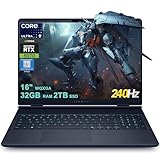
This is the machine for the buyer who has decided that this purchase should not require a compromise in three years. The headline part is the processor: an Intel Core Ultra 9 275HX with 24 cores, which is a desktop-class core count in a laptop body. That matters far beyond gaming. Compiling code, exporting video, running virtual machines, batch-processing photos, or streaming while playing all lean on core count, and 24 cores puts this machine in a different bracket from the 8-core and 10-core chips elsewhere in this list. The 32GB of memory is the other half of that argument, and it is the amount that lets you keep a game, a browser with dozens of tabs, a chat client, and a capture tool all resident at once without the system paging to disk.
The display is a 16-inch WQXGA panel at 240Hz with 100% DCI-P3 coverage. WQXGA is a 2560×1600 resolution in 16:10, so you get both sharpness and vertical space. Full DCI-P3 is the wide-gamut standard used in video and cinema work, and a panel that covers it can display saturated reds and greens that an sRGB-only screen simply cannot render. Combined with 240Hz, this is a display that serves two very different jobs: color-graded editing at a desk, and high-frame-rate gaming in the evening.
Key specs as listed
- Display: 16-inch WQXGA (2560×1600), 240Hz, 100% DCI-P3
- Processor: Intel Core Ultra 9 275HX, 24 cores
- Memory: 32GB RAM
- Storage: varies by configuration
- Graphics: not stated in the listing title, so verify the GPU model and its power limit on the configuration page
- Class: premium gaming and creator laptop
Alienware’s chassis design is aimed at sustained performance rather than thinness. That shows up in the fan and heat-pipe layout, the keyboard deck temperatures during long sessions, and the fact that the machine does not need to downclock aggressively to stay within thermal limits. For a buyer who runs multi-hour sessions or renders overnight, sustained behavior is worth more than a peak number that only holds for ninety seconds.
What you are paying for here is not only the components but the tier of everything around them: a higher-resolution wide-gamut panel, a larger memory complement, and a chassis engineered for the power draw those parts create. That combination is what makes the premium tier defensible for someone whose laptop is also their workstation.
Pros
- 24-core Ultra 9 275HX is exceptionally strong for CPU-bound work, not just games
- 32GB of RAM removes memory pressure for years of normal use
- 240Hz WQXGA panel is sharp, fast, and wide-gamut in one package
- 100% DCI-P3 coverage suits video editing and color-graded photography
- Chassis designed for sustained load rather than short bursts
- 16:10 aspect ratio gives useful vertical workspace
Cons
- Premium-tier pricing; this is the most expensive category in the roundup
- Heavy, and the large power brick adds to the travel weight
- High core counts and high refresh rates both cost battery life under load
- GPU model is not stated in the listing title, so you must confirm it
- More machine than a casual 1080p player needs
Compared with the nearest alternative: the Lenovo Legion 5 5070 OLED is the other premium machine here, and it answers a different question. The Legion pairs its RTX 5070 with an OLED panel that reaches up to 1000 nits, which gives it deeper blacks and higher peak brightness for HDR content. The Alienware counters with 24 CPU cores and 32GB of memory as configured. If your work is CPU-heavy, the Alienware is the stronger tool. If your priority is picture quality in games and films, the Legion’s OLED is the more visible upgrade.
3. iCarp MSI Cyborg 15 – Best for the Cheapest Route to 144Hz
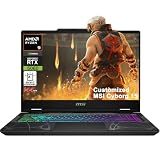
This is the entry point. The Cyborg 15 is a 15.6-inch machine with a 144Hz FHD panel and an 8-core AMD Ryzen 9 270, and the listing’s own claim is that this chip outpaces an Intel Core i9-12950HX in multi-threaded work. Treat marketing comparisons with some caution, but the underlying point is real: an 8-core current-generation Ryzen in a budget chassis gives you more CPU than this price tier used to offer, and that headroom helps with games that lean on the processor, plus streaming and light editing on the side.
The more interesting detail is the memory ladder. This configuration is offered with 16GB, 32GB, or 64GB of RAM. That is unusual at the budget end, and it means a buyer who knows they will be running virtual machines, large mod packs, or heavy browser workloads can simply order more memory up front rather than hoping the machine has accessible slots later. Storage appears to be 512GB-class, which is the standard entry capacity and the first thing most owners will want to expand.
Key specs as listed
- Display: 15.6-inch FHD, 144Hz
- Processor: AMD Ryzen 9 270, 8 cores
- Memory: 16GB, 32GB, or 64GB depending on configuration
- Storage: 512GB-class SSD
- Graphics: not stated in the listing title; confirm the GPU model and wattage before buying
- Class: budget gaming laptop
A 15.6-inch FHD panel at 144Hz is the well-worn sweet spot of budget gaming, and it is well-worn for good reason. At 1920×1080 on a 15.6-inch screen, pixel density is around 141 pixels per inch, which is sharp enough that you will not notice individual pixels at normal viewing distance. And 1080p is the resolution where mid-tier and entry GPUs can still push high frame rates without dropping settings to the floor. Pairing a modest GPU with a 1080p 144Hz screen is a much better balance than pairing that same GPU with a 1440p panel it cannot drive.
The Cyborg line is a mainstream budget design rather than a premium one, which means plastic-heavy construction, a chassis that prioritizes price over silence, and cooling that is adequate rather than exceptional. That is the honest trade at this tier, and it is why budget buyers should think about ambient conditions: a laptop like this performs noticeably better on a hard surface with airflow underneath than on a bed or a soft couch cushion.
Pros
- 8-core Ryzen 9 270 gives genuine CPU headroom at a budget price
- 144Hz FHD panel is the right match for entry and mid-tier GPUs
- Memory options up to 64GB, which is rare in this tier
- 15.6-inch size is portable enough to carry daily
- Lowest entry cost of any machine in this roundup
Cons
- 512GB of storage fills quickly with modern game installs
- GPU is not specified in the listing title, so performance is uncertain until you check
- Budget chassis means more fan noise and warmer surfaces under load
- Build materials are functional rather than premium
- Battery life under gaming load will be short
Compared with the nearest alternative: the ASUS TUF Gaming A16 is the other budget gaming machine here, and it names its GPU explicitly: an RTX 4050. That clarity matters, because knowing the exact card tells you what frame rates to expect. The Cyborg 15 counters with a stronger-sounding 8-core Ryzen 9 and memory options that go all the way to 64GB. If you want certainty about graphics performance and a brand with a long-established gaming line, the TUF A16 is the safer buy. If you want maximum CPU and RAM for the money and are comfortable verifying the GPU first, the Cyborg 15 is the more flexible configuration.
4. HP Omen 16 – Best for Color Work and 240Hz Gaming

The Omen 16 is the machine for someone who needs one laptop to do two jobs properly: play games at high frame rates, and display color accurately enough to trust for photo or video work. The 16-inch WQXGA panel runs at 240Hz, hits 500 nits, and covers 100% sRGB. That combination is unusually well balanced. The resolution gives you a sharp 2560×1600 image, the refresh rate puts it in competitive-gaming territory, and 500 nits is bright enough to stay usable near a window or under overhead lighting, which is where most laptop panels start to look washed out.
The processor is an AMD Ryzen AI 9 365 with 10 cores and an NPU rated up to 50 TOPS. The TOPS figure refers to on-device AI acceleration, which in practice means local tasks like background blur, transcription, image enhancement, and some creative-tool features run without sending data to a server. For gaming it is largely irrelevant; for a machine that doubles as a work laptop, it is a genuine convenience. The 32GB of memory as configured is the number that matters most for longevity here, because it means you will not be juggling applications to free up RAM during a stream or a render.
Key specs as listed
- Display: 16-inch WQXGA (2560×1600), 240Hz, 500 nits, 100% sRGB
- Processor: AMD Ryzen AI 9 365, 10 cores, NPU up to 50 TOPS
- Memory: 32GB RAM
- Storage: varies by configuration
- Graphics: not stated in the listing title; confirm the discrete GPU model and its power limit
- Class: mid-range gaming and productivity laptop
Where this machine earns its place is the display-to-price ratio. A 240Hz panel at WQXGA resolution with 500 nits and full sRGB is normally a premium-tier specification, and finding it in a mid-range machine is the main reason to shortlist the Omen 16. For a photographer or video editor, sRGB coverage plus a 500-nit backlight means the screen can be used for actual editing rather than only for consumption. For a gamer, 240Hz means the panel will not be the limiting factor in a fast shooter.
The Omen line also tends to have a relatively restrained design compared with overtly “gamer” chassis, which matters if the laptop is going to sit in a meeting room. It is a machine you can open in a professional setting without it looking out of place.
Pros
- 240Hz WQXGA panel with 500 nits is a premium specification at a mid-range tier
- 100% sRGB coverage supports genuine photo and video editing
- 10-core Ryzen AI 9 365 with a 50 TOPS NPU handles local AI features
- 32GB of memory as configured is generous for the tier
- Relatively understated design suits both work and play
- 16:10 aspect ratio adds vertical workspace
Cons
- GPU not stated in the listing title, so you must confirm it before buying
- High refresh and high resolution together put pressure on the GPU
- Mid-range tier means mid-range sustained thermals, not desktop-class cooling
- Storage capacity varies, so check the specific configuration
Compared with the nearest alternative: the ASUS TUF Gaming A18 is the other mid-range machine here. The Omen wins clearly on panel quality: 2560×1600 at 240Hz and 500 nits beats 1920×1200 at 144Hz, and the Omen also lists 32GB of RAM against the TUF’s 16GB. The TUF A18 answers back with a much larger 18-inch screen, a 16:10 layout, and a 1TB drive. If you want the sharpest, fastest display for the money, choose the Omen 16. If screen size and storage capacity matter more than pixel density, choose the A18.
5. HP OmniBook 5 16″ – Best for Everyday Work With Light Gaming
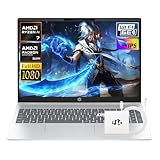
The OmniBook 5 is the odd one out in this list, and it is here on purpose. It is not a gaming laptop in the discrete-GPU sense. It pairs an AMD Ryzen AI 7 350 processor running up to 5GHz with Radeon 860M integrated graphics, 16GB of DDR5 memory, and a 512GB SSD, and it carries the Copilot+ PC designation. That specification describes a fast, efficient everyday laptop, not a machine built to run demanding games at high frame rates. Being clear about that is more useful than pretending otherwise.
What it can do is handle the large category of games that do not need a discrete GPU: esports titles at moderate settings, older back-catalogue games, indie releases, strategy games, and the enormous library of titles that run comfortably on modern integrated graphics. It will also handle streaming, video calls, document work, and browser-heavy days better than most gaming laptops, because its power profile is designed around efficiency rather than maximum draw.
Key specs as listed
- Display: 16-inch class
- Processor: AMD Ryzen AI 7 350, boost up to 5GHz
- Memory: 16GB DDR5
- Storage: 512GB SSD
- Graphics: AMD Radeon 860M integrated
- Platform: Copilot+ PC with on-device AI acceleration
- Class: budget mainstream laptop
The practical case for this machine is battery life and quiet operation. Integrated graphics draw a fraction of what a discrete card does, so the same chassis lasts considerably longer on a charge and runs far quieter under load. For a student, a commuter, or anyone whose laptop spends most of its life in a bag, that difference is felt every single day, while the gaming performance difference is only felt in the specific hours you play something demanding.
16GB of DDR5 is the right amount for general use in 2026 and leaves room for a reasonable number of browser tabs, a chat client, and a music app alongside whatever you are working on. The 512GB SSD is adequate for documents and a moderate game library but will feel tight if you install several large modern titles, which is another reason to treat this as a light-gaming machine.
Pros
- Much better battery life than any discrete-GPU machine in this list
- Quiet operation under everyday workloads
- 16GB DDR5 and a 512GB SSD cover normal work and study needs
- Copilot+ designation means local AI features run on-device
- Lower price tier than every gaming-focused option here
- 16-inch screen gives a comfortable working area for documents
Cons
- Radeon 860M integrated graphics cannot run demanding games at high settings
- No discrete GPU means no path to serious 1080p high-refresh gaming
- 512GB of storage limits how many large games you can keep installed
- Not upgradeable in the way a gaming chassis is
Compared with the nearest alternative: the ASUS TUF Gaming A16 is the natural step up. Both sit in the budget tier, but the TUF A16 adds a discrete RTX 4050, which is the single component that turns a general-purpose laptop into a gaming one. The OmniBook 5 wins on battery life, weight, and quietness. The TUF A16 wins on every gaming metric that matters. Buy the OmniBook if gaming is a secondary activity; buy the TUF A16 if it is the primary one.
6. ASUS TUF Gaming A16 – Best for Budget Gaming Performance

This is the straightforward budget gaming recommendation, and the reason is simple: the listing names its GPU. An NVIDIA GeForce RTX 4050 paired with an AMD Ryzen 5 7535HS, 16GB of DDR5 memory, and a 512GB PCIe SSD on a 16-inch FHD+ display is a coherent, well-matched budget build. Every part is appropriate to the tier, and nothing is obviously out of balance. When you are shopping at the entry end, that coherence is worth more than any single impressive specification.
The RTX 4050 is an entry-tier discrete GPU with support for modern upscaling and frame-generation features. Those features matter enormously at this price point, because they are what allow a modest card to hold high frame rates at 1080p-class settings in demanding titles. A buyer who turns on upscaling and understands the settings menu will get considerably more out of this machine than one who maxes everything and wonders why the frame rate sags.
Key specs as listed
- Display: 16-inch FHD+ class
- Processor: AMD Ryzen 5 7535HS
- Graphics: NVIDIA GeForce RTX 4050
- Memory: 16GB DDR5
- Storage: 512GB PCIe SSD
- Class: budget gaming laptop
The 16-inch FHD+ panel is a sensible match for the RTX 4050. Rendering at roughly 1920×1200 means the card is not fighting an unnecessarily high pixel count, which is exactly the mistake budget buyers make when they chase a 1440p screen on an entry GPU. The Ryzen 5 7535HS is a six-core part with strong single-thread performance, which is what most games actually care about, and 16GB of DDR5 is the correct baseline for 2026.
The TUF line’s reputation is built on durability testing and a chassis designed to take some abuse, which is a meaningful consideration for a laptop that will travel in a backpack. That is not a performance claim; it is a statement about the category the product line occupies, and it is one of the reasons the TUF name is common in budget gaming recommendations.
Pros
- Discrete RTX 4050 clearly named, so performance expectations are predictable
- 16GB DDR5 is the right memory baseline for current games
- FHD+ resolution is well matched to an entry-tier GPU
- 16-inch screen is comfortable without being a burden to carry
- PCIe SSD storage keeps load times reasonable
- Durability-oriented product line suits a machine that travels
Cons
- 512GB of storage will need expansion for a large game library
- RTX 4050 is not a 1440p high-refresh card; expect to play at 1080p-class settings
- Six-core CPU is adequate but not generous for heavy multitasking while gaming
- Budget chassis means noticeable fan noise under sustained load
Compared with the nearest alternative: the iCarp MSI Cyborg 15 occupies the same budget tier but leaves its GPU unspecified and offers up to 64GB of RAM. The TUF A16 gives you a named RTX 4050 and a well-known gaming product line; the Cyborg 15 gives you a stronger-sounding 8-core Ryzen 9 and far more memory headroom. If you want the lowest-risk purchase, the TUF A16’s transparency about its GPU is the deciding factor. If you plan to run memory-hungry workloads alongside your games, the Cyborg 15’s 32GB and 64GB options are genuinely useful.
7. Lenovo Legion 5 5070 OLED – Best Overall

The Legion 5 5070 OLED is the best all-round machine in this roundup because it does not force a choice between gaming and everything else. The RTX 5070 is a current-generation GPU with enough power for high-refresh gaming at the panel’s native QHD+ resolution, and the Core i9-14900HX provides the CPU headroom that keeps the machine responsive in heavy multitasking and creative workloads. The 15.1-inch QHD+ OLED panel runs at 165Hz and reaches up to 1000 nits of peak brightness, which is the specification that sets this machine apart from every other entry on the list.
OLED changes the visual experience in ways that are immediately obvious rather than subtle. Because each pixel emits its own light, black is genuinely black rather than a dark grey backlight bleed, and contrast is effectively infinite. Colors look richer, dark scenes in games reveal detail that an IPS panel crushes, and HDR content finally looks like HDR rather than a slightly brighter image. The 1000-nit peak brightness is what makes that HDR performance meaningful, and it also means the screen stays readable in a bright room, which is where most laptops struggle.
Key specs as listed
- Display: 15.1-inch QHD+ OLED, 165Hz, up to 1000 nits peak brightness
- Processor: Intel Core i9-14900HX
- Graphics: NVIDIA GeForce RTX 5070
- Memory and storage: vary by configuration; check the specific listing
- Class: premium gaming and creator laptop
The 165Hz refresh rate is a deliberate choice rather than a compromise. OLED panels have extremely fast pixel response times, so motion clarity at 165Hz on an OLED is often comparable to or better than a slower-response IPS panel running at a higher nominal refresh rate. In other words, the number on the box does not tell the whole story, and a fast-responding 165Hz OLED can look cleaner in motion than a sluggish 240Hz LCD. For most players, 165Hz is past the point of diminishing returns.
The Core i9-14900HX is a high-performance mobile processor with a large core count and high boost clocks, suited to CPU-bound games, streaming, and creative applications. Combined with the RTX 5070, this is a machine that can play at its native resolution rather than dropping to 1080p to stay smooth, which is the difference between using the panel you paid for and not using it.
Pros
- OLED panel delivers true blacks, infinite contrast, and excellent HDR
- Up to 1000 nits peak brightness keeps the screen usable in bright rooms
- RTX 5070 has the headroom to game at the panel’s native QHD+ resolution
- Core i9-14900HX handles CPU-heavy work well beyond gaming
- 165Hz OLED motion clarity is excellent despite a lower number than 240Hz LCDs
- 15.1-inch size is far more portable than the 18-inch alternative
Cons
- Premium-tier pricing
- OLED panels carry long-term burn-in considerations with static content
- High-performance CPU and GPU mean short battery life under load
- Memory and storage vary by configuration, so check what you are ordering
- Smaller screen than the 18-inch TUF A18 for buyers who prioritize size
Compared with the nearest alternative: the Dell Alienware 16X Aurora is the other premium machine, and it leans on a 24-core Ultra 9 275HX and 32GB of RAM for CPU-bound work and a 240Hz wide-gamut panel for color accuracy. The Legion 5 answers with an OLED display that reaches 1000 nits, which is a bigger visual upgrade for games and films than the jump from 165Hz to 240Hz. If your work is CPU-heavy, choose the Alienware. If you want the best-looking screen and the best balance of gaming and portability, choose the Legion 5.
How to Choose
The right Cyber Monday laptop for you is determined by five things, in this order: GPU class, display resolution and refresh rate, memory capacity, thermal design, and upgrade path. Get those five right and the rest is detail. Get them wrong and no amount of RGB lighting or bundled software will fix the experience.
Start with the GPU, not the CPU
For gaming, the GPU sets the ceiling. A machine with a mid-tier GPU and a flagship CPU will lose to a machine with a flagship GPU and a mid-tier CPU in almost every game, because games are overwhelmingly limited by graphics throughput at realistic settings. CPUs matter for the frame rate floor, for simulation and strategy titles, and for multitasking, but they are not the primary determinant of how a game looks and feels. If your budget forces a choice, spend it on the GPU.
The complication in 2026 is that GPU names alone do not tell you everything. Two laptops with the same GPU model can perform very differently depending on the card’s configured power limit and whether the chassis can cool it. A GPU allowed to draw substantially more power will outperform the same GPU constrained in a thin chassis, sometimes by a wide margin. This is why the listings in this roundup that do not state a GPU model are flagged: you should confirm both the model and its power configuration before buying.
VRAM is the number that ages fastest
Video memory determines which texture settings you can enable and how well a card handles future releases. When a card runs out of VRAM, performance does not degrade gracefully; it collapses, with stuttering and frame drops that no settings tweak fully fixes. Cards in the 8GB class are adequate for 1080p gaming today but are the first thing to become limiting. Cards in the 12GB class are comfortable at 1080p and reasonable at 1440p. Cards at 16GB and above are the ones that will still feel adequate several years from now. If two configurations differ mainly in VRAM, the higher-VRAM option is usually the better long-term purchase.
Resolution, refresh rate, and panel type
Resolution and refresh rate should be chosen together, and they should be matched to your GPU. A 1440p-class panel at 240Hz driven by an entry GPU is a waste, because the card cannot render enough frames to make the refresh rate meaningful. Conversely, a 1080p 144Hz panel on a flagship GPU wastes the card.
- 1920×1080 / 1920×1200 at 144Hz: the correct match for entry and lower-mid GPUs. Sharp enough at 15 to 16 inches, and easy to drive.
- 2560×1440 / 2560×1600 at 165Hz to 240Hz: the mid-to-upper tier. Requires a mid-range or better GPU to exploit fully, and rewards upscaling features.
- Panel type: IPS offers consistent color and no burn-in risk. OLED offers true blacks, near-instant response, and far better HDR, at the cost of some long-term burn-in consideration with static elements like taskbars.
- Brightness: 300 nits is the minimum for comfortable indoor use; 500 nits handles a bright room; 1000 nits makes HDR content look correct rather than merely brighter.
- Adaptive sync: G-SYNC or FreeSync support removes tearing without the input lag penalty of software V-Sync. It is worth prioritizing.
Memory: 16GB is the floor, 32GB is the comfort zone
Sixteen gigabytes of RAM is the practical minimum for gaming in 2026 once you account for the operating system, a browser, a chat client, and the game itself. Thirty-two gigabytes is the comfort zone, and it is the amount that lets you stream, record, or run a virtual machine without closing everything else. Sixty-four gigabytes is for people running large development environments, virtual machines, or heavy media work. Also check whether the memory is soldered or socketed. Socketed SO-DIMM slots mean you can add memory later for far less than the cost of buying a higher-capacity machine up front.
Thermals, power limits, and noise
Thermals are the least glamorous specification and the one that most often disappoints. A laptop that throttles after twenty minutes delivers worse average performance than one with lower peak numbers that holds its clocks. Chassis thickness matters here: an 18-inch body has more room for fans and heat pipes than a 15-inch body running the same silicon. If you plan long sessions, favor a slightly thicker machine over a thinner one with identical parts. Also consider surface temperatures on the keyboard deck, which is what you actually touch, and fan pitch, which is what you actually hear.
Storage and the 512GB problem
Modern games routinely occupy 80 to 150GB each. A 512GB drive, after the operating system and a handful of applications, leaves room for roughly three or four large titles. That is workable if you finish games and uninstall them, and frustrating if you like to keep a library installed. A 1TB drive is the more comfortable baseline, and an open M.2 slot for a second drive is the best-case scenario because it lets you expand without replacing anything.
The ownership math: what a gaming laptop actually costs per hour
It helps to convert the purchase price into a per-hour figure, because gaming laptops look expensive as a lump sum and reasonable as a running cost. Take a mid-range machine used four hours a day for four years:
- 4 hours per day x 365 days x 4 years = 5,840 hours of use
- At a mid-range purchase price, that works out to roughly a quarter per hour of use
- At a premium purchase price, roughly twice that, around half a dollar per hour
Now add electricity. A gaming laptop under load draws in the region of 150 to 250 watts depending on the GPU and CPU tier. Using 200 watts as a middle estimate:
- 200 watts x 4 hours per day = 0.8 kWh per day
- 0.8 kWh x 365 days = 292 kWh per year
- At roughly 0.17 per kWh, that is about 50 per year, or around 200 over four years
Two conclusions follow. First, running cost is real but modest relative to the purchase price, so do not let it dominate the decision. Second, the per-hour figure drops sharply the longer you keep the machine and the more you use it, which is an argument for buying slightly more machine than you need today rather than replacing a compromise in two years.
Decision matrix: match the machine to your situation
| Your situation | Recommended pick | Why it fits |
|---|---|---|
| Budget-focused, plays mostly 1080p games, wants a known GPU | ASUS TUF Gaming A16 | RTX 4050 named in the listing, FHD+ panel matched to the card, 16GB DDR5 |
| Lowest possible spend, wants 144Hz and RAM headroom | iCarp MSI Cyborg 15 | 8-core Ryzen 9 270, 16/32/64GB options, 15.6-inch 144Hz FHD |
| Gaming is secondary; battery life and quiet matter more | HP OmniBook 5 16″ | Integrated Radeon 860M, long battery life, Copilot+ platform |
| Wants the biggest screen and does not carry it daily | ASUS TUF Gaming A18 | 18-inch 16:10 panel, 1TB storage, larger thermal envelope |
| Needs one machine for 240Hz gaming and color-accurate editing | HP Omen 16 | 2560×1600 at 240Hz, 500 nits, 100% sRGB, 32GB RAM |
| Wants the best screen and the best balance overall | Lenovo Legion 5 5070 OLED | RTX 5070, QHD+ OLED at 165Hz, up to 1000 nits, i9-14900HX |
| CPU-heavy work plus high-refresh gaming, budget secondary | Dell Alienware 16X Aurora | 24-core Ultra 9 275HX, 32GB RAM, 240Hz 100% DCI-P3 panel |
What wears out first, and what that means for ownership
Gaming laptops do not usually fail all at once. They degrade in a predictable order, and knowing that order helps you buy better. The battery is first: lithium-ion packs lose capacity with every full cycle and with heat, so a machine that runs hot under load will see its battery health decline faster than the calendar suggests. Expect meaningful capacity loss after two to three years of heavy use, and check whether the battery is user-replaceable.
Second is the thermal path. Dust accumulates in fan intakes and heatsink fins, and thermal paste dries and pumps out over time. The symptom is a laptop that used to hold its clocks and now spins up sooner and runs slower. This is maintenance rather than failure, and it is the single highest-value thing an owner can do after a couple of years. Keeping the machine on a hard, elevated surface and blowing out the intakes periodically slows the decline noticeably.
Third is the storage drive. A nearly full SSD slows down and, on some drives, wears faster. Keeping 15 to 20% of the drive free is a simple habit that preserves performance. Fourth are the mechanical parts: hinges, the charging port, and the keyboard, all of which are affected by how the machine is carried and opened. A laptop that is opened by the center of the lid rather than one corner lasts longer.
Finally, consider repairability before you buy. Accessible memory slots, an open M.2 bay, and a battery that does not require removing the entire cooling assembly all extend useful life. At the budget end, the upgrade path matters most, because adding 16GB of memory or a second terabyte of storage in two years is far cheaper than replacing the laptop.
Frequently Asked Questions
Are Cyber Monday gaming laptop deals actually better than Black Friday?
Historically, the two events overlap closely, and the