What's inside
- Power MIG 262MP: the short buying answer
- Core specifications and what they mean in a shop
- Output and duty cycle: where it fits best
- Process versatility and limitations
- Wire-feed performance and consumable costs
- Input-power demands and installation
- Durability and serviceability
- Which buyer should choose it?
- Final verdict
- Related Guides
- Power MIG 262MP: the short buying answer
- Core specifications and what they mean in a shop
- Output and duty cycle: where it fits best
- Process versatility and limitations
- Wire-feed performance and consumable costs
- Input-power demands and installation
- Durability and serviceability
- Which buyer should choose it?
- Final verdict
- Related Guides
As an Amazon Associate I earn from qualifying purchases. This post may contain affiliate links at no extra cost to you.
The “Miller Power MIG 262 MP” is actually the Lincoln Electric POWER MIG 262MP, and it is a strong shop-fabrication choice if you need a 250-amp-class MIG machine with flux-cored, DC stick, and lift-arc TIG capability from a 208/230-volt single-phase circuit.
As an Amazon Associate we earn from qualifying purchases at no extra cost to you.

What we cover
- Power MIG 262MP: the short buying answer
- Core specifications and what they mean in a shop
- Output and duty cycle: where it fits best
- Process versatility and limitations
- Wire-feed performance and consumable costs
- Input-power demands and installation
- Durability and serviceability
- Which buyer should choose it?
- Final verdict
- Related Guides
Power MIG 262MP: the short buying answer
For a fabrication shop, the 262MP makes the most sense when the main workload is steel MIG welding in the roughly 1/8- to 1/2-inch range, with occasional aluminum, outdoor flux-cored work, or repair jobs requiring stick or TIG. Its wire-feed system and broad process selection are more valuable than its multiprocess label alone: the machine can move between common shop tasks without requiring three separate power sources.
It is less attractive for continuous production at maximum output, frequent field work, or a shop limited to 120 volts. It is also not a substitute for a dedicated high-frequency TIG machine if precise aluminum TIG, foot-pedal control, or advanced TIG features are important.
Core specifications and what they mean in a shop
| Specification | POWER MIG 262MP | Shop implication |
|---|---|---|
| Primary processes | MIG, flux-cored, DC stick, lift-arc DC TIG | One machine covers general fabrication and repair work |
| Output range | Approximately 30–300 amps | Suitable for thin sheet through substantial structural sections |
| Rated MIG output | About 250 amps at 26.5 volts | Enough headroom for common 1/4-inch steel fabrication |
| Duty cycle | 40% at 250 amps; about 60% at 200 amps; 100% near 170 amps | At rated output, weld for roughly 4 minutes in a 10-minute period |
| Input power | 208 or 230 volts, single phase, 60 Hz | Requires a suitable high-voltage shop circuit |
| Solid wire range | Approximately 0.023–0.045 inch | Works for sheet metal through heavier steel wire applications |
| Flux-cored wire range | Approximately 0.030–0.045 inch | Useful for outdoor work and higher-deposition steel welding |
| Machine weight | Roughly 90–100 pounds, depending on configuration | Portable around a shop, but not convenient for frequent stair or vehicle transport |
Exact ratings can vary by serial-number revision, input voltage, spool-gun arrangement, and regional configuration. Check the rating plate and Lincoln documentation before sizing a circuit or comparing a used unit.
Output and duty cycle: where it fits best
The 262MP has enough output for most general-purpose fabrication, including tables, frames, brackets, equipment repairs, gates, trailers, and machinery components. With appropriate joint preparation and wire selection, its 250-amp rated output is comfortable for many 1/4-inch steel assemblies and can handle thicker material with multiple passes.
The duty cycle deserves more attention than the 300-amp maximum headline. At 250 amps and approximately 26.5 volts, a 40% duty cycle means four minutes of arc time followed by six minutes of cooling within a ten-minute period. At 200 amps, the available duty cycle is considerably more practical for repetitive shop work. This makes the machine well suited to intermittent fabrication, but less ideal for long, uninterrupted production seams at maximum settings.
A useful way to estimate workload is to count arc-on time rather than clock time. If a job takes 30 minutes but the operator welds for only 10 minutes while fitting, clamping, cleaning, and repositioning, the machine is operating at about 33% arc-on time. That is a realistic pattern for one-off fabrication and explains why the 262MP can feel more capable in a small shop than its maximum-output duty-cycle figure suggests.
Process versatility and limitations
MIG and flux-cored welding
MIG is the machine’s natural role. A continuously adjustable voltage and wire-speed system, along with a capable feeder, helps the operator establish a repeatable arc on mild steel. Solid wire with shielding gas is the cleanest option for indoor fabrication. Flux-cored wire is more tolerant of drafts and surface contamination, although it creates slag and generally requires more cleanup.
Polarity must match the wire. Gas-shielded solid wire normally uses electrode positive, while many self-shielded flux-cored wires use electrode negative. A polarity mistake can produce excessive spatter, poor penetration, and an unstable arc even when the voltage and wire speed appear reasonable.
Stick welding
DC stick capability adds useful repair flexibility. It is valuable when steel is dirty, rusty, or too awkward to prepare for a clean MIG setup. However, the machine is not a dedicated engine-driven field welder, and the available electrode range and arc characteristics should be checked against the work. It is best viewed as a convenient secondary process rather than the reason to buy this unit.
Lift-arc TIG
Lift-arc DC TIG can produce clean welds on mild steel and stainless steel when the operator has the appropriate torch, gas equipment, and technique. It does not provide the high-frequency start, AC output, or full TIG controls needed for serious aluminum TIG work. Buyers who regularly weld aluminum should consider a dedicated AC/DC TIG machine instead.
Wire-feed performance and consumable costs
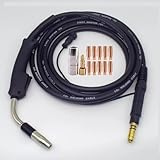
For shop fabrication, feeder behavior often matters more than a small difference in maximum amperage. The 262MP’s spool compartment and drive system are intended for regular production-style use, but performance still depends on setup. Match the drive-roll groove to the wire diameter, use the correct contact tip, and keep the liner clean and properly sized.
A typical mild-steel setup might use 0.030-inch solid wire for general fabrication or 0.035-inch wire for heavier work. Smaller wire gives better control on thinner material; larger wire supports higher deposition but demands more current and increases the risk of burn-through on light-gauge parts.
One simple operating-cost calculation illustrates the tradeoff. Suppose a 33-pound spool costs $100 and the wire feed consumes roughly 8 pounds of wire during a job. The wire portion of the cost is approximately:
8 pounds ÷ 33 pounds × $100 = about $24
That excludes shielding gas, electricity, contact tips, nozzles, and wasted wire. Flux-cored wire may cost more per pound but can reduce gas dependence and setup time outdoors. The cheapest wire is not always the lowest-cost process when cleanup and rework are included.
Input-power demands and installation
The 262MP needs a 208- or 230-volt, single-phase supply. This is a major buying criterion, not a minor installation detail. A typical shop should plan for a properly sized branch circuit, suitable receptacle, grounding, and cable length that does not create excessive voltage drop. Have a qualified electrician confirm the breaker and conductor size from the machine’s actual nameplate and local electrical requirements.
At 230 volts, the machine is easier to accommodate in a properly wired garage or fabrication shop than a large three-phase industrial power source. It still should not be treated like a household 120-volt welder. Long extension cords, undersized conductors, and shared circuits can cause nuisance trips, unstable output, or overheated connections.
Durability and serviceability
The likely wear items are ordinary welding consumables rather than the main power electronics: contact tips, liners, drive rolls, nozzle components, gun trigger parts, and ground-clamp connections. Keeping the feeder compartment free of wire dust and cleaning the gun liner before feeding problems become severe can prevent many apparent “machine” failures.
- Inspect the liner when wire feed becomes jerky or the gun cable is sharply bent.
- Replace contact tips when the wire hole becomes oversized or the arc starts wandering.
- Remove spatter from the nozzle without damaging its threads or diffuser.
- Check drive-roll tension: too little causes slipping, while too much can deform soft wire.
- Keep cooling vents clear of grinding dust and compressed-air debris.
- Inspect the work lead, gun lead, and input cord for heat damage before heavy use.
When buying used, test the feeder at low and high wire speeds, inspect the gun connection, verify that the display and controls respond normally, and confirm that the unit reaches a stable arc under load. Missing spool-gun hardware, damaged leads, and obsolete feeder parts can erase the apparent savings of a low purchase price.
Which buyer should choose it?
| Situation | Verdict | Reason |
|---|---|---|
| Small fabrication shop doing varied steel work weekly | Strong match | Good output, useful duty cycle, and multiple processes |
| Beginner learning MIG and occasional stick | Capable but possibly more machine than necessary | Versatility helps, but a simpler MIG unit may cost less and be easier to learn |
| Frequent maximum-output production welding | Look at a higher-duty-cycle machine | Cooling pauses become a bottleneck |
| Mobile repairs away from shop power | Weak match | Requires 208/230-volt power and is relatively heavy |
| Regular aluminum TIG work | Poor match | Lift-arc DC TIG is not an AC TIG system |
Final verdict
The Lincoln Electric POWER MIG 262MP is a sensible shop-fabrication machine for buyers who value process flexibility, a useful 250-amp working range, and a conventional 208/230-volt installation. Its strongest use case is intermittent to moderately repetitive steel fabrication where MIG is primary and flux-cored, stick, or DC TIG are occasional but valuable additions.
Choose it when your shop already has the required input power and your work benefits from one adaptable machine. Choose something simpler for light hobby MIG work, something with a higher duty cycle for sustained production, or an AC/DC TIG machine for serious aluminum work. Also, search and verify the model under its correct name—Lincoln POWER MIG 262MP—because referring to it as a Miller can lead to incorrect parts, specifications, or service information.