What's inside
- Board Shears vs. Stack Guillotines vs. Rotary Trimmers: What Book Artists Actually Need
- Key Decision Criteria for Bookbinding Cutters
- Spec Comparison: Real Models Used for Book Arts
- Decision Matrix: Which Cutter Fits Your Situation
- Durability and Ownership Realities
- Worked Example: Cost Per Use for Blade Sharpening
- How to Choose Without Overbuying
- FAQ
- Board Shears vs. Stack Guillotines vs. Rotary Trimmers: What Book Artists Actually Need
- Key Decision Criteria for Bookbinding Cutters
- Spec Comparison: Real Models Used for Book Arts
- Decision Matrix: Which Cutter Fits Your Situation
- Durability and Ownership Realities
- Worked Example: Cost Per Use for Blade Sharpening
- How to Choose Without Overbuying
- FAQ
As an Amazon Associate I earn from qualifying purchases. This post may contain affiliate links at no extra cost to you.
The best board shears and paper guillotines for book arts are heavy-duty board shears like the Kutrimmer 1043/1080 and Dahle 587 for ultra-square, full-sheet board cutting, and precision stack guillotines like the Ideal 1058, Ideal 4700, and Dahle 848 for clean paper signatures and text block trimming, with the right choice depending on whether you cut binder’s board and book cloth most often or paper and trimmed text blocks.
As an Amazon Associate we earn from qualifying purchases at no extra cost to you.



What we cover
- Board Shears vs. Stack Guillotines vs. Rotary Trimmers: What Book Artists Actually Need
- Key Decision Criteria for Bookbinding Cutters
- Spec Comparison: Real Models Used for Book Arts
- Decision Matrix: Which Cutter Fits Your Situation
- Durability and Ownership Realities
- Worked Example: Cost Per Use for Blade Sharpening
- How to Choose Without Overbuying
- FAQ
Board Shears vs. Stack Guillotines vs. Rotary Trimmers: What Book Artists Actually Need
Book arts involves three very different cutting tasks, and no single cutter does all three perfectly. Understanding the tool type prevents the most common buying mistake.
1. Board Shears (Arm Guillotines)
This is the traditional bindery shear with a long pivoted blade and counterweighted arm. The blade shears past a fixed bed knife. This is the correct tool for binder’s board, greyboard, millboard, mat board, and laminated cover stock. The shearing action avoids crushing the board edge and holds squareness over long cuts. Look for cast iron construction and a stamped steel or cast clamp.
2. Stack Guillotines (Heavy-Duty Lever or Hydraulic)
A vertical blade driven straight down through a clamped stack. This is the correct tool for trimming text blocks, cutting signatures, and reducing large stacks of paper (70-300+ sheets) in one pass. Squareness is set by the back gauge and side guide, not by hand alignment. Essential if you edition books or trim digitally-printed blocks after sewing.
3. Rotary Trimmers and Light Office Guillotines
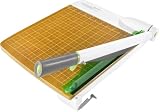
A sliding round blade on a rail (rotary) or a light hinged blade (Fiskars, Dahle 500-series office models). Useful only for single sheets of paper, endpapers, dust jackets, and book cloth. They lack the mass and blade geometry to cut 1.5mm – 3mm binder’s board cleanly and will warp or feather the edge.
For a functional book arts studio, the classic combination is one board shear for board and a stack guillotine or heavy Dahle-style professional guillotine for paper. If you can only own one, choose based on your primary material: board-heavy work (case binding, boxes) = board shear first; editioned text blocks and paper-heavy work = stack guillotine first.
Key Decision Criteria for Bookbinding Cutters
Cutting Capacity and Material Compatibility
Do not judge by paper sheet capacity alone. Check board capacity separately. A cutter rated for 300 sheets of 80 gsm paper (approx. 30mm stack) may only be rated for 2-3mm binder’s board, and some cannot cut board at all without damaging the blade.
- Binder’s board (1.5mm, 2.0mm, 2.5mm, 3.0mm): Requires a true board shear with a 2-4mm board capacity. Greyboard compresses, so a shear that handles 3mm will cut two pieces of 1.5mm easily.
- Mat board / museum board (4-ply): Most board shears and professional guillotines handle this, but light rotary trimmers will leave a burr.
- Book cloth and laminated stock: Needs a sharp, high-angle blade and strong clamp to prevent drag and lifting. Board shears excel here.
- Text block paper stacks: Requires clamp pressure and a back gauge. A 20mm stack of 100 gsm paper is about 200 sheets.
Blade Precision and Squareness
Squareness is more important than raw length. A 1-degree error over a 70cm cut becomes a 12mm deviation. In book arts this means cases that do not close and text blocks that are rhomboid.
- Board shears maintain squareness via a fixed side guide and bed. Check that the side guide is 90 degrees to the blade and cannot flex.
- Stack guillotines maintain squareness via the back gauge and side lay. Look for spindle-adjusted or hand-crank back gauges with millimeter scales and a lock.
- Blade sharpness matters more than blade material. High-carbon steel blades can be re-sharpened 2-3 times; lower-end stainless blades must be replaced. Hollow-ground blades stay sharp longer for board.
Safety Features
For studio and classroom use, prioritize: transparent safety guard over the blade path, two-hand operation or lever lock on stack cutters, automatic blade lock when not cutting, and a friction-held arm on board shears so the blade does not fall. Kutrimmer and Ideal/Dahle professional models include spring-balanced or counterweighted guards as standard. Never remove the guard to gain cutting length.
Footprint and Weight
This is a limiting factor in home studios. Board shears are long and heavy because mass equals squareness and vibration damping. A tabletop model still needs a dedicated bench that can support 50-100 kg and resist tipping when you pull the arm down. Stack guillotines are deeper than they are wide and need wall clearance for the lever. Measure your bench depth and door width before buying.
Spec Comparison: Real Models Used for Book Arts
These are established models commonly found in bindery and conservation studios. Specifications are manufacturer ranges for 2026 and will vary slightly by production year.
| Model / Type | Cut Length | Max Board Capacity | Max Paper Stack | Weight (approx.) | Best For in Book Arts |
|---|---|---|---|---|---|
| Kutrimmer 1043 Board Shear | 430 mm (17″) | 3.0 mm | ~10 mm / 40 sheets 80 gsm | 32 kg | Small cases, boxes, 2-up board cutting |
| Kutrimmer 1071 / 1080 Board Shear | 710-800 mm (28-31.5″) | 4.0 mm | ~15 mm / 60 sheets 80 gsm | 78-95 kg | Full-sheet greyboard, large case boards, squaring millboard |
| Dahle 587 Professional Guillotine | 580 mm (22.8″) | 2.5 mm (light board) | ~8 mm / 30 sheets 80 gsm | 29 kg | Endpapers, signatures, light board, edition trimming |
| Dahle 848 Professional Stack Guillotine | 475 mm (18.7″) | Not rated for board | 35 mm / ~350 sheets 80 gsm | 48 kg | Text block trimming, large paper editions |
| Ideal 1058 Guillotine | 580 mm (22.8″) | Not rated for board | 40 mm / ~400 sheets 80 gsm | 137 kg (with stand) | Professional text block finishing, creased sections |
| Ideal 4700 / 4850 Stack Cutter (manual/electric) | 475-485 mm | Not rated for board | 70-80 mm / ~700-800 sheets | 180-260 kg | High-volume edition production, binderies |
Takeaway: If your table lists “paper capacity” only, assume board capacity is zero unless the manufacturer explicitly lists a board thickness in millimeters. Cutting 2mm greyboard on a paper-only guillotine will nick the blade and create a concave edge that never squares again.
Decision Matrix: Which Cutter Fits Your Situation
| Your Situation | Primary Recommendation | Why |
|---|---|---|
| Home studio, case binding and boxes, limited budget and space | Kutrimmer 1043 or Dahle 587 | 430-580mm is enough for A3 boards cut twice, bench-mountable weight, handles board and paper without needing two machines |
| Dedicated bindery, full sheets of 2-3mm binder’s board | Kutrimmer 1080 (or 1071) | 800mm length squares a full 700x1000mm board in one pull, 4mm board capacity, holds squareness after thousands of cuts |
| Artist’s books, photo books, trimming sewn text blocks | Dahle 848 or Ideal 1058 | Clamp + back gauge ensures a flat, square text block edge; prevents text block splay better than a board shear |
| Teaching, community studio, shared access | Ideal 1058 with safety guard + a separate board shear | Two-hand safety, lockable blade, and durability under inconsistent technique; separates board grit from paper blades |
| Small editions (50-200 copies) on a regular schedule | Ideal 4700 / 4850 class electric stack cutter | Saves hours vs. single-sheet trimming; electric clamp prevents shifting on coated and digital stocks |
Durability and Ownership Realities
Brand listings rarely explain ongoing costs. For book arts, these are the points that determine long-term satisfaction.
What Wears First
- Blade edge: Board is abrasive. Cutting greyboard dulls a blade 5-10x faster than paper. Expect to sharpen a board shear blade once per 1,500-3,000 board cuts, or annually in a moderate studio. Paper guillotine blades need sharpening after 15,000-30,000 sheets of text paper.
- Cutting stick / cutting batten: The plastic strip the blade lands on. It must be rotated or replaced when grooved, otherwise the last 2cm of the cut will not separate. Keep 2-3 spares; they are inexpensive consumables.
- Clamp facing: Rubber or felt clamp inserts compress and get board dust embedded, which can mark endpapers. Clean with a dry brush and replace when indented.
Cleaning and Maintenance
Wipe the bed and blade with a dry lint-free cloth after board cutting. Greyboard dust is acidic and hygroscopic; it will pit a blade if left overnight. Lightly oil the pivot bolt and back gauge spindle monthly if used weekly. Never use water or solvents on the cutting stick.
Common Mistakes That Ruin Squareness
- Cutting board that is too thick for the machine in one pass. Take two lighter passes rather than forcing the arm.
- Cutting pasted or PVA-damp board. Adhesive dulls the blade instantly and gums the bed knife. Let boards dry fully.
- Using the board shear as a paper guillotine for thick stacks. The blade deflects without a front clamp and creates a curved edge.
- Moving a heavy shear by its arm. This bends the pivot. Always lift by the base or frame.
Worked Example: Cost Per Use for Blade Sharpening
Whether a heavy board shear is economical depends on how often you cut board vs. paper.
Assume a new hollow-ground board shear blade costs within a general market range of 120-220 and professional regrinding costs 40-75 per sharpening, with 2-3 regrinds possible before replacement.
If you cut 20 case boards per week (40 cuts, front and foredge): 40 cuts x 50 weeks = 2,000 board cuts per year. One sharpening per year at 60 = 0.03 per cut. Over 5 years, including one blade replacement (170 average), total blade cost is 60 x 5 + 170 = 470. Cost per cut = 470 / 10,000 cuts = 0.047. For classroom use at 100 cuts per week, cost triples but remains well below outsourcing board cutting, which often runs 1.50-3.00 per board in bindery services.
The same calculation for a text block guillotine (300-sheet capacity) where you trim 30 text blocks of 200 sheets each per month: 30 x 12 = 360 blocks per year. Even with one sharpening every two years, cost per block stays under 0.10, making an in-house stack cutter practical once you exceed ~15-20 blocks per month.
How to Choose Without Overbuying
Prioritize cut length over stack height for board work, and stack height plus clamp quality for paper work. Measure your largest board size and your typical text block height, then add 50mm clearance. Check that the machine fits your bench with the arm fully extended and that you can stand to the side, not directly behind the blade path, while operating.
For conservation and artist books where edge quality is visible, avoid combination machines that claim to cut both thick board and thick paper stacks with the same blade geometry. A dedicated board shear and a separate paper cutter will keep edges cleaner and blades sharper longer than one compromised tool.
If space only allows one machine, the most versatile compromise for 2026 is a 580mm professional guillotine (Dahle 587 / Ideal 1058 class) paired with hand-cutting board using a straight edge and snap-off knife for occasional thick boards, until you can add a true 710mm+ board shear.
FAQ
Can I cut binder’s board on a Dahle or Ideal paper guillotine?
Only light 1.0-1.5mm board on models explicitly rated for it, and only a few sheets at a time. Standard stack guillotines are not designed for millboard; you will chip the blade and lose squareness. Use a board shear for any board over 1.5mm or for full-size boards.
What cut length do I need for book arts?
430mm covers A3 and small octavo cases with two cuts. 580mm covers most quarto cases. 710-800mm is needed to square a full sheet of 700x1000mm binder’s board in one pass without repositioning, which is how you guarantee opposite edges are parallel.
How do I keep cuts square?
Always register against the fixed side guide, not a pencil mark. Hold the board firmly against both the back gauge and side guide before clamping. On board shears, make a light scoring pull first, check alignment, then complete the cut in one firm motion. Check squareness monthly with a certified engineer’s square.