Our Top Picks
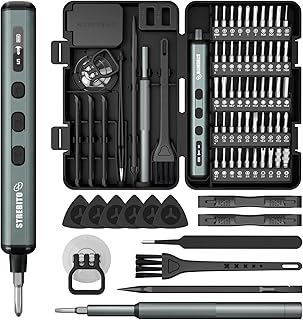
 Mini Electric Screwdriver Set 140-IN-1: Small Electric ScrewdriverMini Electric Screwdriver Set9.45 x 5.7 x 1.57 inches1.56 PoundsCheck on Amazon
 Milwaukee 2457-20 M12 Cordless 3/8" Sub-Compact 35 ft-Lbs3/8"9.47 x 2.94 x 1.76 inches1 PoundsCheck on Amazon


What's inside
As an Amazon Associate I earn from qualifying purchases. This post may contain affiliate links at no extra cost to you.
The car is on stands, the exhaust flange bolt is rusted into one piece, and your air hose is coiled behind the welding cart on the far wall. That is why the best cordless tools for auto repair matter in a metal shop. Not convenience. Reach and uptime. A battery impact gets up over a subframe or behind a rocker panel where fifty feet of hose and a tired compressor never will.
Cordless caught air on torque. High torque 1/2 inch battery guns break fasteners that used to need a 3/4 inch air impact. That does not make every cordless tool worth buying, and it does not make battery tools safer. More power in a smaller package, closer to fuel lines and old undercoating, is a fire and PPE problem before it is a spec sheet.
As an Amazon Associate we earn from qualifying purchases at no extra cost to you.





| Tool | Job on the car | What actually matters |
|---|---|---|
| High torque 1/2 in. impact wrench | Lug nuts, suspension, axle and crank bolts | Nut busting torque plus a low mode that will not snap studs |
| 3/8 in. impact or ratchet | Manifolds, brackets, bell housing, tight bays | Short head, low speed control, compact pack |
| 4-1/2 in. angle grinder | Cutting exhaust, dressing welds, stripping rust | Paddle switch, wheel brake, 5.0Ah or bigger |
| Portable band saw | Tube, rod and bar cut cold | Variable blade speed, no sparks near fuel |
| Reciprocating saw | Seized hardware, rusted brackets | Bi metal blades, short stroke, no orbital |
| Work light and inflator | Seeing the job, setting tire pressure | Same battery as everything else |
What we cover
Why the best cordless tools for auto repair belong in a fab shop
Two reasons. First, your compressor is already committed. Plasma, blast cabinet, DA sander, air chisel. Run two of those at once and the impact gun goes weak right when you need it. Battery tools take nothing off the line. Second, cars do not always come to you. Trailer repair in a yard, a truck dead in a customer lot. A charged pack works there. The trade is real too: packs die mid job, high torque guns are heavy overhead, and building a platform costs more up front than the air setup you already own.
Torque, in numbers you can use
Manufacturers publish two figures and they are not the same thing. Fastening torque is what the tool can tighten to. Nut busting torque, sometimes called breakaway, is what it rips loose in reverse, and it is always the bigger number. Reverse is easier because the tool hammers without stretching the fastener. A gun advertised in the four figure nut busting range will twist a wheel stud in half and never slow down.
So use the modes. Most passenger car lug nuts land around 80 to 100 ft lbs, and the service manual is the only number that counts. Run them down on the lowest setting, then set final torque with a click type torque wrench, star pattern, wheels on the ground. Same rule for caliper brackets, ball joints, axle nuts and head hardware. An impact removes. A torque wrench installs.
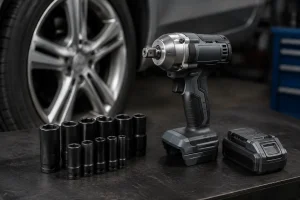
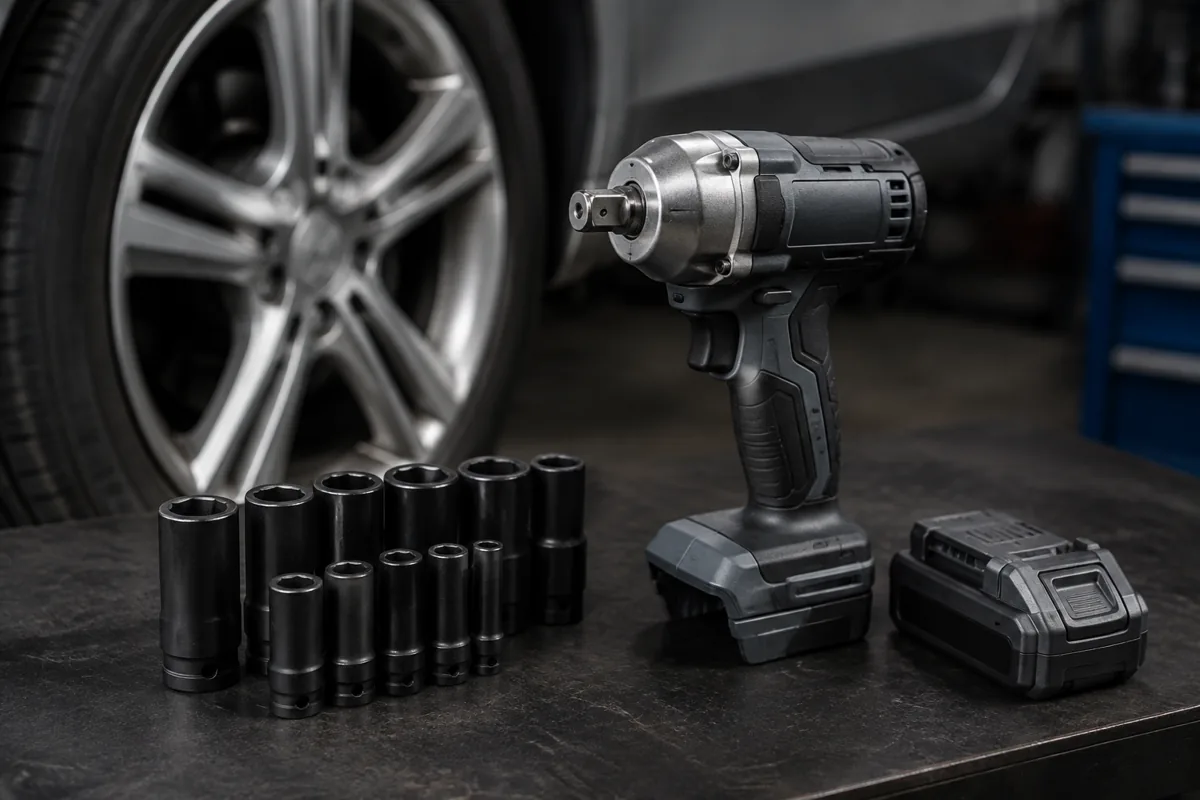
High torque 1/2 in. cordless impact wrench
Skip the compact version for shop work and buy the high torque gun with multiple power modes. Those low modes are what save wheel studs and aluminum brackets. Whatever platform your batteries are already on has one.
Cutting and grinding: sparks live in the engine bay
Match the wheel to the metal. Exhaust tubing is thin, roughly 16 to 18 gauge, call it a sixteenth of an inch or less. A 0.045 inch cut off wheel walks through that fast and wanders less. Frame brackets, spring hangers and heavy tube run 1/8 to 1/4 inch, and there a thicker 3/32 or 1/8 wheel is less likely to bind and burst. Dress welds with a grinding or flap disc, never the face of a cut off wheel.
Fire next, because this is where shops burn down. Sparks throw twenty feet and bounce off concrete into things you forgot about. Undercoating, seam sealer, old sound deadening, grease, brake cleaner vapor, fuel lines, plastic tanks. Pull the ground cable off the battery. Drop or shield the fuel tank if you are cutting near it. Use a real welding blanket, not cardboard, and wet what you cannot move. Extinguisher within arm’s reach. Then stay in the bay thirty minutes after the last cut, because most shop fires start after everybody leaves.
PPE still applies just because the grinder is quiet. Face shield over safety glasses, since wheels come apart. Sleeves down, no synthetics, leather gloves, hearing protection. Half mask with P100 filters when you grind rust, cut galvanized, or burn off undercoating. Galvanized fume is zinc oxide and it will give you metal fume fever. Older paint can be leaded. Old brake dust may still contain asbestos, so wet it and wipe it instead of blowing it off with air.
Cordless angle grinder, 4-1/2 to 5 in.
Get a paddle switch with a kickback brake and buy the biggest packs the tool takes. A full exhaust job eats batteries, so plan on one in the charger at all times. Thin wheels for tubing, thicker wheels for brackets.
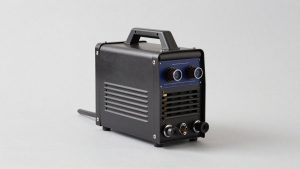
Amperage: what a battery welder can and cannot do
Amps are heat. The working rule of thumb on steel is about one amp per thousandth of an inch of thickness. An 18 gauge body panel is roughly 0.048 inch, so it wants somewhere near 40 to 50 amps and a stitch, not a bead. A 1/8 inch bracket at 0.125 inch wants around 120 to 130 amps. That math is why cordless welding stays niche. Pushing a hundred plus amps at any real duty cycle takes a big, heavy pack, and the machine cools down long before you finish a seam.
Battery stick machines earn their keep for what they are: a couple of tacks on a broken trailer bracket where there is no outlet. They are not the tool for a floor pan patch. Sheet metal still wants a 120V MIG with gas, low amps and short stitches with cool down between them. Grind to clean bare metal and back the panel. Before you strike an arc on a vehicle, disconnect both battery cables, unplug the ECU if you are welding near the harness, and clamp the ground to the piece you are welding, not across a bearing where current will pit the races. Ventilate or run an extractor and keep your head out of the plume.
Batteries, platform and buy order
Pick one platform and stay on it. DeWalt XR, Milwaukee FUEL and Makita LXT all cover the tools above, and switching ecosystems means paying for chargers twice. Keep two high capacity packs, 5.0Ah or larger, for the high torque gun and the grinder, plus compact packs for the ratchet and light so you are not fighting weight overhead. Brushless is worth it on impacts and grinders. On battery safety: never set a pack on an exhaust manifold, never charge one with a cracked case or one that took a drop into coolant, and charge away from the solvent shelf. Damaged cells can light off hours later sitting on a bench.
- ✔ No hose dragged across fresh paint or a hot manifold
- ✔ Full torque on the first trigger pull, no tank pressure to wait on
- ✔ Works on field and roadside repairs with no power available
- ✔ One platform runs the impact, grinder, light and inflator
- ✘ Real money up front next to air tools you already own
- ✘ High torque guns are heavy and nose heavy overhead
- ✘ Cutting and grinding drain packs fast
- ✘ Damaged lithium packs are a fire risk in a shop full of solvent
Cordless 3/8 in. impact ratchet
The tool that pays you back on every intake, manifold and bracket job. Look for a short head, a compact battery, and enough speed control to break a bolt loose without rounding it. Finish by hand wherever torque is specified.
Frequently asked questions
Will a cordless impact wrench break loose rusted suspension bolts? A modern high torque 1/2 inch gun handles most of it, including seized control arm and cradle hardware. Heat, penetrant and time still do half the work, and a bolt you drill out on purpose is faster than one you snap off inside a bushing.
Can I set lug nut torque with an impact wrench? No. Run the nuts down on the lowest setting and finish with a click type torque wrench to the manual spec, commonly around 80 to 100 ft lbs on passenger cars. Impacts overtighten, warp rotors and stretch studs.
Do I need a respirator to grind rust and undercoating? Yes. Half mask with P100 filters, plus ventilation. Galvanized coating puts zinc oxide fume in the air, older paint can be leaded, and burning undercoating is nasty as well as flammable.
Buy in order: high torque 1/2 inch impact, 3/8 ratchet, grinder, work light, then the band saw and recip when the work calls for them. One platform, two big packs charged, extinguisher where you can grab it without walking.
Check prices on Amazon →