What's inside
- What Can a Fiber Laser Engrave? A Material-by-Material Guide
- Fiber laser material compatibility chart
- Metals: the strongest reason to choose fiber
- Coatings, finishes, and plated parts
- Plastics: formulation matters more than the label
- What a fiber laser should not be bought for
- How much is a fibre laser machine?
- Ownership realities: optics, cleaning, and mistakes
- Related Guides
- What Can a Fiber Laser Engrave? A Material-by-Material Guide
- Fiber laser material compatibility chart
- Metals: the strongest reason to choose fiber
- Coatings, finishes, and plated parts
- Plastics: formulation matters more than the label
- What a fiber laser should not be bought for
- How much is a fibre laser machine?
- Ownership realities: optics, cleaning, and mistakes
- Related Guides
As an Amazon Associate I earn from qualifying purchases. This post may contain affiliate links at no extra cost to you.
What we cover
- What Can a Fiber Laser Engrave? A Material-by-Material Guide
- Fiber laser material compatibility chart
- Metals: the strongest reason to choose fiber
- Coatings, finishes, and plated parts
- Plastics: formulation matters more than the label
- What a fiber laser should not be bought for
- How much is a fibre laser machine?
- Ownership realities: optics, cleaning, and mistakes
- Related Guides
What Can a Fiber Laser Engrave? A Material-by-Material Guide
A fiber laser can engrave and mark most bare metals, many metal coatings, and selected engineering plastics, but it is not a universal cutter or engraver: the safest, cleanest results come from materials that absorb its near-infrared wavelength at the intended power and speed.
Fiber lasers commonly operate around 1,060–1,080 nm. Their concentrated beam is especially effective on steel, stainless steel, aluminum, brass, copper, titanium, and nickel alloys. On plastics, success depends less on the plastic name alone and more on whether the formulation contains a laser-markable additive. Before buying a machine, ask for a material sample test and confirm the supplier’s safety guidance.
As an Amazon Associate we earn from qualifying purchases at no extra cost to you.


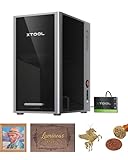

Fiber laser material compatibility chart
| Material | Typical result | Common starting power | Important cautions |
|---|---|---|---|
| Stainless steel | Clean dark, light, or annealed marks; optional deep engraving | 20–50 W | Power, speed, frequency, and air assistance affect contrast and heat tint |
| Mild or carbon steel | Dark marks, surface etching, and deeper engraving | 20–50 W | Rust, scale, oil, and mill finish can make the result uneven |
| Anodized aluminum | High-contrast removal of the anodized layer | 20–30 W | Usually cleaner than marking bare aluminum; color varies by coating |
| Bare aluminum | Gray or white surface marks; deeper work is possible | 30–60 W | Reflective surfaces can require careful focus, power, and enclosure design |
| Brass and copper | Marking is possible, though contrast and speed can be challenging | 30–60 W | High reflectivity increases back-reflection risk; use a machine rated for these metals |
| Titanium | Sharp marks and heat-colored finishes | 20–50 W | Color depends strongly on pulse settings, cleaning, and surface condition |
| Painted or powder-coated metal | Coating removal to reveal the metal underneath | 20–50 W | Coating chemistry determines fumes; provide extraction and inspect the coating data |
| Laser-markable ABS, polycarbonate, and nylon | Dark, light, or foamed marks when specially formulated | 20–30 W | Ordinary grades may melt, discolor, or produce poor contrast |
| PVC, vinyl, and unknown plastics | Do not process without verified composition and safety approval | Not recommended | Chlorine-containing fumes can be hazardous and corrosive to equipment |
| PTFE, fluoropolymers, and rubber of unknown composition | Generally unsuitable for an unverified fiber-laser setup | Not recommended | May release hazardous decomposition products; do not rely on appearance |
| Wood, paper, leather, and clear glass | Usually poor or unsuitable with a standard fiber laser | Not recommended | A CO2 or diode laser is normally the better tool for these materials |
The wattage figures are practical starting ranges rather than guaranteed recipes. A 20 W source can produce excellent serial numbers and logos, while a 50 W source generally completes deep marking and larger jobs faster. Lens choice also matters: a common 110 mm field lens gives roughly a 70–75 mm square working area, while a 175 mm lens may cover approximately 110–120 mm square with a larger spot and lower fine-detail performance.
Metals: the strongest reason to choose fiber
Stainless and carbon steel
Stainless steel is one of the easiest materials for a fiber laser to mark consistently. You can remove the surface, create a dark oxide or annealed mark, or build depth through repeated passes. For tools, tags, knives, brackets, and machine parts, a 20–30 W machine is often sufficient for identification work. A 50 W machine is more attractive when production speed or deeper engraving matters.
Carbon steel can mark quickly, but oil, mill scale, and oxidation cause patchy results. Degrease the part first and use a test grid that varies speed, power, frequency, and line spacing. Deep engraving creates heat and debris, so allow cooling between demanding jobs and remove residue before judging the finish.
Aluminum, brass, copper, and titanium
Anodized aluminum is particularly practical because the laser can remove the colored anodized layer without substantially cutting into the base metal. Bare aluminum is more demanding: it reflects strongly and often produces a softer gray mark rather than a dramatic black one.
Brass and copper are also reflective and thermally conductive. They can be marked, but a suitable galvo source, correct focus, and protection against back-reflection are important. Do not assume that a machine sold for steel is automatically safe for highly reflective copper. Titanium is usually cooperative and can produce both crisp identification marks and attractive oxide colors, although repeatability depends on surface preparation.
Coatings, finishes, and plated parts
A fiber laser can remove paint, powder coating, anodizing, and some plating to expose a contrasting layer below. This is useful for control panels, electrical labels, signs, and serialized components. The laser is not reacting with “paint” as a single material category: epoxy powder coat, solvent paint, ceramic coating, chrome-like finishes, and industrial primers can behave very differently.
Coated parts may release pigments, binders, or metal compounds when heated. Use local extraction, keep the work area enclosed, and obtain the coating’s safety data sheet when possible. If the coating is unknown, make a small test only after confirming that the material is appropriate for laser processing. A clean-looking mark does not prove that the fumes are safe.
Plastics: formulation matters more than the label
Standard fiber lasers are not general-purpose plastic engravers. Some plastics contain pigments or additives designed to absorb 1,064 nm light and create a high-contrast mark without excessive melting. These laser-markable grades are sold for electrical components, automotive parts, instrument panels, and industrial labels.
ABS, polycarbonate, polyamide, and certain acetal formulations may work, but ordinary consumer-grade versions can bubble, melt, turn brown, or produce almost no contrast. Request the exact resin grade and supplier marking guidance. Test a small area at low heat input before committing a production part.
Never process PVC, vinyl, or an unidentified flexible sheet simply because it resembles a material that marked successfully. Chlorine-containing plastics can produce corrosive and hazardous gases. PTFE and some fluoropolymers also require specialized hazard assessment. The same caution applies to rubber, foam, leatherette, and recycled plastics whose additives are unknown.
What a fiber laser should not be bought for
- Wood, paper, and most organic materials: a CO2 or diode laser is generally better suited.
- Transparent glass: a standard fiber wavelength usually produces little useful surface marking.
- Thick cutting: a marking fiber laser is optimized for surface work, not sheet-metal fabrication. Cutting capability depends on a different machine class, power level, assist gas, and safety system.
- Unknown plastics: material identification and fume control come before parameter testing.
How much is a fibre laser machine?
In 2026, a compact enclosed 20 W fiber marking machine commonly falls around $2,500–$6,000, depending on the source, lens, enclosure, rotary attachment, extraction, and support. A 30–50 W machine is often roughly $4,000–$10,000. Higher-power industrial systems, automated fixtures, larger work areas, and integrated extraction can push the investment into the $10,000–$30,000-plus range.
Budget for more than the laser source. Useful additions include a rotary axis, extra field lenses, fume extraction, replacement protective windows, fixturing, software support, and electrical installation. A low purchase price is less appealing if the machine cannot safely process your reflective parts or if replacement optics are difficult to obtain.
| Your situation | More suitable choice | Why |
|---|---|---|
| Occasional hobby marking on steel or anodized aluminum | 20 W enclosed fiber laser | Lowest practical entry point for tags, tools, and small logos |
| Small business, several jobs per week | 30 W fiber laser with rotary option | More speed and headroom for varied parts |
| Frequent production or deeper engraving | 50 W fiber laser with extraction and fixtures | Shorter cycle times and more effective multi-pass work |
| Mostly wood, acrylic, and leather | CO2 or diode laser instead | Better wavelength match and broader organic-material capability |
Ownership realities: optics, cleaning, and mistakes
The fiber source itself is usually not the first component to wear out. Protective windows, lenses, extraction filters, galvo components, and fixtures receive more routine attention. Keep the enclosure closed during operation, inspect the protective window for haze or splatter, and clean only with the method recommended for that optic. A contaminated window can absorb energy, heat up, and fail suddenly.
Common errors include engraving out of focus, using excessive power for a thin coating, skipping a test grid, and assuming that a material name guarantees a particular result. Record successful settings by exact alloy, finish, lens, and mark size. For production work, verify contrast after cleaning and after any change in batch, coating, or surface treatment.
The best answer to “what can a fiber laser engrave” is therefore: bare and coated metals very well, verified laser-markable plastics selectively, and unknown or chlorine-containing materials not at all until their composition and fume risks are established. Choose the machine around your actual materials, part size, marking depth, production frequency, and ventilation—not wattage alone.