What's inside
- Top 3 Picks
- Quick Comparison
- How We Chose
- 1. Caiman Premium Goat Grain – Best for Mixed MIG and TIG Work
- 2. IRONCAT 6141 Kidskin – Best Budget TIG Glove
- 3. ARCCAPTAIN TIG – Best Premium Glove for TIG Feel
- 4. Tillman 1328 – Best Budget Goatskin TIG Glove
- 5. YESWELDER Premium Goatskin – Best Premium Glove for All-Day TIG
- 6. HOVhomeDEVP MIG/Stick – Best Budget MIG and Stick Glove
- 7. TICONN 16-Inch – Best Mid-Range Glove for Heavy MIG and Stick
- 8. WZQH Leather Work Glove – Best Budget Entry-Level Glove
- 9. TOPDC 16-Inch – Best Mid-Range Glove for Hot, High-Amperage Work
- 10. Black Stallion GM1611-WT – Best Premium MIG Glove with Reinforced Palm
- 11. RAPICCA 16-Inch – Best Mid-Range Glove for Spatter-Heavy Stick and MIG
- Related Guides
- Top 3 Picks
- Quick Comparison
- How We Chose
- 1. Caiman Premium Goat Grain – Best for Mixed MIG and TIG Work
- 2. IRONCAT 6141 Kidskin – Best Budget TIG Glove
- 3. ARCCAPTAIN TIG – Best Premium Glove for TIG Feel
- 4. Tillman 1328 – Best Budget Goatskin TIG Glove
- 5. YESWELDER Premium Goatskin – Best Premium Glove for All-Day TIG
- 6. HOVhomeDEVP MIG/Stick – Best Budget MIG and Stick Glove
- 7. TICONN 16-Inch – Best Mid-Range Glove for Heavy MIG and Stick
- 8. WZQH Leather Work Glove – Best Budget Entry-Level Glove
- 9. TOPDC 16-Inch – Best Mid-Range Glove for Hot, High-Amperage Work
- 10. Black Stallion GM1611-WT – Best Premium MIG Glove with Reinforced Palm
- 11. RAPICCA 16-Inch – Best Mid-Range Glove for Spatter-Heavy Stick and MIG
- Related Guides
As an Amazon Associate I earn from qualifying purchases. This post may contain affiliate links at no extra cost to you.
Buy the Caiman Premium Goat Grain TIG/Multi-Task gloves if you weld both MIG and TIG and want one pair that covers both. The goat-grain palm keeps enough fingertip feel to walk a TIG torch or feed filler rod, the split-cowhide back takes light MIG spatter, and the 4-inch extended cuff tucks under a jacket sleeve so nothing drops into the gap. If your work is almost entirely TIG below roughly 150 amps, the IRONCAT 6141 kidskin gloves give you more feel for less money, at the cost of heat resistance you will notice the first time you strike an arc on MIG. If your day is MIG and stick at 180–250 amps, especially overhead, go the other direction: a 16-inch split-leather glove such as the TICONN or the TOPDC. The whole category comes down to one trade-off — the thinner and more sensitive the leather, the less heat it absorbs and the faster it wears. Everything below is about finding your point on that line.
What we cover
- Top 3 Picks
- Quick Comparison
- How We Chose
- 1. Caiman Premium Goat Grain – Best for Mixed MIG and TIG Work
- 2. IRONCAT 6141 Kidskin – Best Budget TIG Glove
- 3. ARCCAPTAIN TIG – Best Premium Glove for TIG Feel
- 4. Tillman 1328 – Best Budget Goatskin TIG Glove
- 5. YESWELDER Premium Goatskin – Best Premium Glove for All-Day TIG
- 6. HOVhomeDEVP MIG/Stick – Best Budget MIG and Stick Glove
- 7. TICONN 16-Inch – Best Mid-Range Glove for Heavy MIG and Stick
- 8. WZQH Leather Work Glove – Best Budget Entry-Level Glove
- 9. TOPDC 16-Inch – Best Mid-Range Glove for Hot, High-Amperage Work
- 10. Black Stallion GM1611-WT – Best Premium MIG Glove with Reinforced Palm
- 11. RAPICCA 16-Inch – Best Mid-Range Glove for Spatter-Heavy Stick and MIG
- Related Guides
Top 3 Picks
Best overall: Caiman Premium Goat Grain TIG/Multi-Task. A goat-grain palm with a split-cowhide back and a 4-inch extended cuff is the closest thing to a genuine dual-purpose glove. It gives up a little TIG sensitivity compared with a pure kidskin glove and a lot of heat margin compared with a 16-inch gauntlet, but it is the pair that stays on your hands through a mixed afternoon of TIG root passes and MIG tack welds.
Best budget: IRONCAT 6141 Kidskin. Kidskin is the thinnest leather used in welding gloves, which is exactly what you want when the job is feeding 0.045-inch filler into a tight joint. Kevlar-thread construction and a 4-inch gold cuff round it out. It is a TIG glove first; treat MIG and stick as occasional use only.
Best premium: Black Stallion Revco GM1510 Premium Touch. If feel is the priority and budget is not, this is the top of the range for TIG work that also sees MIG duty. The construction is aimed at preserving touch and control in the fingertips, which is where most gloves fail a TIG welder first.
Quick Comparison
Every glove below is grouped by what it is actually good at, not by what its listing name claims. Cuff lengths, listed heat ratings and leather types are taken from the product names and standard category specifications.
| Product | Best for | Key specs | Price tier |
|---|---|---|---|
| Caiman Premium Goat Grain | Mixed MIG and TIG in one pair | Goat-grain palm, split-cowhide back, 4 in. extended cuff | Mid-range |
| IRONCAT 6141 Kidskin | Precision TIG at low amperage | Kidskin leather, Kevlar thread, 4 in. gold cuff, straight thumb, size M | Budget |
| ARCCAPTAIN TIG | Premium feel for TIG | Premium grain goatskin, TIG-focused pattern | Premium |
| Tillman 1328 | Budget TIG and light fabrication | Top-grain goatskin, straight thumb, size L | Budget |
| YESWELDER Premium Goatskin | All-day TIG comfort | Premium goatskin, TIG-oriented cut | Premium |
| HOVhomeDEVP MIG/Stick | Budget MIG, stick and torch work | Leather construction, MIG/stick rated, standard gauntlet cuff | Budget |
| TICONN 16 in. | Heavy MIG and stick | 16 in. overall length, 1000°F listed heat resistance | Mid-range |
| WZQH Leather Work | Entry-level general purpose | Leather work glove, size S, welding/gardening crossover | Budget |
| TOPDC 16 in. | Hot, high-amperage MIG and stick | 16 in. overall length, 932°F listed heat resistance | Mid-range |
| Black Stallion GM1611-WT | Production MIG with palm wear | Top-grain cowhide, reinforced patched palm and thumb | Premium |
| RAPICCA 16 in. | Spatter-heavy stick and MIG | 16 in. overall length, 932°F listed heat resistance, blue finish | Mid-range |
| Black Stallion Revco GM1510 | Premium TIG touch with MIG capability | TIG/MIG pattern, Premium Touch construction, size XL | Premium |
How We Chose
This roundup is built from published specifications, category standards and the way these gloves are actually used, not from shop time with each pair. The first filter was leather type, because leather type determines almost everything else — kidskin and goatskin buy dexterity, cowhide buys abrasion and heat margin, and split versus grain changes the same hide’s behaviour dramatically. The second was cuff length and construction, since a 4-inch cuff and a 16-inch cuff are different tools for different processes rather than better and worse versions of the same thing.
The third filter was seam and thread information, where listings disclose it, because stitched seams are where most welding gloves die. The fourth was sizing and availability across the range, since a glove that only comes in one size or one colourway is a poor recommendation for a general audience. Finally we looked at upgrade path: each entry had to occupy a distinct slot — budget, mid-range or premium, TIG-leaning or MIG-leaning — so that a reader could move up or down the list without ending up with two pairs that do the same job. Where a listing did not state a figure, we describe the glove by spec class instead of guessing.
1. Caiman Premium Goat Grain – Best for Mixed MIG and TIG Work
As an Amazon Associate we earn from qualifying purchases at no extra cost to you.

This is the pair for the welder who owns one machine, or two, and does not want to think about which glove goes with which process. The Caiman Premium Goat Grain TIG/Multi-Task glove pairs a goat-grain palm with a split-cowhide back and a 4-inch extended cuff. That combination is a deliberate compromise, and it is a well-judged one.
Key specs
- Palm: goat grain leather — high dexterity, good abrasion resistance
- Back: split cowhide — thicker, more heat-tolerant than the palm
- Cuff: 4-inch extended, designed to tuck under a jacket sleeve
- Colourway: white palm with gold cuff and trim
- Intended use: TIG plus multi-task welding, light MIG
The logic behind the two-leather build is straightforward. Goat grain is one of the few leathers that stays supple at 0.7–0.9 mm while resisting abrasion better than kidskin, so the palm can survive dragging across a bench and still let you feel a filler rod through the leather. Split cowhide on the back is heavier and coarser, which is exactly what you want on the surface that faces spatter and radiant heat when your hand rolls over the joint. Very few gloves in this price tier bother to differentiate front and back; most use one hide throughout.
The 4-inch cuff is the other decision point. Four inches covers roughly the lower third of an average adult forearm, which is enough for TIG and light MIG with a long-sleeved shirt or a welding jacket whose cuff overlaps the glove. It is not enough for overhead stick welding, where molten metal runs down the arm. If you do much overhead work, this glove is the wrong tool and the 16-inch options further down the list are the right ones.
Where this glove earns its place is the switching. A pure kidskin TIG glove will let you feel everything and then punish you with a hot spot the moment you run a MIG bead at 180 amps. A 16-inch split-cowhide gauntlet will protect you all day and feel like operating a torch through a boxing glove. The Caiman sits between them, and for a mixed workload that is worth more than being the best at either extreme.
Pros
- Genuine dual-process design: sensitive palm, protective back
- Goat grain holds up better than kidskin against abrasion and moisture
- 4-inch cuff tucks cleanly under a jacket or welding shirt sleeve
- Straightforward sizing and widely available colourway
- Good middle ground for a hobbyist or small shop that does both processes
Cons
- Not enough cuff length for overhead stick or heavy spatter work
- Less fingertip sensitivity than a dedicated kidskin TIG glove
- Less heat margin than a 16-inch split-cowhide gauntlet at high amperage
- Split cowhide back stiffens with age and does not soften back up
Compared with the IRONCAT 6141, this is the more versatile glove and the less sensitive one — the IRONCAT wins on TIG feel and loses badly the moment you change process. Compared with the TICONN 16-inch, it is the more precise glove and the less protective one. If you are choosing between this and either of those, the question is simply how often you switch processes.
2. IRONCAT 6141 Kidskin – Best Budget TIG Glove
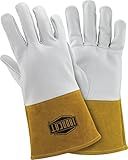
The IRONCAT 6141 is a specialist: a kidskin TIG glove with Kevlar thread and a 4-inch gold cuff, sold in size Medium with a straight thumb. Kidskin is the thinnest leather commonly used in welding gloves, and that single fact explains both why TIG welders like it and why it should not be your only pair.
Key specs
- Leather: kidskin — the thinnest, most tactile welding leather
- Thread: Kevlar (aramid) stitching
- Cuff: 4-inch gold cuff
- Thumb: straight thumb pattern
- Size: Medium
- Process fit: TIG first, light MIG second
Kidskin comes from young goats, and the fibre structure is finer and more uniform than adult hide. The practical result is a glove you can bend at the knuckles without fighting it, which matters more in TIG than in any other process. TIG welding is a two-handed job: one hand on the torch, one hand feeding filler rod at a rate that changes several times a second. A glove that resists finger movement makes that feed jerky, and a jerky feed shows up in the weld.
The Kevlar thread is a real specification point rather than marketing. Standard cotton-wrapped thread chars at the temperatures a TIG weld pool radiates, and once a seam lets go the glove is finished — you cannot repair a welding glove seam reliably enough to trust it near an arc. Aramid thread tolerates substantially more heat before it fails, which is why it appears on gloves aimed at higher-temperature work. If you are comparing two similarly priced kidskin gloves and only one states its thread material, that is the one to take.
The straight thumb pattern is worth understanding too. A straight thumb puts the thumb in line with the palm, giving a flatter, more open hand position — good for gripping a torch body and for sliding your hand along a joint. A wing thumb, more common on heavier MIG gloves, adds a gusset for flexibility at the cost of some precision. For TIG, straight is usually the right call.
Pros
- Highest fingertip sensitivity of anything on this list
- Kevlar thread at a budget price point is unusual and worth having
- Straight thumb suits torch grip and filler feed
- Light, cool and comfortable for long TIG sessions
- Inexpensive enough to keep two pairs and rotate them
Cons
- Very little heat margin — light MIG is the practical limit
- Kidskin abrades faster than goatskin or cowhide
- 4-inch cuff leaves the forearm exposed without a sleeve
- Offered in Medium, which will not suit large hands
Against the Tillman 1328, the IRONCAT is thinner and more sensitive but less abrasion-resistant; the Tillman’s top-grain goatskin will outlast kidskin on a bench. Against the Caiman, the IRONCAT is the better pure TIG glove and the worse everything-else glove. Buy it as a dedicated TIG pair, not as your only protection.
3. ARCCAPTAIN TIG – Best Premium Glove for TIG Feel

ARCCAPTAIN’s TIG glove uses premium grain goatskin and is built specifically around the TIG process rather than adapted from a MIG pattern. It suits the welder who spends most of their arc time on TIG, cares about fingertip control more than cuff coverage, and is willing to pay for a hide that is selected rather than simply cut.
Key specs
- Leather: premium grain goatskin
- Construction: TIG-oriented pattern with a focus on fingertip control
- Cuff: short gauntlet, designed to tuck under a sleeve
- Process fit: TIG primary, light MIG acceptable
- Price tier: premium
“Grain” versus “split” is the most misunderstood distinction in welding glove shopping. Grain leather is the outer surface of the hide, with the tight fibre structure intact; split leather is the inner layer, sanded to a uniform nap. Grain is smoother, more abrasion-resistant per unit thickness and holds its shape better. Split is thicker, cheaper and more heat-tolerant because you can cut it heavy. Premium grain goatskin means the maker is paying for the top of the hide and cutting it thin enough to preserve feel — which is the opposite priority from a heavy MIG gauntlet.
The practical benefit shows up in three places. First, filler rod control: goat grain at this thickness lets you feel the rod move between your fingers, which is what separates a consistent dab rate from a hesitant one. Second, torch manipulation: walking the cup or making small wrist adjustments on a thin section requires a glove that does not fight the movement. Third, moisture: goatskin handles sweat and humidity better than cowhide, staying flexible where a cheaper glove goes stiff and slick.
What you give up is heat margin and coverage. This is not a glove for 200-amp MIG on thick plate, and the short cuff means your forearm is exposed unless you wear a leather sleeve or a jacket with a long cuff. That is a deliberate trade, not a flaw: a glove built for maximum fingertip control cannot also be a 16-inch heat shield without becoming a different product.
Pros
- Premium grain goatskin is a genuine step up in feel and abrasion resistance
- Pattern designed for TIG rather than adapted from a MIG glove
- Goatskin stays flexible when damp, unlike cowhide
- Short cuff tucks under a jacket without bunching
- Good longevity for TIG-only use despite the thin leather
Cons
- Premium price for a glove that only does one process well
- Not appropriate for high-amperage MIG or any stick work
- Short cuff requires a separate sleeve for forearm protection
- Thin grain leather can be punctured by sharp edges on the workpiece
Compared with the YESWELDER Premium Goatskin, this is a close call and mostly comes down to fit — both are premium goatskin TIG gloves, and the right one is the one that matches your hand size and cuff preference. Compared with the IRONCAT 6141, the ARCCAPTAIN costs more and returns better abrasion resistance and a more refined pattern, while giving up a little of kidskin’s raw thinness.
4. Tillman 1328 – Best Budget Goatskin TIG Glove

Tillman has been making welding gloves and leather protective gear in the United States for a long time, and the 1328 is its top-grain goatskin TIG glove in a straight-thumb pattern, offered here in size Large. It is the pick for someone who wants goatskin’s balance of feel and durability without paying a premium-tier price.
Key specs
- Leather: top-grain goatskin
- Thumb: straight thumb pattern
- Size: Large
- Cuff: short TIG-style cuff
- Process fit: TIG and light fabrication
Top-grain goatskin sits in a useful spot. It is thinner and more tactile than cowhide, more abrasion-resistant than kidskin, and it tolerates the repeated flexing that a TIG glove goes through better than either. Where kidskin is a specialised tool that wears quickly, goatskin is the leather that most TIG welders eventually settle on because it does the job and lasts.
The straight thumb matters here as much as the leather. In TIG, you spend a lot of time with the torch hand rolled slightly so the cup can be walked along the joint, and the filler hand making small pinch-and-release movements. A straight-thumb glove keeps the palm flatter, which gives you a more consistent grip on a torch body and lets you roll the glove across a bench without catching. If you do a lot of out-of-position work, you will notice the difference within a session.
What you should expect from a budget goatskin glove is a slightly less selective hide. Premium tiers pay for consistent thickness and fewer scars across the palm; budget tiers cut the same leather type with more variation. For TIG that variation is usually harmless — a slightly thicker patch on the back of the hand does not affect your rod feed. It matters more if you are using the glove for heavy spatter work, which this one is not built for.
Pros
- Top-grain goatskin at a budget price is the value proposition here
- Straight thumb suits TIG torch grip and filler control
- Established brand with a long track record in leather protective gear
- More durable than kidskin for the same money in most cases
- Good general-purpose glove for light fabrication, not just TIG
Cons
- Budget-grade hide selection means occasional thickness variation
- Short cuff, so no forearm coverage without a sleeve
- Not suitable for stick or high-amperage MIG
- Sold in a single size in this listing, which limits fit options
Against the IRONCAT 6141, the Tillman trades a little fingertip sensitivity for noticeably better durability — the right choice if you weld several times a week rather than occasionally. Against the ARCCAPTAIN, it gives up pattern refinement and premium hide selection but costs a fraction as much.
5. YESWELDER Premium Goatskin – Best Premium Glove for All-Day TIG
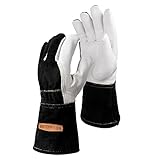
YESWELDER’s premium goatskin TIG glove is aimed at welders who are in the gloves for hours at a time and care as much about comfort over a long shift as about peak sensitivity. It suits the fabricator doing production TIG, the shop welder running thin-wall stainless all day, and anyone whose hands get hot and damp inside lesser gloves.
Key specs
- Leather: premium goatskin
- Pattern: TIG-oriented cut with attention to finger articulation
- Cuff: short gauntlet
- Process fit: TIG primary, light MIG secondary
- Price tier: premium
Comfort in a welding glove is not a soft metric. A glove that bunches at the palm, twists at the wrist, or holds sweat against the skin will have you taking it off between beads, and every removal is a chance to pick up a hot part bare-handed. The premium tier buys better pattern cutting, more consistent hide thickness, and seams placed where they do not sit under your grip.
Goatskin is the right leather for this. It is naturally more breathable than cowhide and, unusually among leathers, it tends to soften rather than stiffen when it gets damp from sweat. That combination is why goatskin dominates the TIG category. A cowhide glove that gets soaked through on a humid day will dry stiff and stay stiff; a goatskin glove comes back.
The limitation is the same as every other TIG-first glove here: short cuff, thin leather, no meaningful protection against heavy spatter or molten slag running down the arm. If your work includes overhead stick welding, this glove is a supplement, not a solution. If your work is TIG on a bench or a positioner, it is close to ideal.
Pros
- Premium goatskin gives consistent thickness across both gloves
- Breathable and comfortable for multi-hour sessions
- Softens rather than stiffens with sweat and humidity
- Good fingertip articulation for filler feed and torch control
- Durable enough to justify the price for regular TIG work
Cons
- Premium pricing for a single-process glove
- Short cuff leaves the forearm exposed
- Not rated or intended for stick or heavy MIG
- Thin leather can be cut by sharp sheet edges
Against the ARCCAPTAIN, the choice is mostly fit and cuff preference — both are premium goatskin TIG gloves with similar priorities, and the deciding factor is usually which pattern matches your hand. Against the Black Stallion Revco GM1510, the YESWELDER is the more comfort-focused glove while the Revco leans harder into fingertip touch.
6. HOVhomeDEVP MIG/Stick – Best Budget MIG and Stick Glove

The HOVhomeDEVP glove is sold as a MIG and stick glove with a standard gauntlet cuff, positioned as premium hand protection at a budget price. It suits the occasional welder, the home garage fabricator, and anyone doing torch and cutting work who needs a general-purpose leather glove rather than a TIG specialist.
Key specs
- Construction: leather welding glove
- Rated use: MIG and stick welding, torch work and cutting
- Cuff: standard gauntlet, longer than a TIG cuff
- Process fit: MIG, stick, Oxy-fuel and cutting
- Price tier: budget
The key thing to understand about a general-purpose MIG and stick glove is that it is built for a different threat than a TIG glove. TIG threatens your hand with radiant heat from a small, intense pool and with contact heat from hot metal you have just welded. MIG and stick threaten you with spatter, sparks, and molten slag that can land on the glove and stay there. Those two threats want different answers: TIG wants thin leather and feel, MIG and stick want thickness, coverage and a surface that sheds molten metal.
A budget glove in this class typically uses a split or lower-grade hide with a heavier cut. That means less sensitivity and more protection per dollar. It also means the glove will feel clumsy if you try to use it for TIG — feeding filler rod through a thick, stiff glove is genuinely difficult, and the seams can interfere with your grip on the rod.
Where this glove makes sense is as the second pair in your kit. Many welders keep one thin TIG pair and one heavier pair for everything else, and a budget MIG/stick glove is a reasonable choice for the heavier role, especially if your welding volume is low. It is also a sensible choice for torch and cutting work, where a heavier leather glove is the right call and precision is not the priority.
Pros
- Heavier leather construction suited to spatter-producing processes
- Longer gauntlet than a TIG cuff for better forearm coverage
- Versatile — works for MIG, stick, torch work and cutting
- Budget price makes it easy to keep a spare pair
- Reasonable entry point for a new welder who is not sure what they need
Cons
- Too stiff and insensitive for serious TIG work
- Budget hide selection means variable thickness and shorter life
- Less refined stitching than premium MIG gloves
- Not the best choice if TIG is your main process
Against the WZQH leather work glove, this is the more welding-specific option — the WZQH is a general leather work glove that happens to be usable for light welding, while the HOVhomeDEVP is designed around the process. Against the TICONN 16-inch, it gives up four inches of coverage and a lot of heat margin in exchange for a much lower price.
7. TICONN 16-Inch – Best Mid-Range Glove for Heavy MIG and Stick

The TICONN 16-inch leather welding glove is listed with a 1000°F heat resistance rating and is aimed at MIG and TIG work where coverage matters. Realistically it is a MIG and stick glove: 16 inches of leather is a lot of material, and it is there for a reason.
Key specs
- Overall length: 16 inches (cuff extends well past the wrist toward the elbow)
- Listed heat resistance: 1000°F
- Material: leather
- Rated processes: MIG, TIG, stick
- Price tier: mid-range
Sixteen inches is the longest common welding glove length, and it exists because of overhead and out-of-position work. When you weld above your head, spatter and slag fall. A 4-inch cuff gives them a clear path to your forearm; a 16-inch glove reaches close to the elbow crease, and with a jacket sleeve overlapping it you can get five or six inches of double coverage where the two meet.
The 1000°F figure needs a careful reading. That is a contact-heat rating — the temperature the leather can be touched to briefly without failing — not a statement about radiant heat. An arc column runs far hotter than any leather can survive, but you are never in contact with it; what reaches your glove is a brief burst of radiant energy and a few sparks. The rating tells you the leather resists hot contact well, not that you can hold a hot part.
What 16 inches costs you is dexterity. Extra leather at the cuff is manageable — it folds or slides over a sleeve. But gloves in this class generally use heavier hides and fuller cuts, so the palm is thicker than a TIG glove and the fingers less articulate. For running beads on thick plate, that is a fair trade. For feeding 0.035-inch filler into a root gap, it is not.
Pros
- 16-inch length gives real forearm and lower-arm coverage
- 1000°F listed contact-heat resistance is at the top of the common range
- Long cuff overlaps a jacket sleeve for double coverage
- Suitable for MIG, stick and heavier TIG work
- Mid-range pricing for a large, heavy glove
Cons
- Reduced dexterity compared with any short-cuff TIG glove
- The long cuff can catch on fixtures and workpiece edges
- Heavier and warmer to wear than a 4-inch cuff glove
- Overkill for bench TIG on thin material
Against the TOPDC 16-inch, the two are very similar in concept — 16-inch leather, high listed heat resistance — and the difference comes down to fit and cuff construction rather than capability. Against the Caiman, the TICONN is the protection-first choice and the Caiman is the versatility-first choice. If you do any overhead work at all, the TICONN is the safer pick.
8. WZQH Leather Work Glove – Best Budget Entry-Level Glove

The WZQH leather work glove is a general-purpose leather glove sold for gardening and welding among other tasks, offered in size S. It is not a purpose-built welding glove, and understanding that is the whole point of this entry.
Key specs
- Type: general leather work glove
- Stated uses: gardening, welding and general tasks
- Size: Small
- Colour: coffee grey
- Price tier: budget
A crossover glove is a different product from a welding glove, and the differences are structural rather than cosmetic. Welding gloves are cut longer at the cuff, stitched with heat-tolerant thread, and shaped so the palm and fingers can grip a torch or electrode holder. Work gloves are cut for general tasks: shorter cuffs, thread chosen for strength and cost rather than heat, and a pattern optimised for gripping tools and garden implements.
That does not make it useless. For very light welding — a few tack welds, a repair job on a gate, occasional MIG on thin material at low amperage — a decent leather work glove will get you through, and it will also be the glove you reach for when you are grinding, handling hot metal briefly, or doing yard work. As a first pair for someone who is not yet sure how much welding they will do, it is a defensible way to spend very little.
What you should not do is rely on it for anything hot. The seams are the weak point: if the thread is not aramid, a spatter burst that lands on a seam can burn through the stitching, and a welding glove with a failed seam is finished. The cuff is short, so the forearm is exposed. And the leather is generally cut for durability against abrasion rather than against heat, which is a different property.
Pros
- Very low cost, useful as a first glove or a spare
- Doubles as a general work and garden glove
- Leather construction gives basic abrasion and light-heat protection
- Available in smaller sizes that welding-specific gloves often skip
Cons
- Not a purpose-built welding glove — shorter cuff, no stated heat rating
- Thread type unspecified, so seam durability under spatter is unknown
- No forearm coverage
- Not appropriate for stick welding or high-amperage MIG
Against the HOVhomeDEVP, the WZQH is the broader-use glove and the HOVhomeDEVP is the more welding-focused one. Against the IRONCAT 6141, it is not a comparison at all — the IRONCAT is a purpose-built TIG glove with Kevlar thread, and it is worth the small extra cost if welding is the actual job.
9. TOPDC 16-Inch – Best Mid-Range Glove for Hot, High-Amperage Work

The TOPDC 16-inch welding glove is listed with a 932°F heat resistance rating and is sold for MIG and stick work. Like the TICONN, it is a coverage-first design; unlike a TIG glove, its whole purpose is to keep heat and molten metal away from your arm rather than to transmit feel to your fingertips.
Key specs
- Overall length: 16 inches
- Listed heat resistance: 932°F (equivalent to 500°C)
- Material: leather
- Rated processes: MIG, stick
- Price tier: mid-range
932°F is 500°C, which is a meaningful number in glove standards. Under the EN 407 thermal test framework, contact heat is graded from level 1 at 100°C up to level 4 at 500°C. A glove that states 932°F is therefore claiming the top contact-heat band — it can be touched to a 500°C surface for the specified short duration without igniting or transmitting damaging heat. That is a genuinely high rating for leather, and it is the reason 932°F and 1000°F appear on so many heavy welding gloves: they are the practical ceiling for the material.
What those numbers do not cover is convective and radiant heat, which are the dominant threats in stick welding. A stick arc is a sustained, intense source, and a glove that shrugs off a 500°C touch can still get uncomfortably hot after thirty seconds of continuous welding close to the arc. This is why duty cycle matters more than the rating for heavy work: short beads with a pause let the leather shed heat, while long continuous runs build it up.
Practically, this glove suits high-amperage MIG on thick material and stick welding where slag is flying. The long cuff is the main safety feature, and the heavier leather gives you time to notice heat before it becomes a burn. It is a poor choice for thin-section TIG, where the thickness and length will both work against you.
Pros
- 932°F contact-heat rating corresponds to the top standard band
- 16-inch length protects the forearm during overhead and vertical work
- Heavier leather gives warning time before heat reaches the skin
- Well suited to stick welding and high-amperage MIG
- Mid-range price for a large, high-coverage glove
Cons
- Contact-heat rating does not describe radiant heat performance
- Long cuff can snag on clamps, fixtures and workpiece edges
- Thick leather limits filler and torch control — not a TIG glove
- Hot to wear in summer or in a confined space
Against the RAPICCA 16-inch, this is a near-equivalent proposition with the same length and the same 932°F class rating; the deciding factor is fit and how the cuff is finished. Against the Black Stallion GM1611-WT, the TOPDC gives up palm reinforcement and hide quality but costs considerably less.
10. Black Stallion GM1611-WT – Best Premium MIG Glove with Reinforced Palm

The Black Stallion GM1611-WT is a top-grain cowhide MIG glove with a reinforced patched palm and thumb, in a white and tan colourway. It is built for welders whose gloves fail in the palm, and it is the pick for production MIG work where a pair has to survive week after week.
Key specs
- Leather: top-grain cowhide
- Reinforcement: patched palm, thumb and wear zones
- Pattern: MIG-oriented cut with a wing-style thumb
- Cuff: gauntlet, longer than a TIG cuff
- Process fit: MIG primary, stick acceptable
- Price tier: premium
Reinforced patches are not decoration. In MIG welding, the palm and the thumb crotch are where gloves fail first, because that is where the heat from the gun, the spatter that rolls off the workpiece, and the friction of dragging your hand across plate all converge. A glove with an unreinforced palm wears through in the middle of the palm, usually within a few weeks of daily production work. Adding a second layer of leather over that zone roughly doubles the time before it fails.
Top-grain cowhide is the right leather for the job. It is less tactile than goatskin but more abrasion-resistant and it holds up better against the sharp edges of cut plate, which is where thin TIG leather gets destroyed. Cowhide also tolerates higher radiant heat loads before it starts to harden and crack, which matters if you are running long beads close to the glove.
The cost is feel. A cowhide MIG glove is not something you would want to feed filler rod in, and it is not intended for that. What it is intended for is pulling the trigger, steadying the gun with your off hand, and protecting both hands while you do it for eight hours. For that job, the extra stiffness is irrelevant.
Pros
- Reinforced palm and thumb address the most common failure points
- Top-grain cowhide resists abrasion and sharp edges well
- Handles sustained radiant heat better than goatskin or kidskin
- Built for production MIG volumes rather than occasional use
- Longer gauntlet cuff for forearm coverage
Cons
- Premium price, justified mainly by high-volume users
- Cowhide is stiff and low on feel compared with goatskin
- Reinforcement patches add bulk at the palm
- Not suitable for precision TIG work
Against the TOPDC and RAPICCA 16-inch gloves, the Black Stallion gives up cuff length — those reach further up the arm — but wins on hide quality and palm reinforcement. If your failure mode is palm wear rather than forearm spatter, this is the better buy. If you weld overhead, go with the longer glove.
11. RAPICCA 16-Inch – Best Mid-Range Glove for Spatter-Heavy Stick and MIG
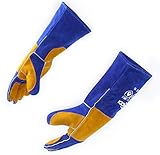
The RAPICCA 16-inch welding glove is a fireproof leather gauntlet with a 932°F listing, sold in blue, aimed at MIG and stick work in high-spatter conditions. It suits welders doing structural, repair and field work where slag and spatter are a constant rather than an occasional nuisance.
Key specs
- Overall length: 16 inches
- Listed heat resistance: 932°F (500°C class)
- Material: leather, blue finish
- Rated processes: MIG, stick, general welding
- Price tier: mid-range
The phrase “fireproof leather” in a listing is best read as “leather that will not sustain combustion from a spark” rather than “leather that cannot be damaged by heat.” Leather is a natural material; prolonged exposure to high heat causes it to shrink, harden and eventually crack. What a heavy glove buys you is time — enough time for a spatter ball to land, sit for a moment, and roll off before it transfers damaging heat to your skin.
Sixteen-inch gauntlets are also the right answer for vertical and overhead stick work, where gravity carries slag down the rod and along your arm. If you have ever had a piece of slag find its way into a short-cuff glove, you know that the difference between a 4-inch and a 16-inch cuff is not a matter of degrees. It is the difference between coverage and exposure.
The trade-off is the same as with the other 16-inch gloves here: reduced dexterity and a cuff that can catch on things. There is also a practical point about fit — a long gauntlet that is too loose will slide and bunch, and one that is too tight will restrict wrist movement. Getting the size right matters more on a 16-inch glove than on a 4-inch one, because there is more leather to be wrong.
Pros
- Full 16-inch coverage for overhead, vertical and field work
- 932°F listed heat resistance at the top of the common leather range
- Heavy leather absorbs spatter and sheds sparks effectively
- Straightforward, durable construction suited to rough environments
- Mid-range price for a large protective glove
Cons
- Low dexterity — not suitable for TIG filler feed
- Long cuff can snag on fixtures and equipment
- Warm to wear in hot conditions
- Fit is more critical than on short-cuff gloves
Against the TOPDC 16-inch, this is a very close comparison with identical length and rating class; choose on fit and cuff comfort. Against the Black Stallion GM1611-WT, the RAPICCA is the longer, more coverage-oriented glove while the Black Stallion is the better-built glove
