What's inside
- Start with the load, not the cart dimensions
- How to size a welding cart
- Concrete cart size comparison
- Choose wheels for your floor and doorway
- Stability and cylinder restraint come first
- A simple sizing calculation
- Decision matrix for beginner buyers
- Assembly details that affect the buying decision
- Ownership realities: what wears first
- Final buying checklist
- Start with the load, not the cart dimensions
- How to size a welding cart
- Concrete cart size comparison
- Choose wheels for your floor and doorway
- Stability and cylinder restraint come first
- A simple sizing calculation
- Decision matrix for beginner buyers
- Assembly details that affect the buying decision
- Ownership realities: what wears first
- Final buying checklist
As an Amazon Associate I earn from qualifying purchases. This post may contain affiliate links at no extra cost to you.
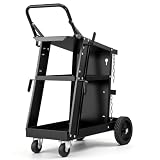
The best welding cart for a beginner is one that carries your welder, gas cylinder, leads, and accessories with at least 20% spare capacity, while keeping the cylinder upright, the wheels stable, and the whole load easy to move through your workspace.
As an Amazon Associate we earn from qualifying purchases at no extra cost to you.



What we cover
- Start with the load, not the cart dimensions
- How to size a welding cart
- Concrete cart size comparison
- Choose wheels for your floor and doorway
- Stability and cylinder restraint come first
- A simple sizing calculation
- Decision matrix for beginner buyers
- Assembly details that affect the buying decision
- Ownership realities: what wears first
- Final buying checklist
Start with the load, not the cart dimensions
A cart that looks large enough may still be unsuitable if its shelves are too shallow, its cylinder tray is undersized, or its handle cannot clear your welding leads. Before comparing models, list everything the cart must carry:
- The welder and its power cord
- A shielding-gas cylinder, regulator, and hose
- Ground clamp, electrode holder, MIG gun, or TIG torch
- Welding cables and extension cords
- Wire spool, electrodes, tungsten, nozzles, tips, and other consumables
- Gloves, helmet, brush, pliers, magnets, and basic hand tools
Measure the equipment as it will actually be stored. Include protruding knobs, cable connectors, regulator fittings, and the height of a mounted gas cylinder. Then add clearance rather than choosing a shelf that fits exactly.
How to size a welding cart
Welder shelf size
For a compact inverter welder, a shelf around 18 to 24 inches wide and 12 to 16 inches deep is usually sufficient. A larger MIG machine with a built-in wire compartment may need approximately 24 to 30 inches of width and 16 to 20 inches of depth. A TIG welder with a foot pedal, water cooler, or separate gas-flow equipment can require a wider two- or three-shelf cart.
Allow at least 2 inches of clearance around the machine where possible. This makes it easier to lift the welder off the cart and leaves room for ventilation. Do not block cooling fans with a side panel, storage bin, or tightly wrapped cable.
Cylinder capacity
Gas cylinders vary by supplier and region, so check the actual diameter and height stamped or listed for your cylinder. As a practical guide, a cart intended for a common medium cylinder should support at least 9 to 10 inches of diameter and 36 to 42 inches of height. A larger cart for a cylinder around 12 inches in diameter may need a tray at least 13 inches wide.
The cylinder tray should have a raised lip or retaining ring. A flat shelf is not enough: a cylinder can roll or slide during a turn even when the cart is stationary on level ground. The retaining chain or strap should wrap around the upper half of the cylinder and attach to the cart frame, not merely to a thin sheet-metal panel.
Cable and accessory storage
Look for a side hook, rear hanger, or dedicated cable rack. A single 4-inch hook may hold short leads but becomes crowded with a MIG gun, ground cable, and power cord. For longer cables, choose two hooks or a rack at least 8 inches wide.
Small shelves, a drawer, or a lipped tray are useful for contact tips and hand tools. Open wire baskets improve visibility, while enclosed drawers protect consumables from grinding dust. Avoid storing abrasive discs or sharp tools where they can rub against torch hoses.
Concrete cart size comparison
| Cart type | Typical shelf size | Suggested cylinder size | Typical load rating | Best use |
|---|---|---|---|---|
| Compact two-wheel cart | 18–22 in. wide × 12–16 in. deep | Up to about 9 in. diameter | 150–250 lb | Small inverter welder and occasional home projects |
| Three-shelf shop cart | 24–30 in. wide × 16–20 in. deep | Up to about 12 in. diameter | 250–400 lb | MIG or TIG machine with accessories and medium cylinder |
| Heavy-duty four-wheel cart | 28–36 in. wide × 20–24 in. deep | One large or two smaller cylinders | 400–600 lb | Frequent fabrication, multiple processes, or shop use |
These figures are comparison targets rather than universal standards. The cart’s rated capacity includes the cylinder, welder, tools, and accessories, not just the machine. A cart rated for 300 pounds should not routinely operate close to 300 pounds, particularly on uneven floors.
Choose wheels for your floor and doorway
Wheel diameter affects both stability and effort. Wheels around 3 inches in diameter work well on a smooth concrete floor, but 4- to 6-inch wheels roll more easily over thresholds, welding-cable loops, and minor floor damage. Larger wheels also reduce the chance of the front edge catching when you push the cart.
Check the wheel width as well as diameter. Narrow caster wheels can sink into cracks or gravel. For a home garage, two fixed wheels and two locking swivel casters provide a useful compromise between tracking and maneuverability. Four swivel casters turn tightly, but a tall cart can feel less predictable when pushed sideways.
Measure the narrowest doorway and compare it with the cart’s overall width, including handles and cylinder brackets. A cart that fits between shelves may still fail at a doorway because the cylinder extends beyond the frame.
Stability and cylinder restraint come first
A tall gas cylinder raises the cart’s center of gravity. Stability depends on more than the stated weight capacity, so inspect the frame and base:
- Prefer a wide base with the cylinder positioned low and close to the center.
- Choose a steel frame that does not visibly flex when the handle is lifted.
- Look for a deep tray with a raised edge rather than a narrow circular ring alone.
- Use two restraint points where possible: a lower chain or strap and an upper chain or strap.
- Confirm that the cylinder cannot contact a wheel, caster, brake lever, or sharp frame edge.
- Use the caster brakes when parked, but do not treat brakes as a substitute for restraints.
The restraint must remain fastened whenever the cylinder is on the cart. Keep the cylinder upright and protect the valve and regulator from impact. Follow the cylinder supplier’s handling instructions, especially when moving over ramps or uneven ground.
A simple sizing calculation
Suppose your machine measures 20 inches wide by 14 inches deep, your regulator and hose need another 3 inches at the rear, and you want 2 inches of side clearance. The minimum useful shelf width is:
20 + 2 + 2 = 24 inches
The required depth is approximately:
14 + 3 + 2 = 19 inches
That means a nominal 24-by-20-inch shelf is a safer choice than a 20-by-16-inch shelf, even if the welder technically fits on the smaller one. If your loaded equipment weighs 180 pounds, a cart rated for 225 pounds provides only 25% spare capacity, which is reasonable for a smooth floor. For frequent movement over thresholds, choosing a 300-pound rating gives a more comfortable margin.
Decision matrix for beginner buyers
| Your situation | Recommended configuration | Why | General market range |
|---|---|---|---|
| Low budget, occasional projects, compact inverter | Two shelves, two fixed wheels, two locking casters, 150–250 lb rating | Enough capacity without paying for unused storage | About $60–$130 |
| Beginner using MIG regularly | Three shelves, 4-inch wheels, cable hooks, 250–400 lb rating | Provides room for wire, tools, and a medium cylinder | About $120–$250 |
| Limited garage space | Narrow frame under 24 inches wide, vertical cylinder mount, locking casters | Improves storage and doorway clearance | About $100–$220 |
| Frequent fabrication or multiple processes | Wide four-wheel frame, 400 lb or higher rating, two-cylinder capability | Reduces cable clutter and avoids replacing the cart later | About $220–$500 |
Assembly details that affect the buying decision
Many carts arrive as bolt-together kits. Assembly is usually manageable, but inspect the instructions before buying if you are new to shop equipment. A good design uses captive nuts, clearly labeled hardware, and accessible bolt heads. Poorly arranged fasteners may require holding a wrench inside a narrow frame while tightening from the outside.
Allow time to square the frame before final tightening. A twisted frame can make one caster sit off the floor, causing rocking and uneven steering. After assembly, tighten all fasteners again after the first few uses. Vibration from moving the cart and welding equipment can loosen hardware.
Check whether the supplied caster bolts match the frame thickness and whether the handle can be installed on either side. A reversible handle is valuable when the cart must be parked beside a wall. If the cart has a powder-coated finish, avoid overtightening until the frame is aligned; crushed coating can expose bare steel and encourage rust.
Ownership realities: what wears first
Casters and wheel bearings usually show wear before the steel frame. Grinding dust can enter bearings, while heavy loads can flatten inexpensive wheels. Keep the wheel paths swept, inspect fasteners periodically, and replace a damaged caster rather than continuing with a leaning cart.
Cylinder chains can stretch or rust, especially near wet floors. Replace a questionable chain or strap promptly. Cable hooks may bend when overloaded, and thin shelf lips can deform if a heavy machine is dragged across them. Lift equipment onto the shelf instead of sliding it over the edge.
Do not use the cart as a general storage rack for flammable liquids, loose grinding discs, or unrelated heavy tools. Excess weight at the top makes the cart less stable. Keep ventilation openings on the welder clear, and route leads so they cannot catch under a wheel.
Final buying checklist
- Measure the welder, cables, regulator, cylinder, and doorway before ordering.
- Select a shelf with roughly 2 inches of clearance on each side where practical.
- Choose a load rating at least 20% above your expected total load.
- Confirm the cylinder tray diameter, height, retaining lip, and chain or strap locations.
- Check wheel diameter, width, swivel arrangement, and brake access.
- Look for cable hooks and accessory storage that match your actual equipment.
- Read the assembly instructions and verify that replacement casters and restraints are available.
- After assembly, test the cart empty, then loaded, before moving it near thresholds or ramps.
For most beginners, a three-shelf steel cart with a 250- to 400-pound rating, 4-inch wheels, a deep cylinder tray, two restraints, and dedicated cable hooks is the most flexible choice. A smaller two-shelf cart is sensible when space and budget are tight, while frequent shop users should buy a wider heavy-duty frame rather than trying to make a compact cart carry equipment it was never designed to support.