What's inside
- What “MIG” means
- How the wire-feed process works
- Shielding gas: the part that makes MIG different
- MIG, flux-core, or stick: which process fits?
- Buying criteria that matter more than the maximum amp number
- A practical choice by situation
- Setup steps that prevent common failures
- Ownership costs and what wears first
- Bottom line
- Related Guides
- What “MIG” means
- How the wire-feed process works
- Shielding gas: the part that makes MIG different
- MIG, flux-core, or stick: which process fits?
- Buying criteria that matter more than the maximum amp number
- A practical choice by situation
- Setup steps that prevent common failures
- Ownership costs and what wears first
- Bottom line
- Related Guides
As an Amazon Associate I earn from qualifying purchases. This post may contain affiliate links at no extra cost to you.
A MIG welder is a machine that feeds a continuously melting wire electrode through a gun while an electric arc joins the wire to the workpiece, usually with shielding gas protecting the molten weld pool from contamination.
If you are comparing welding machines in 2026, the important question is not simply “how many amps does it have?” It is whether the machine suits your material thickness, power supply, workshop space, and willingness to manage gas cylinders and consumables. MIG is usually the easiest process for beginners, but flux-core and stick welding can be better choices in specific conditions.
As an Amazon Associate we earn from qualifying purchases at no extra cost to you.


What we cover
- What “MIG” means
- How the wire-feed process works
- Shielding gas: the part that makes MIG different
- MIG, flux-core, or stick: which process fits?
- Buying criteria that matter more than the maximum amp number
- A practical choice by situation
- Setup steps that prevent common failures
- Ownership costs and what wears first
- Bottom line
- Related Guides
What “MIG” means
MIG stands for metal inert gas. In strict terminology, a machine using carbon-dioxide or oxygen-containing shielding gas is technically a MAG welder, but “MIG” is the common retail term for wire-feed welding machines.
The machine performs four jobs at once:
- It supplies welding current at a controlled voltage.
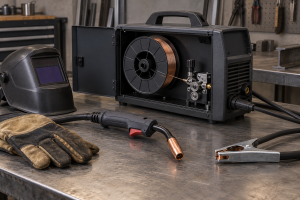
- It pushes a spool of wire through a liner and gun.
- It creates an arc between the wire and the metal.
- It releases shielding gas around the arc to keep oxygen and nitrogen away from the weld.
The wire is both the electrode and, in most applications, the filler metal. Because the wire feeds continuously, you can weld longer seams without stopping to replace a rod, as you would with stick welding.
How the wire-feed process works
When you pull the MIG gun trigger, the machine typically starts feeding wire, energizes the contact tip, and opens the gas valve. The wire touches or nearly touches the workpiece, creating an arc. The arc melts the wire and a small area of the base metal. As you move the gun, the molten metal cools behind the arc and forms the weld bead.
Wire speed controls how much electrode enters the arc. Voltage controls the arc length and strongly affects bead shape, penetration, and spatter. These controls are linked: increasing wire speed normally requires more voltage, while changing wire diameter or material thickness requires a new starting combination.
Most MIG machines use either short-circuit transfer for thinner steel or spray and globular transfer at higher power. Short-circuit transfer is practical on 120- or 230-volt hobby machines. Spray transfer produces a smoother, higher-deposition weld but generally requires more amperage and an argon-rich gas mixture, making it less suitable for thin sheet metal.
Shielding gas: the part that makes MIG different
Solid-wire MIG requires a separate gas cylinder, regulator, and hose. Common choices are:
- 75% argon/25% carbon dioxide: a versatile blend for mild steel, with relatively low spatter and a smooth arc.
- 100% carbon dioxide: inexpensive and capable of deeper penetration, but usually produces more spatter and a harsher arc.
- Argon-rich blends: useful for aluminum and spray-transfer steel, depending on the machine and application.
A typical gas flow setting is about 20–30 cubic feet per hour (CFH) indoors with limited drafts. Excessive flow does not improve protection; it can create turbulence that draws air into the weld. A small 20-cubic-foot cylinder may last roughly 30–60 minutes of actual arc time at common flow rates, while a 40-cubic-foot cylinder may provide about 1–2 hours. Actual duration is lower if you spend time repositioning, purging the hose, or welding outdoors.
Gas shielding is easily disrupted by wind, fans, dirty steel, or a gun held too far from the work. If you need to weld outside, flux-core wire is often more practical.
MIG, flux-core, or stick: which process fits?
| Process | Typical useful thickness | Power and setup | Best use | Main limitations |
|---|---|---|---|---|
| Solid-wire MIG | Approximately 1/16–1/4 inch steel on compact machines; more with higher output | 120 or 230 volts; gas cylinder; solid wire | Clean shop work, automotive panels, brackets, general mild steel | Wind-sensitive; steel must be reasonably clean; gas adds cost and storage needs |
| Gas-shielded flux-core | Approximately 1/8–1/2 inch, depending on output and passes | Usually 230 volts for heavier work; gas may be used | Outdoor work, structural repairs, thicker steel | Slag removal; more smoke and spatter; less convenient on thin sheet |
| Self-shielded flux-core | Approximately 1/8–1/2 inch, depending on wire and machine | No gas cylinder; correct polarity is essential | Farm repairs, fencing, outdoor fabrication, windy locations | More cleanup; wire is moisture-sensitive; rougher appearance |
| Stick | Approximately 1/8 inch and up; excellent for heavy sections | 230 volts is common; no gas or wire feeder | Outdoor repairs, rusty steel, thick plate, simple durable equipment | Slower; rods require technique; difficult on thin sheet |
Many shoppers should choose a dual-process machine rather than a basic MIG-only unit. A machine offering solid-wire MIG, self-shielded flux-core, and stick gives you more flexibility, but check whether the advertised output is continuous-duty output or only a short peak rating.
Buying criteria that matter more than the maximum amp number
Input power
A 120-volt machine is convenient for a garage or household circuit and is often adequate for sheet metal and light brackets. It may be limited to roughly 90–140 amps of usable output. A 230-volt machine commonly reaches 180–250 amps and is the better choice for repeated work on 1/4-inch steel or thicker material. Confirm that your workshop circuit can support the machine; an adapter cannot turn a 120-volt circuit into a 230-volt supply.
Duty cycle
Duty cycle describes how long a welder can operate during a 10-minute period at a specified output. For example, a 20% duty cycle at 180 amps means about two minutes of welding followed by eight minutes of cooling at that rated output. A 60% duty cycle allows approximately six minutes of arc time. For occasional repairs, a low duty cycle may be acceptable. For production or long seams, it becomes a major productivity limit.
Wire diameter and spool capacity
Common solid-wire sizes include 0.023, 0.030, and 0.035 inch. Smaller wire gives better control on thin sheet; 0.030 inch is a useful general-purpose size; 0.035 inch suits higher output and thicker steel. Check whether the machine accepts 4-, 8-, or 12-inch spools. A 4-inch spool saves space but costs more per pound and requires more frequent changes.
Controls and usability
At minimum, look for separate voltage and wire-speed adjustment, polarity selection, a clear chart for wire type and thickness, and a proper metal drive system. An inductance control can alter arc softness and spatter. A spool-gun connection is useful if you plan to weld aluminum, because soft aluminum wire can jam in a long standard liner.
Auto-setting modes can provide a helpful starting point, but they do not replace correct surface preparation, gun angle, travel speed, or fit-up. Prefer a machine that still allows manual adjustment.
A practical choice by situation
| Your situation | Best starting choice | Why |
|---|---|---|
| Low budget, indoor repairs, mostly 16-gauge to 1/8-inch steel | 120-volt solid-wire MIG | Lowest setup burden and good control on thin material |
| Beginner who wants one machine for varied household projects | 120/230-volt multi-process welder | Offers MIG now and stick or flux-core later |
| Frequent work on 1/4-inch steel or long welds | 230-volt MIG or multi-process machine | More amperage, better duty cycle, and less circuit strain |
| Outdoor work or windy conditions | Self-shielded flux-core or stick | No dependence on a stable shielding-gas cloud |
| Very dirty steel, farm equipment, or thick repairs | Stick or flux-core | More tolerant of less-than-perfect surfaces and outdoor conditions |
| Thin automotive panels | Low-amperage solid-wire MIG | Fine wire and adjustable settings reduce burn-through risk |
Setup steps that prevent common failures
- Identify the metal and thickness. Select compatible wire, polarity, and a starting voltage and wire speed from the machine chart.
- Prepare the joint. Remove paint, rust, oil, and galvanizing near the weld. Contamination causes porosity and weak, irregular beads.
- Fit the consumables. Match the drive-roll groove, liner, contact tip, and wire diameter. Install the correct polarity for the wire type.
- Set gas flow if using solid wire. Check for leaks, keep the cylinder upright, and avoid drafts. Do not use oxygen as shielding gas.
- Make a test weld on matching scrap. Listen for a steady arc and inspect penetration, bead width, spatter, and burn-through before welding the actual part.
- Clean between passes. Remove flux slag completely before adding another pass. Solid-wire MIG does not normally create a slag layer, but spatter still needs removal.
A common troubleshooting clue is useful: a popping, stuttering arc can indicate incorrect wire speed, poor grounding, a blocked tip, or insufficient gas coverage. Bird-nesting near the drive rolls often means excessive tension, a worn liner, the wrong drive-roll setting, or a kinked gun cable.
Ownership costs and what wears first
The welding machine itself may last for years, but the gun consumables usually need attention first. Contact tips wear from heat and arc starts; nozzles accumulate spatter; liners collect dust and can cause intermittent feeding. Keep spare tips and nozzles in the sizes you use most. Replace a liner when cleaning no longer restores smooth feeding.
Solid MIG wire is commonly sold in 2- to 12-pound spools, while flux-core wire is often more expensive per pound. A rough consumable calculation illustrates the difference: if a 10-pound spool costs $45 and only about 60% becomes deposited metal after starts, stops, and trimming, the effective wire cost is approximately $45 ÷ 6 pounds, or $7.50 per deposited pound. Gas, electricity, tips, and discarded wire add to the real cost.
Store wire sealed and dry. Moisture can cause porosity, unstable feeding, and brittle flux-core performance. Clean the machine’s ventilation openings periodically, keep the ground clamp faces bright, and avoid coiling the gun cable tightly. These small maintenance habits often improve weld consistency more than buying a machine with a higher peak amperage.
Bottom line
Choose solid-wire MIG for the cleanest, most beginner-friendly indoor work; flux-core for windy locations and heavier outdoor repairs; and stick for rugged, simple welding on thick or dirty steel. For most first-time buyers, a 120/230-volt machine with adjustable voltage, reliable wire feeding, a useful duty cycle, and support for both solid and flux-core wire offers the best balance. Match the welder to the material and circuit you actually have, rather than paying for an output rating you cannot use.