What's inside
As an Amazon Associate I earn from qualifying purchases. This post may contain affiliate links at no extra cost to you.
Yes, an angle grinder can cut wood, but only with a wood-rated accessory and careful control; for most straight cuts, a circular saw or jigsaw is the safer and more predictable choice. The answer to “can an angle grinder cut wood?” is therefore conditional: the grinder itself has enough power, but its high speed, short body, exposed disc, and aggressive torque make wood cutting less forgiving.
As an Amazon Associate we earn from qualifying purchases at no extra cost to you.


What we cover
Which wood-cutting discs are appropriate?
Do not fit an ordinary metal-cutting abrasive disc and expect it to behave like a saw. Abrasive discs can scorch wood, clog with resin, break under side loading, and produce a rough, difficult-to-control kerf. They are also a poor choice for timber because they remove material by grinding rather than by producing a stable saw cut.
Use only an accessory whose manufacturer explicitly rates it for wood and for your grinder’s diameter, arbor, and maximum revolutions per minute. The main types are:
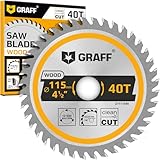
- Thin, toothed wood-cutting discs: These use carbide teeth or a toothed steel design. They are intended for limited cutting in clean timber, plywood, or boards, but their exposed teeth can grab suddenly.
- Carving and shaping discs: These are better suited to shallow cuts, notches, rough sculpting, and removing small amounts of wood. They are not a replacement for a circular-saw blade.
- Wood-shaping discs with a guarded cutting edge: Some designs surround much of the cutting area, improving control during carving. They still require the exact guard and operating method specified by the maker.
Avoid improvised chainsaw-style attachments, loose sanding flaps used as cutting tools, damaged discs, and generic “universal” blades with no clear wood rating. Never modify a disc, remove teeth, enlarge the arbor hole, or use a disc whose maximum RPM is below the grinder’s no-load speed.
Angle grinder versus circular saw for wood
An angle grinder is compact and versatile, but a circular saw is designed around wood cutting. The differences matter more than the raw motor power.
| Characteristic | Typical 115/125 mm angle grinder | Typical 165/190 mm circular saw | Practical consequence |
|---|---|---|---|
| No-load speed | About 9,000–12,000 rpm | About 4,000–6,000 rpm | The grinder reaches much higher surface speed and reacts more abruptly to a grab. |
| Typical cutting depth | Roughly 20–35 mm, depending on disc and guard | About 55–65 mm at 90 degrees | A circular saw handles ordinary framing timber in one pass; a grinder usually does not. |
| Cut guidance | Usually hand-guided, with no base plate | Base plate, fence markings, and bevel adjustment | The circular saw holds a straighter, more repeatable line. |
| Blade or disc diameter | 115 or 125 mm is common | 165 or 190 mm is common | Larger saw blades provide more depth without burying the tool. |
| Best use | Short notches, rough trimming, carving, and access-limited work | Long crosscuts, rip cuts, sheet goods, and repeated work | Choose the circular saw when accuracy, speed, or volume matters. |
The grinder’s lack of a broad shoe is the key control disadvantage. A circular saw rests on the workpiece and keeps the blade aligned. With a grinder, your wrists and arms maintain the angle, depth, and direction. That can work for a short notch, but it becomes tiring and unstable over a long cut.
Kickback: why the grinder feels less forgiving
Kickback occurs when the cutting accessory catches, stalls, or becomes pinched and the tool is driven back toward the operator. Wood can cause this when a kerf closes, when a knot catches a tooth, or when the disc enters at an angle.
A circular saw can kick back too, especially during a rip cut, but its shoe, blade guard, handle position, and controlled cutting direction give the operator more support. Many circular saws also include a riving feature or other design elements that help keep the kerf from closing around the blade.
An angle grinder is easier to twist because it has no supporting base. A toothed disc can bite into the timber and rotate the tool before you can release the switch. The risk increases when:
- the cut is deep or long;
- the timber is not clamped and moves during cutting;
- the disc is forced sideways;
- the workpiece is supported at both ends but unsupported near the cut, allowing the kerf to pinch;
- you cut near a knot, nail, screw, staple, or hidden metal fastener;
- you use a disc that is too large, damaged, or not rated for the grinder.
When can you use an angle grinder to cut wood?
Using an angle grinder can make sense when the cut is short, rough, and difficult to reach with a larger saw. Examples include trimming a small protrusion, opening a shallow notch for a repair, shaping a rough timber sculpture, or cutting a small piece of clean, securely clamped softwood outdoors.
It is less suitable for finish carpentry, cabinetry, flooring, roof framing, repeated construction cuts, or any job where the cut must be straight and clean. It is also a poor choice in dusty indoor areas where the motor can ingest fine wood dust and where sparks from a hidden nail could create a fire hazard.
| Your situation | Better choice | Reason |
|---|---|---|
| One rough notch, limited access, already own a grinder | Wood-rated grinder accessory, with caution | Convenient for a short cut when precision is modest. |
| Several straight cuts in 2×4-size timber | 165 or 190 mm circular saw | Greater depth, better guidance, and faster repeatability. |
| Curved cut in plywood or thin board | Jigsaw | The narrow blade turns more predictably and leaves a controllable cut line. |
| Fine trim or a small indoor adjustment | Oscillating multi-tool | Lower exposed cutting action and better control in confined spaces. |
| Frequent or professional wood cutting | Dedicated saw matched to the material | Lower fatigue and more consistent results justify the extra tool. |
How to make a short grinder cut safer
- Read both manuals. Confirm that the accessory is approved for wood, fits the spindle, and has a maximum speed at least as high as the grinder’s no-load speed. For example, a 125 mm grinder running at 11,000 rpm must not use a disc rated below 11,000 rpm.
- Inspect the timber. Remove nails, screws, staples, bark, and loose knots. Do not assume reclaimed wood is metal-free.
- Support the work correctly. Clamp it firmly and support both sides of the cut without creating a closing kerf. For a board, arrange supports so the offcut cannot fall and twist the disc.
- Install the correct guard and handle. Keep the guard between you and the cutting zone, and use the side handle in the position that gives both hands control.
- Mark a shallow starting line. Begin with a light pass rather than plunging to full depth. Let the accessory cut at its own rate; forcing it increases grabbing and heat.
- Keep the disc aligned. Cut straight into the material and never twist, lever, or use the side of a cutting disc to widen the kerf.
- Stop before the cut closes. If the timber shifts, the disc binds, or the tool begins to pull, release the trigger and wait for a complete stop before repositioning.
Wear safety glasses plus a face shield, hearing protection, appropriate respiratory protection for the dust, sturdy footwear, and close-fitting clothing. Keep bystanders away from the cutting plane. Do not wear loose gloves that can catch in rotating equipment, and do not hold the timber in your free hand.
Ownership and maintenance realities
The accessory usually wears before the grinder. Carbide teeth become dull or chipped, shaping discs lose their cutting profile, and resin can build up on the cutting surface. A dull accessory requires more force, generates more heat, and makes kickback more likely. Replace it when teeth are damaged, the disc is warped, vibration increases, or the manufacturer’s wear indicator is reached.
After dusty work, unplug a corded grinder or remove the battery from a cordless model before cleaning. Brush dust from the vents and guard, and use the cleaning method allowed by the manual. Compressed air can drive dust deeper into bearings and switches, so use it cautiously. A cordless grinder may be convenient for one or two short cuts, but a high-speed wood accessory can drain a small battery quickly; a 2.0 Ah pack may provide only a limited number of deep cuts, while a 4.0 or 5.0 Ah pack generally offers longer working time at the cost of extra weight.
Bottom line
So, can you cut wood with an angle grinder? Yes, but only for carefully chosen, short, rough work with a purpose-made, correctly rated wood accessory. For a long, straight, deep, or repeated cut, use a circular saw; for curves, use a jigsaw; and for tight indoor trimming, consider an oscillating multi-tool. If you are asking “will an angle grinder cut wood?” the technical answer is yes—the safer buying decision is often to use a tool designed specifically for the cut.