What's inside
As an Amazon Associate I earn from qualifying purchases. This post may contain affiliate links at no extra cost to you.
The best angle grinder wood blade for fast, controlled cuts is a low-tooth-count, carbide-tipped blade with a diameter matched to your grinder’s guard and spindle, while carving discs are better for shaping than making straight cuts.
For most occasional woodworking, choose a 4-1/2-inch or 5-inch wood-cutting blade with a reinforced body, limited teeth, and a maximum RPM rating at least as high as your grinder’s no-load speed. Do not treat every toothed disc sold for wood as interchangeable: blade design determines whether the tool behaves like a controlled cutter or an unpredictable grab hazard.
As an Amazon Associate we earn from qualifying purchases at no extra cost to you.



What we cover
Quick picks by cutting job
| Situation | Best blade type | Typical size | Useful cutting depth | Why it fits |
|---|---|---|---|---|
| Occasional straight cuts in softwood | Carbide-tipped, low-tooth wood blade | 4-1/2 in | About 1-1/4 in | Compact, relatively easy to control, suitable for smaller grinders |
| Deeper cuts in framing lumber | Carbide-tipped wood blade | 5 in | About 1-1/2 in | More capacity without moving to a larger grinder |
| Notches, relief cuts, and freehand shaping | Carving disc with fixed carbide teeth | 4 in to 4-1/2 in | Variable; commonly 1/2 in or less per pass | Removes material quickly while allowing curved work |
| Fine trimming and shallow detail work | Fine-tooth wood-cutting disc | 4-1/2 in | About 1 in | Cleaner edge than aggressive carving discs |
| Very clean, repeatable joinery | Purpose-built circular saw or trim saw blade | Usually larger than 5 in | Depends on saw | Better stability and depth control than an angle grinder |
Depth figures are practical approximations, not guarantees. The grinder’s guard, flange arrangement, blade construction, and the shape of the workpiece can reduce the usable depth. Always follow the blade manufacturer’s marked rating.
Tooth patterns: the most important buying decision
Limited-tooth carbide blades
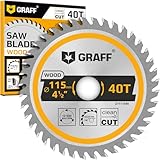
A blade with a small number of large carbide teeth, often around three to six, removes wood rapidly and leaves generous gullets for clearing chips. This pattern is useful for rough crosscuts, trimming boards, and cutting openings where speed matters more than a furniture-grade edge.
The trade-off is a more aggressive bite. Feed slowly, keep both hands on the grinder, and avoid twisting the blade in the kerf. A limited-tooth blade is usually the most practical wood blade for an angle grinder, but it is not automatically safe simply because it has carbide teeth.
Fine-tooth carbide blades
More teeth generally produce a smoother edge and a less abrupt bite, but they can load with resin and sawdust if forced through thick stock. Fine-tooth patterns are preferable for thin boards, laminate-covered panels, and trimming tasks. They are not a substitute for a table saw when you need a perfectly straight, splinter-free cut.
Carving discs and shaping wheels
Carving discs use exposed or embedded carbide cutters rather than a conventional circular saw tooth pattern. They excel at hollowing, rounding edges, rough sculpting, and making shallow relief cuts. A carving disc is the right answer when the search is for an angle grinder blade for wood shaping, but the wrong answer for long, straight cuts.
Products such as Arbortech shaping accessories and Kutzall carbide discs are examples of this category. They are specialty tools, not general-purpose replacement saw blades. Their cutting action can pull the grinder sideways, so use light passes and support the work securely.
Chain-style and highly aggressive discs
A chain-based disc can remove wood extremely quickly, but its ability to grab and climb makes it a poor general recommendation for beginners. It can also be difficult to control when the chain contacts an edge or knot. For routine cutting wood with an angle grinder, a guarded, fixed-tooth carbide blade is the more defensible choice.
4-1/2-inch versus 5-inch blades
A 4-1/2-inch blade is the common choice for compact corded grinders and many 18-volt or 20-volt cordless models. Its smaller diameter is easier to control and typically provides around 1-1/4 inches of practical cutting depth in flat stock. It is adequate for trim, pallet boards, small framing pieces, and shallow notches.
A 5-inch blade can provide roughly 1-1/2 inches of depth, depending on the guard and blade geometry. That extra quarter-inch matters when cutting nominal 2-by lumber from one side, although it may still not pass completely through true 1-1/2-inch-thick stock once the grinder is held at a safe angle.
Do not install a 5-inch disc on a grinder whose guard is rated only for 4-1/2-inch accessories. Check three details before purchase:
- Diameter: the blade must be within the grinder’s approved accessory size.
- Bore and mounting system: common grinders use a 7/8-inch bore with a suitable flange, while some accessories use threaded or proprietary mounts.
- Maximum RPM: the blade’s rating must meet or exceed the grinder’s no-load speed. A 10,000-RPM grinder requires an accessory rated for at least 10,000 RPM.
For example, a nominal 4-1/2-inch blade has a radius of 2.25 inches. In theory, that is the maximum geometric reach from the blade center, but the guard and safe cutting angle reduce the usable depth substantially. Buying by diameter alone therefore overstates capacity.
Kickback control and compatibility
Kickback occurs when the cutting edge catches, stalls, or climbs out of the material. Wood knots, nails, screws, warped boards, and closing kerfs all increase the risk. A blade with a reduced number of teeth and an anti-kickback design can help, but no blade eliminates the hazard.
- Use the grinder’s correct wheel guard and position it between your body and the exposed cutting area.
- Keep the grinder’s side handle installed and use two hands.
- Clamp the work so the kerf cannot close on the blade.
- Cut with the blade’s lower or forward section as directed by the accessory instructions; do not bury the upper quadrant.
- Let the blade reach full speed before contact and use light, steady feed pressure.
- Inspect reclaimed lumber for nails, screws, staples, and embedded grit before cutting.
A variable-speed grinder is not automatically safer. Lower speed may suit some shaping accessories, but only use a reduced setting when the blade manufacturer permits it. Never exceed the accessory’s maximum speed.
Decision matrix for buying a wood blade for an angle grinder
| Your priority | Choose | Avoid |
|---|---|---|
| Lowest initial cost | One 4-1/2-inch limited-tooth carbide blade | Buying a multi-disc carving kit for occasional cuts |
| New to grinder woodworking | Small diameter, fixed-tooth, anti-kickback design | Chain-style or very aggressive exposed cutters |
| Frequent rough carpentry | 5-inch carbide blade with replaceable or durable teeth | Fine-tooth blades used in thick, resinous stock |
| Freehand sculpting | Carbide shaping disc with a defined cutting profile | Standard saw blade for deep curved cuts |
| Clean furniture work | Fine-tooth blade for rough sizing, followed by a saw or router | Using an angle grinder as the final edge-making tool |
Setup and cutting method
First, disconnect the grinder from power or remove its battery. Fit the blade according to the arrow showing its rotation direction, tighten the flange correctly, and confirm that the blade spins freely without contacting the guard. Check that the accessory is intended for wood and that its RPM rating is sufficient.
Mark the cut and support the board on both sides, but leave the waste section free to fall away. Make a shallow scoring pass first. This creates a visible kerf and reduces the tendency of the teeth to skate. Deepen the cut through several passes rather than forcing the blade to its full capacity immediately.
Stop if the grinder begins to slow sharply, vibrate, or pull sideways. After cutting, allow the blade to stop before setting the tool down. Remove pitch and dust with a dry brush; do not use a damaged blade simply because only one tooth appears chipped.
Ownership costs and what wears first
For general market planning, a basic carbide-tipped wood blade commonly falls in the approximate $15–$35 range, while specialty carving discs often cost about $35–$100 or more. A $25 blade used for 25 clean cutting sessions costs about $1 per session before considering grinder wear. A specialty disc may cost more per use but can be economical if it replaces repeated hand shaping.
Carbide tips usually lose cutting performance before the steel body becomes visibly worn. Resin buildup, chipped teeth, a widened kerf, vibration, and increased feed pressure are signs to stop and inspect the blade. On carving discs, the exposed cutters may dull unevenly; sharpening should be done only as the manufacturer specifies. Never flatten, grind, or modify the tooth geometry yourself.
Bottom line
For most people looking for a wood blade angle grinder accessory, a 4-1/2-inch limited-tooth carbide blade is the easiest starting point for controlled, occasional cuts. Select a 5-inch version when your grinder and guard approve it and the extra depth is useful. Choose a carving disc for shaping, not straight cutting, and use a dedicated circular saw or trim saw whenever accuracy, repeatability, and a clean finished edge matter more than portability.