What's inside
As an Amazon Associate I earn from qualifying purchases. This post may contain affiliate links at no extra cost to you.
The right welder power plug depends on three numbers you can read off your machine’s nameplate: input voltage, maximum input amperage, and duty cycle — from those you select a NEMA configuration, wire gauge, and breaker size that carry the load without heating up.
As an Amazon Associate we earn from qualifying purchases at no extra cost to you.
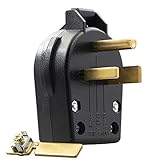
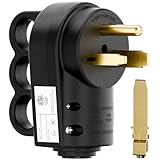


What we cover
How to Match a Welder Power Plug to Your Machine
Every welder draws power differently, and the plug is the last link in a chain that includes the breaker, wire gauge, outlet, and adapter. Get any link wrong and you get nuisance tripping, melted receptacles, or a welder that never reaches full output.
- Voltage: Most 120V welders use a standard NEMA 5-15 or 5-20 plug. Machines running on 240V need a 6-30, 6-50, 14-50, or L14-30 depending on design.
- Input amperage (I1max): Check the nameplate, not the output rating. A “250 amp” welder may only draw 40–50 amps input at 240V.
- Single-phase vs. three-phase: Nearly all home and farm welders are single-phase; industrial three-phase machines need completely different connectors (e.g., L15-30 or pin-and-sleeve types).
Common NEMA Configurations for Welders
NEMA codes encode voltage, amperage, and grounding in one label. Here are the configurations that actually show up on welders and in workshops:
| NEMA Config | Voltage | Max Amps | Blade Pattern | Typical Welder Use |
|---|---|---|---|---|
| 5-15 | 120V | 15A | Two flat + ground | Small flux-core and 120V MIG welders |
| 5-20 | 120V | 20A | T-slot neutral | Higher-draw 120V machines |
| 6-30 | 240V | 30A | Two angled + ground | Mid-size MIG/TIG, some plasma cutters |
| 6-50 | 240V | 50A | Two straight + ground | The de facto welder standard; most 240V MIG/stick machines ship with this plug |
| 14-30 | 120/240V | 30A | Four-prong (dryer) | Adapter target — common in laundry rooms |
| 14-50 | 120/240V | 50A | Four-prong (range/RV) | Adapter target — RV parks, newer ranges |
| L14-30 | 120/240V | 30A | Locking twist | Generator outputs, portable setups |
The 6-50R receptacle is what most dedicated welder circuits terminate in — three conductors (two hots plus ground), no neutral. Multi-process machines from Lincoln Electric, Miller, and Hobart typically ship with a 6-50P factory plug for this reason.
Wire Gauge and Breaker Sizing
The plug is only safe if the circuit behind it can carry the load. Undersized wire is the most common workshop mistake — it overheats silently inside the wall.
| Circuit Rating | Breaker | Min. Copper Wire (THHN, <100 ft run) | Receptacle |
|---|---|---|---|
| 120V / 20A | 20A single-pole | 12 AWG | 5-20R |
| 240V / 30A | 30A double-pole | 10 AWG | 6-30R |
| 240V / 50A | 50A double-pole | 6 AWG | 6-50R or 14-50R |
| 240V / 60A (hardwired) | 60A double-pole | 4 AWG | Disconnect or direct wire |
For runs over 100 feet, step up one gauge to compensate for voltage drop — a 6 AWG run of 150 feet behaves electrically like an undersized circuit and can cause low-voltage faults in inverter welders.
Choosing an Adapter: What Works and What Doesn’t
An adapter bridges a mismatched plug and outlet; it does not change the circuit’s capacity. A 6-50P welder plugged into a 30A dryer outlet through an adapter can still only draw 30 amps — the breaker protects the wire, but the welder may trip it at high settings.
- 6-50P to 14-30R (dryer adapter): Works for welders drawing under ~24A continuous. The dryer’s neutral pin is unused — safe, since 6-50 welders don’t need neutral.
- 6-50P to L14-30R (generator adapter): Good for portable welding off a generator, but verify the generator’s 240V outlet is rated for continuous duty.
- 120V welder to 240V: Never. No adapter converts voltage; you need a dual-voltage machine with an auto-switching plug kit.
- Extension cords: Use SOOW or STW jacketed cords at 6 AWG minimum for a 50A welder, and keep lengths under 25 feet where possible.
For adapters themselves, look for molded one-piece construction, UL or ETL listing, and full-size conductors inside — cheap adapters that neck down to 12 AWG internally are a fire risk at welder loads. Established electrical brands such as Southwire, Conntek, and Camco produce properly rated welder adapter cords, generally in the $40–$90 range depending on length and NEMA pairing.
Decision Matrix by Situation
| Your Situation | Recommended Setup | Est. Circuit Cost (materials) |
|---|---|---|
| Hobbyist, 120V welder, occasional use | Dedicated 20A circuit, 5-20R, 12 AWG | $40–$80 |
| 240V MIG, garage shop, regular use | New 50A circuit, 6-50R, 6 AWG | $80–$150 |
| 240V welder, no spare breaker slots | 6-50P to 14-30R adapter on dryer circuit; cap welder output ~80% | $45–$70 (adapter only) |
| Portable welding off generator | L14-30 adapter cord + SOOW extension | $100–$180 |
| Multiple welder types, evolving shop | 50A subpanel feed with both 6-50R and 14-50R | $200–$400 |
Safe Installation: Step-by-Step
A 240V welder receptacle is a manageable DIY project in many jurisdictions (check permit requirements), but treat the panel with respect — the main lugs are live even with the breaker off.
- Step 1: Confirm the welder’s nameplate input amps and pick a breaker sized at least 125% of continuous draw (e.g., a 40A input → 50A breaker).
- Step 2: Run 6 AWG THHN in conduit, or 6/2 NM-B where code allows, from a double-pole breaker to the receptacle location.
- Step 3: Land the two hots on the X and Y terminals of the 6-50R and the ground on the green screw. There is no neutral on a 6-50 — do not improvise one.
- Step 4: Torque terminals to the receptacle’s spec (typically 45–50 in-lb) — loose terminals are the number-one cause of melted welder plugs.
- Step 5: Test under load gradually. Feel the plug body after ten minutes of welding; warm is normal, too hot to hold is not.
Ownership Realities: What Wears and What Fails
Plug blades oxidize and lose spring tension over years of use — inspect for discoloration, arcing pits, or blades that slide in without resistance. Adapter cords fail first at the strain relief where the cable enters the molded body; hanging heavy adapters so they pull sideways accelerates this. Receptacles themselves wear out after roughly 5,000–10,000 insertion cycles, but heat damage from a single loose connection can kill one in a week. Replacement 6-50R receptacles run $15–$40 for commercial-grade units from Leviton or Legrand — cheap hardware-store outlets at half that price use thinner contacts and aren’t worth it at welder loads.
FAQ
Can I run a 240V welder on a dryer outlet?
Yes, with a properly rated 6-50P to 14-30R adapter, as long as the welder’s input draw stays under the circuit’s 30A rating. Dial back output on thicker material or expect tripped breakers.
Why does my welder plug get hot?
Usually a loose receptacle terminal, worn contact springs, or an adapter with undersized internal conductors. Address it immediately — heat begets more resistance and more heat.
Is a 4-prong or 3-prong welder plug better?
Functionally identical for welding — 240V welders need two hots and a ground. Four-prong 14-50R outlets are simply more versatile if you later add EV charging or RV service on the same circuit.