What's inside
- Best Gasoline Welder Generators for Remote Job Sites
- Gasoline welder generator comparison
- Head-to-head: which machine makes the most sense?
- Decision matrix by job situation
- Runtime, fuel cost, and generator sizing
- What matters for outdoor work
- Ownership realities: what wears first
- Bottom line
- Related Guides
- Best Gasoline Welder Generators for Remote Job Sites
- Gasoline welder generator comparison
- Head-to-head: which machine makes the most sense?
- Decision matrix by job situation
- Runtime, fuel cost, and generator sizing
- What matters for outdoor work
- Ownership realities: what wears first
- Bottom line
- Related Guides
As an Amazon Associate I earn from qualifying purchases. This post may contain affiliate links at no extra cost to you.
What we cover
- Best Gasoline Welder Generators for Remote Job Sites
- Gasoline welder generator comparison
- Head-to-head: which machine makes the most sense?
- Decision matrix by job situation
- Runtime, fuel cost, and generator sizing
- What matters for outdoor work
- Ownership realities: what wears first
- Bottom line
- Related Guides
Best Gasoline Welder Generators for Remote Job Sites
The best gasoline welder generator for most remote repair crews is the Miller Bobcat 265 EFI, while the Miller Trailblazer 330 is the stronger choice for high-duty-cycle welding and the Lincoln Electric Ranger 330MPX is a good fit when maximum welding output matters more than compactness.
A gasoline engine gives these machines long operating range without a mains connection, but the right choice depends on more than amperage. Compare the usable welding range, generator output, fuel tank and runtime, noise, weight, starting system, and how easily the machine can be moved across unfinished ground.
As an Amazon Associate we earn from qualifying purchases at no extra cost to you.


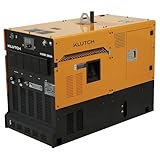
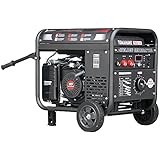
Gasoline welder generator comparison
| Model | Welding output | Generator output | Fuel tank | Approx. weight | Best suited to |
|---|---|---|---|---|---|
| Miller Bobcat 265 EFI | 40–265 A | About 11,000 peak / 9,500 rated W | Approximately 12 gal | About 500 lb | General repair, structural work, and mixed power needs |
| Miller Trailblazer 330 | 30–330 A | About 11,000 peak / 9,500 rated W | Approximately 12 gal | About 600 lb | Frequent heavy welding and high duty cycles |
| Lincoln Electric Ranger 330MPX | 30–330 A | About 11,000 peak / 10,000 rated W | Approximately 12 gal | About 570 lb | Heavy fabrication and jobs needing strong auxiliary power |
| Hobart Champion Elite 225 | 40–225 A | About 11,000 peak / 9,500 rated W | Approximately 12 gal | About 500 lb | Farm maintenance, light construction, and lower-cost ownership |
Weights and electrical ratings can change with engine, fuel, and regional configurations. Treat the figures as a practical comparison, then confirm the exact specification for the model-year configuration before purchase. Rated or continuous generator watts are more important than the advertised peak figure when powering grinders, pumps, compressors, or battery chargers.
Head-to-head: which machine makes the most sense?
Miller Bobcat 265 EFI: the balanced all-rounder
The Bobcat 265 EFI is a sensible default for contractors who regularly weld with 1/8-inch and 5/32-inch electrodes, run a spool gun or TIG setup, and need auxiliary power at the same site. Its 265-amp ceiling covers most repair and construction work without the size and fuel demands of a 330-amp machine.
Electronic fuel injection can improve starting and throttle response across changing temperatures and elevations, although it also adds electrical and fuel-system components compared with a basic carbureted machine. Choose the Bobcat when one welder must handle varied work rather than continuous large-diameter electrode production.
Miller Trailblazer 330: best for welding-heavy schedules
The Trailblazer 330 is the better choice when welding occupies most of the day. Its 330-amp output provides more headroom for larger electrodes, heavier material, and demanding wire-feed applications. Engine-driven welders in this class also offer refined engine-throttle control, reducing fuel consumption and noise when the load is light.
The disadvantages are size, higher purchase cost, and greater transport effort. A trailer, lifting eyes, or a dedicated welding skid becomes much more valuable once the machine approaches 600 pounds. It is excessive for occasional gate repairs but appropriate for pipeline support, structural fabrication, and remote construction crews.
Lincoln Ranger 330MPX: strong output with useful auxiliary capacity
The Ranger 330MPX competes directly with the Trailblazer 330. Its appeal is the combination of 330 amps of welding output and roughly 10,000 rated generator watts, giving it a slight advantage on paper for simultaneous auxiliary loads, depending on the exact configuration.
It is a good match for crews that use a welder, grinder, lights, and small compressor in the same work area. As with any gasoline welder generator, do not assume the maximum generator rating is available while welding at maximum amperage. Read the duty-cycle and simultaneous-load chart before sizing the machine for a specific process.
Hobart Champion Elite 225: the economical workhorse
The Champion Elite 225 is aimed at users who need dependable stick welding and generator power but do not routinely weld at 300 amps. Its 225-amp class is enough for many farm, ranch, trailer, fence, and maintenance jobs, and its purchase price is commonly lower than premium 265- and 330-amp machines.
It gives up output refinement and heavy-duty headroom compared with the Miller and Lincoln alternatives. That trade-off is worthwhile if the machine will be used a few times per month and most work involves mild-steel repairs rather than prolonged production welding.
Decision matrix by job situation
| Your situation | Most suitable type | Why | What to avoid |
|---|---|---|---|
| Occasional farm or property repairs | 225-amp gasoline welder generator | Lower purchase and transport burden; enough for common repair electrodes | Paying for 330 amps you will rarely use |
| Daily mixed welding and tool power | 265-amp EFI machine | Good balance of output, starting convenience, and generator capacity | Small units with weak auxiliary power |
| Heavy welding most of the workday | 330-amp premium machine | More amperage headroom and better tolerance for demanding duty cycles | Light-duty units operated continuously at their limit |
| Frequent relocation over rough ground | Machine with a proper trailer or skid | Wheels alone are not enough at roughly 500–600 lb | Planning to lift it manually into a pickup |
| Noise-sensitive outdoor work | Low-idle engine-throttle model | Quieter and more economical when demand is low | Running a fixed high engine speed unnecessarily |
Runtime, fuel cost, and generator sizing
Runtime depends heavily on welding amperage, idle control, ambient temperature, elevation, and how much auxiliary equipment is connected. A 12-gallon tank may provide roughly 8 to 14 hours of intermittent work, but continuous high-output welding can reduce that substantially. Published “runtime” figures often assume a particular load percentage, so they should not be compared without checking the test condition.
For a planning example, suppose a machine burns 0.8 gallons per hour during a mixed day and gasoline costs $4 per gallon. An eight-hour shift uses about 6.4 gallons, or approximately $25.60 in fuel:
0.8 gallons per hour × 8 hours × $4 per gallon = $25.60
If the machine is idling between welds, an automatic throttle can reduce consumption. If it runs a compressor continuously, expect a higher figure. Keep fuel cost separate from electrode, wire, shielding gas, and engine-maintenance costs when comparing ownership.
For generator loads, add the running watts of every device and account for starting surge. A 1,500-watt grinder, 800-watt light setup, and 1,200-watt charger require 3,500 running watts before motor-starting demand. A generator rated around 9,500 continuous watts has comfortable capacity for that combination, but a compressor may briefly require several times its running wattage.
What matters for outdoor work
- Noise: Engine-driven welders commonly produce roughly 70–80 dBA near the operator, depending on load and measurement method. Place the machine away from occupied areas and use hearing protection; never treat a lower advertised noise figure as silent operation.
- Portability: A factory wheel kit helps on firm ground, but mud, gravel, slopes, and steps favor a trailer or craneable skid. Confirm lifting points rather than attaching straps to the enclosure.
- Weather resistance: Use a canopy for rain and direct sun while preserving generous ventilation. Do not weld or run the engine inside a vehicle, tent, shed, or partially enclosed structure because exhaust can accumulate rapidly.
- Electrical quality: Check whether sensitive chargers and electronics are approved for the generator output. Use correctly sized extension cords and ground-fault protection where required.
- Cold starting: EFI simplifies starting in many conditions, but a healthy battery, clean terminals, and the correct oil viscosity still matter.
Ownership realities: what wears first
The first problems are often not the alternator or welding transformer. Air filters load with dust, fuel deteriorates during storage, batteries lose capacity, and engine oil becomes contaminated by short, cool running periods. Remote-site dust also enters through poorly fitted covers and clogged pre-filters.
Before each job, inspect fuel lines, oil level, battery terminals, weld leads, electrode holders, work clamps, and the exhaust area. Keep the work clamp clean and close to the weld; a poor connection creates heat, unstable arcs, and unnecessary stress on cables. Replace damaged leads instead of taping over deep cuts or crushed insulation.
For seasonal equipment, use fresh fuel, follow the manufacturer’s storage procedure, stabilize or drain fuel as specified, and protect the battery with an appropriate maintainer. Run the engine long enough to reach operating temperature, but do not leave it idling for long periods solely to “keep it ready.”
Bottom line
Choose the Hobart Champion Elite 225 for occasional, cost-conscious repair work. Choose the Miller Bobcat 265 EFI for the broadest mix of welding and generator duties. Choose the Miller Trailblazer 330 or Lincoln Ranger 330MPX when heavy welding, high duty cycles, and substantial auxiliary power justify a larger machine. In every case, budget for transport equipment, fuel storage, hearing protection, maintenance, and safe exhaust management—the practical details that determine whether a gasoline welder generator remains useful in the field.