What's inside
- What “multi-process” means in this category
- Head-to-head comparison by output and cut capacity
- Best choice by workshop situation
- Output is only half the cutting decision
- Setup: the sequence that prevents most problems
- Ownership costs and what wears first
- When an integrated machine is the wrong purchase
- Bottom line
- Related Guides
- What “multi-process” means in this category
- Head-to-head comparison by output and cut capacity
- Best choice by workshop situation
- Output is only half the cutting decision
- Setup: the sequence that prevents most problems
- Ownership costs and what wears first
- When an integrated machine is the wrong purchase
- Bottom line
- Related Guides
As an Amazon Associate I earn from qualifying purchases. This post may contain affiliate links at no extra cost to you.
The best welding machine with cutting capability for most small shops is a 50-amp, dual-voltage 3-in-1 unit such as the LOTOS CT520D or PrimeWeld CT520D; choose a larger separate plasma cutter and welder when you regularly cut thick plate or weld for long periods.
A combined cutting and welding machine saves bench space and reduces the number of power leads, but it is not automatically equal to owning two dedicated machines. The important questions are whether it provides MIG as well as TIG and stick, how thick it can cut cleanly, how long it can run before cooling, and whether your electrical supply can support it.
As an Amazon Associate we earn from qualifying purchases at no extra cost to you.

What we cover
- What “multi-process” means in this category
- Head-to-head comparison by output and cut capacity
- Best choice by workshop situation
- Output is only half the cutting decision
- Setup: the sequence that prevents most problems
- Ownership costs and what wears first
- When an integrated machine is the wrong purchase
- Bottom line
- Related Guides
What “multi-process” means in this category
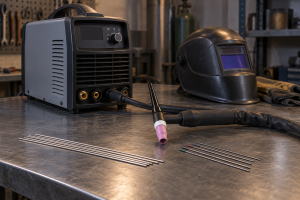
Integrated machines are sold in several different configurations. A compact 3-in-1 model may combine plasma cutting, TIG, and stick welding, while a larger shop machine may add MIG and flux-core welding. Those functions do not all have the same practical value.
- Plasma plus TIG and stick: compact and relatively affordable, but slower for repeated welding of thin sheet because it lacks MIG wire feeding.
- Plasma plus MIG, TIG, and stick: the most versatile arrangement, but uncommon and usually more expensive than buying separate machines.
- Plasma and welding power source in one cabinet: space-efficient, though the cutting circuit, air system, and welding accessories still require room around the unit.
The LOTOS CT520D and PrimeWeld CT520D are examples of compact plasma/TIG/stick machines rather than full MIG multi-process welders. They are suitable for repair work, brackets, gates, light fabrication, and occasional sheet-metal cutting. If your main welding process is MIG, compare the cost of a dedicated MIG welder plus a separate plasma cutter before choosing a compact combination unit.
Head-to-head comparison by output and cut capacity
| Machine type or example | Welding output | Plasma output | Practical cut thickness | Typical duty cycle | Approximate machine weight |
|---|---|---|---|---|---|
| Compact 3-in-1, such as LOTOS CT520D | 15–200 A TIG/stick | Up to 50 A | About 1/2 in clean; up to roughly 3/4 in severance | About 60% at rated cutting output | About 20 lb |
| Compact 3-in-1, such as PrimeWeld CT520D | Low-to-mid 200-A class TIG/stick | Up to 50 A | About 1/2 in clean; thicker with slower, rougher severance | Typically around 60% at rated output | Roughly 30 lb, depending on version |
| Dedicated 40-A plasma cutter | None | 40 A | Approximately 3/8 in clean | Commonly 35–60% | 15–25 lb |
| Dedicated 60-A plasma cutter | None | 60 A | Approximately 5/8 in clean; more for severance | Commonly 50–60% | 30–45 lb |
| Separate 200-A MIG welder plus plasma cutter | 180–210 A MIG output | 40–60 A, depending on cutter | About 3/8–5/8 in clean | Often 20–60%, varying by function | 50–90 lb combined |
These are useful comparison ranges, not a promise that every machine will achieve them on the same steel. “Clean cut” normally means a usable edge with manageable dross at a controlled travel speed. “Severance” means the torch can get through the material, but the edge may be heavily beveled or require grinding.
Best choice by workshop situation
| Your situation | Best fit | Why |
|---|---|---|
| Limited storage, occasional repairs, mostly 1/8–1/4-in steel | Compact 3-in-1 plasma/TIG/stick machine | One cabinet covers several jobs and can run from 120 or 240 V |
| Frequent thin-sheet fabrication | MIG welder plus dedicated plasma cutter | MIG is faster and easier for repeated short welds |
| Regular cutting of 1/2-in plate or thicker | 60-A or larger dedicated plasma cutter | More cutting headroom and usually better sustained performance |
| Beginner learning several processes | 3-in-1 machine with clear controls and supplied consumables | Lower entry cost, but expect a steeper learning curve than with MIG alone |
| Daily fabrication or production repair | Separate professional welder and plasma cutter | Less changeover, better cooling, easier troubleshooting, and less downtime |
Output is only half the cutting decision
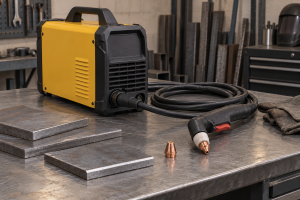
A 50-A plasma circuit does not guarantee a fast 1/2-inch cut. Compressed air quality, torch consumables, material cleanliness, and travel speed have a large effect. Most compact machines need a clean, dry air supply capable of roughly 4–6 cubic feet per minute at about 60–90 psi. Check the specific manual before buying a compressor.
For example, a compressor rated at 5 CFM at 90 psi may not actually deliver 5 CFM while its tank pressure falls. If the cutter needs 5 CFM and the compressor supplies only 3.5 CFM at working pressure, the unit may cut initially and then develop a weak, sputtering arc. A larger receiver tank can extend short cuts, but it cannot replace adequate compressor output during continuous work.
Dual-voltage operation is another practical advantage. On 120 V, many compact welders have reduced output and may trip a 15-A circuit. On 240 V, they usually reach their advertised welding and cutting performance more reliably. Use the correct breaker, plug, extension-cord size, and grounding arrangement specified by the manufacturer.
Setup: the sequence that prevents most problems
- Prepare the workspace. Leave at least 12 inches of clearance around ventilation openings, keep flammable dust away, and provide a stable metal work surface.
- Connect dry air. Use a water separator or filter. Drain the compressor tank regularly because moisture damages the torch and interrupts the plasma arc.
- Install the correct consumables. The electrode, nozzle, swirl ring, and shield cap must match the torch and amperage. Do not mix worn parts with new ones.
- Set air pressure in the cutting mode. Let the machine purge before cutting. Pressure set while the air is static can be misleading.
- Clamp the work lead close to the cut. Remove rust, paint, and mill scale where the clamp contacts the steel.
- Start with a test coupon. Use the manufacturer’s amperage and travel guidance, then adjust speed. Excessive dross on the bottom usually means travel is too slow, amperage is too low, or the air supply is inadequate.
- Switch processes only after shutdown. Turn off the machine and change leads, polarity, torch, or gas connections according to the manual rather than leaving unused cables connected casually.
Ownership costs and what wears first
The cheapest part of plasma ownership is often the machine itself. Nozzles and electrodes are consumables, and they wear faster when the torch is held too far from the work, dragged through wet material, or used with contaminated air. A shield cap may also need replacement after contact with molten metal. Keep a spare set available, particularly for remote repair work.
For a simple cost estimate, suppose a consumable set costs $20–$35 and lasts 30–60 minutes of actual arc-on cutting. That equals roughly $0.33–$1.17 per cutting minute before electricity and compressed-air costs. Piercing thick plate, cutting expanded metal, and operating at excessive amperage can reduce that life substantially.
On the welding side, the first maintenance items are commonly contact surfaces, TIG tungstens, stick electrodes, cable connectors, and cooling-fan filters. Keep vents clean with low-pressure, dry air as recommended by the manual. Avoid blowing shop dust deeper into the cabinet, and never operate a fan-cooled machine in a way that blocks its intake.
When an integrated machine is the wrong purchase
Choose separate equipment if you need uninterrupted MIG production, precise repeatability, a longer duty cycle, or reliable cutting near the machine’s maximum thickness. A dedicated plasma cutter also makes troubleshooting easier: an air problem, torch problem, and welding-circuit problem are not sharing one enclosure.
Choose the integrated option when portability and storage matter more than maximum throughput. A compact 3-in-1 unit can be excellent for a home workshop that cuts brackets occasionally and performs TIG or stick repairs, especially when a 240-V outlet is available. Just do not treat its maximum severance specification as the normal production thickness.
Bottom line
For occasional cutting and welding in a small workspace, a 50-A plasma/TIG/stick machine offers the best balance of output, portability, and price. For thin-sheet work, prioritize a machine that includes MIG or buy a separate MIG welder. For thick plate, long duty cycles, and frequent fabrication, the better cutting and welding machine is usually two dedicated machines: a 60-A-or-larger plasma cutter paired with a welder sized for the material and workload.