What's inside
- Quick comparison of portable MIG welder generators
- Which mig welder generator fits your work?
- Head-to-head: generator output versus welding output
- Material thickness: what these machines can actually handle
- Fuel use and ownership cost
- Portability: the hidden trade-off
- What wears first and how to avoid downtime
- Bottom line
- Related Guides
- Quick comparison of portable MIG welder generators
- Which mig welder generator fits your work?
- Head-to-head: generator output versus welding output
- Material thickness: what these machines can actually handle
- Fuel use and ownership cost
- Portability: the hidden trade-off
- What wears first and how to avoid downtime
- Bottom line
- Related Guides
As an Amazon Associate I earn from qualifying purchases. This post may contain affiliate links at no extra cost to you.
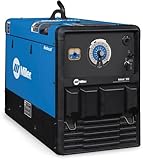
The best MIG welder generator for most mobile repair work is the Lincoln Electric Ranger 330MPX, while the Miller Trailblazer 330 is the stronger choice when low fuel use and quiet operation matter more than purchase price.
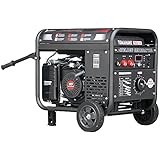
An engine-driven welder does not usually contain a complete spool-gun MIG machine. Instead, it supplies welding current to a separate suitcase or portable wire feeder, shielding-gas bottle, gun, and work lead. That distinction matters when comparing a “MIG welder with generator”: the engine unit provides power and welding output, but the feeder determines wire size, controls, and much of the MIG experience.
As an Amazon Associate we earn from qualifying purchases at no extra cost to you.


What we cover
- Quick comparison of portable MIG welder generators
- Which mig welder generator fits your work?
- Head-to-head: generator output versus welding output
- Material thickness: what these machines can actually handle
- Fuel use and ownership cost
- Portability: the hidden trade-off
- What wears first and how to avoid downtime
- Bottom line
- Related Guides
Quick comparison of portable MIG welder generators
| Machine | Maximum welding output | Usable generator output | Duty-cycle reference | Fuel tank and runtime class | Approx. weight | Practical MIG thickness |
|---|---|---|---|---|---|---|
| Lincoln Electric Ranger 330MPX | 330 A DC | About 10,000 W continuous | 100% near 300 A | Approximately 12 gal; roughly 10–15 hours at light generator loads | About 500–530 lb | 16-gauge to 3/4 in steel, depending on joint preparation and passes |
| Miller Trailblazer 330 | 330 A DC | About 9,500–11,000 W, depending on configuration | 100% near 300 A | Approximately 12 gal; commonly among the most fuel-efficient units in this class | About 500–530 lb | 16-gauge to 3/4 in steel with suitable wire, gas, and multiple passes |
| Miller Bobcat 265 | 265 A DC | About 10,000 W continuous | 100% near 250 A | Approximately 12 gal; around 10–14 hours at light loads | About 500–530 lb | 18-gauge to 1/2 in steel for typical field repairs |
| Hobart Champion Elite | Approximately 210 A DC | About 9,500 W rated output | 100% near its rated welding range | Approximately 12 gal; around 8–12 hours at light loads | About 400–450 lb | 18-gauge to 3/8 in steel, usually with beveling or multiple passes above 1/4 in |
These figures are representative manufacturer ratings and operating ranges rather than guaranteed runtime. Generator output, welding amperage, ambient temperature, altitude, wire size, and duty cycle all affect the result. A wire feeder, gas bottle, leads, and mounting bracket add substantial weight and cost.
Which mig welder generator fits your work?
- Choose the Ranger 330MPX if one machine must cover MIG, stick, TIG, air carbon-arc gouging, and high-output generator work. Its extra amperage gives more headroom for thick steel and long welds.
- Choose the Trailblazer 330 for truck, trailer, agricultural, and roadside work where fuel economy, smooth auxiliary power, and reduced engine noise are valuable over many operating hours.
- Choose the Bobcat 265 for general maintenance, gates, frames, brackets, and structural repairs that rarely require more than 250 amps. It is often the sensible middle ground.
- Choose the Champion Elite when the budget is tighter and the workload is intermittent. It can run a MIG feeder and common job-site tools, but it has less reserve for heavy continuous welding.
Head-to-head: generator output versus welding output
Welding amperage and generator wattage are separate specifications. Welding output determines how much heat the arc can put into steel. Generator output determines whether the machine can run a wire feeder, grinder, lights, compressor, heater, or another tool at the same time.
For example, a 250-amp weld at approximately 25 volts represents about 6,250 watts of arc power before efficiency losses. That does not mean a 6,250-watt generator will necessarily weld at 250 amps: the engine-driven welder has its own alternator, controls, transient demands, and power factor limitations. A unit rated around 9,500 to 10,000 continuous watts provides a more useful margin for the feeder and auxiliary equipment.
If the intended work is light sheet metal, buying a 330-amp machine solely for its headline amperage may waste money and payload capacity. Conversely, a 210-amp unit may weld 1/4-inch steel successfully but become frustrating when making long multi-pass repairs on 1/2-inch plate.
Material thickness: what these machines can actually handle
With solid ER70S-6 wire and a suitable shielding gas, a portable wire feeder can weld thin automotive-style steel at approximately 18-gauge, provided the operator controls heat and avoids excessive travel speed. A 0.023-inch wire is useful for thin material; 0.030-inch wire is the general-purpose choice; 0.035-inch wire is better for heavier repairs.
- 16-gauge to 1/8-inch: 90–150 amps is commonly sufficient. Use short welds and allow cooling on thin sections.
- 1/4-inch: approximately 180–250 amps, often with a V-groove and more than one pass.
- 3/8-inch to 1/2-inch: a 250- to 330-amp machine offers useful capacity, but joint preparation becomes as important as amperage.
- Above 1/2-inch: beveling, preheating where appropriate, multiple passes, and inspection become important. A high-output engine-driven unit does not make a single oversized MIG pass equivalent to a properly prepared structural weld.
Aluminum requires a compatible spool gun or push-pull setup, suitable liner and contact tips, and usually 100% argon. Stainless steel needs the correct wire and gas blend. Check feeder compatibility before assuming that every generator MIG welder can run every gun.
Fuel use and ownership cost
Fuel consumption is often more important than the purchase price for contractors who weld daily. At light loads, an efficient 330-class machine may use roughly 0.4–0.8 gallons per hour; heavy welding or simultaneous generator use can raise that substantially. A 12-gallon tank therefore does not represent a fixed number of welding hours.
For a worked example, assume a machine burns 0.6 gallons per hour, fuel costs $4 per gallon, and actual arc time is 3 hours during a six-hour site visit. Fuel costs about $7.20 for that visit based on engine runtime. Add wire, shielding gas, contact tips, and electricity-free tool operation when comparing it with a shop-based MIG welder. The engine may run while the operator lays out parts, changes wire, or grinds, so real fuel cost per finished weld is higher than the arc-time calculation.
The more expensive efficient model can pay back its premium when it replaces hundreds of hours of generator operation. For occasional repairs, a less expensive 210- or 265-amp machine may have the lower total ownership cost.
Portability: the hidden trade-off
None of these machines is genuinely portable in the hand once equipped for MIG work. The engine unit may weigh 400–530 pounds, while a gas cylinder, feeder, cables, gun, wire, and fuel add another 100 pounds or more. Plan for a receiver hitch, skid, service truck, trailer, or lifting point rated for the complete setup.
Compare footprint as carefully as weight. A narrow machine may fit behind a truck cab but leave no room for the gas bottle. Verify whether the model includes a lifting eye, battery isolation, remote-control connection, and a fuel gauge. An integrated fuel gauge and hour meter save time during mobile maintenance.
What wears first and how to avoid downtime
- MIG consumables: contact tips, nozzles, liners, and drive rolls wear far sooner than the engine. Keep replacements matched to wire diameter.
- Dirty wire paths: dust and rust increase feeding resistance. Store wire in a dry cabinet and blow out the liner according to the feeder manufacturer’s instructions.
- Cooling airflow: chaff, welding dust, and mud restrict the engine and alternator. Clean intake screens and radiator areas before overheating occurs.
- Battery and fuel system: infrequent users commonly encounter a flat starting battery, stale gasoline, or blocked fuel filters. Follow the engine maker’s storage procedure and use fresh fuel.
- Duty cycle mistakes: a 60% duty cycle at a stated amperage means six minutes of welding in a ten-minute period, not continuous operation. Reduce current or pause before thermal protection trips.
Bottom line
For a serious portable MIG welder generator, prioritize a 250- to 330-amp welding range, at least about 9,000 watts of continuous auxiliary power, a 100% duty-cycle rating near your normal amperage, and a feeder that supports your chosen wire and gas setup. The Ranger 330MPX and Trailblazer 330 suit frequent heavy field work; the Bobcat 265 is a balanced general-maintenance choice; and the Hobart Champion Elite is appropriate when cost, not maximum thickness, leads the decision.