What's inside
- Best FCAW Welders and Flux-Cored Welding Wire
- Choose the setup for your work
- What FCAW means for a buyer
- Compare self-shielded and gas-shielded wire
- Wire choice: match the classification to the job
- Practical thickness limits
- Estimate the real setup cost
- Setup and maintenance that prevent common problems
- Related Guides
- Best FCAW Welders and Flux-Cored Welding Wire
- Choose the setup for your work
- What FCAW means for a buyer
- Compare self-shielded and gas-shielded wire
- Wire choice: match the classification to the job
- Practical thickness limits
- Estimate the real setup cost
- Setup and maintenance that prevent common problems
- Related Guides
As an Amazon Associate I earn from qualifying purchases. This post may contain affiliate links at no extra cost to you.
What we cover
- Best FCAW Welders and Flux-Cored Welding Wire
- Choose the setup for your work
- What FCAW means for a buyer
- Compare self-shielded and gas-shielded wire
- Wire choice: match the classification to the job
- Practical thickness limits
- Estimate the real setup cost
- Setup and maintenance that prevent common problems
- Related Guides
Best FCAW Welders and Flux-Cored Welding Wire
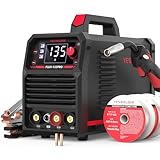
For most home and farm repairs, choose a 120/240 V inverter welder rated for at least 140 A, pair it with 0.030-inch E71T-11 wire for convenient self-shielded welding, and use 0.035-inch wire when you regularly weld thicker steel or want a smoother, higher-deposition setup. The best choice depends on your available power, material thickness, workspace, and whether you can shield the weld from wind.
Choose the setup for your work
| Situation | Welder and wire choice | What to expect |
|---|---|---|
| Occasional repairs; standard 120 V outlet | 120 V machine rated around 90–140 A; 0.030-inch E71T-11 | Portable and relatively inexpensive. Best for thin-to-moderate steel and short welds; duty cycle and circuit capacity limit sustained work. |
| Frequent repairs; 120/240 V available | Dual-voltage inverter rated around 140–200 A; 0.030- or 0.035-inch E71T-11 | More headroom and flexibility. A 240 V supply generally makes it easier to use higher output without overloading a household circuit. |
| Outdoor work in breeze | Self-shielded E71T-11 or another wire explicitly approved for the job | No shielding-gas cylinder to transport. Wind can still disturb the arc and cool the weld, so shelter the work when possible. |
| Shop welding with gas available | FCAW-G machine and gas-compatible wire such as E71T-1, with the specified shielding gas | Typically smoother welds and less spatter than self-shielded wire, but requires a cylinder, regulator, gas hose, and draft-controlled workspace. |
Numbers in the table are practical selection ranges, not a promise that every machine can sustain its maximum output. Compare rated output, duty cycle, input requirements, wire-feed range, and the manufacturer’s recommended wire diameters before buying.
As an Amazon Associate we earn from qualifying purchases at no extra cost to you.


What FCAW means for a buyer
Flux cored arc welding (FCAW) feeds a tubular wire containing flux through a welding gun. The flux helps protect the molten weld pool and forms slag, which must be removed after welding. FCAW is not the same as conventional solid-wire MIG, even though many multiprocess and MIG machines can be configured for it.
There are two main wire arrangements. Self-shielded flux-cored wire (FCAW-S) generates its shielding from the flux and normally needs no external gas. Gas-shielded wire (FCAW-G) uses a shielding gas in addition to its flux; the required gas and polarity depend on the specific wire. Do not assume that all flux-cored wire runs with the same polarity. Check the wire label and welder manual, then set the machine accordingly.
Compare self-shielded and gas-shielded wire
| Factor | Self-shielded FCAW-S | Gas-shielded FCAW-G |
|---|---|---|
| Shielding | Flux supplies shielding; no cylinder | Requires specified external gas |
| Outdoor suitability | Usually the more practical option, though wind protection still helps | Drafts can blow gas away and cause porosity |
| Cleanup | Slag and often more spatter; clean between passes | Slag remains; weld appearance is often cleaner, depending on wire and settings |
| Setup cost | Lower initial cost: wire, compatible machine, and basic accessories | Higher initial cost: wire plus cylinder, regulator, gas hose, and refills or rental |
| Common use | Repair work, outdoor fabrication, portable setups | Shop production and work where gas coverage and process requirements can be controlled |
For either process, the machine must have a suitable wire-feed system and contact tip for the wire diameter. Many machines are sold as MIG welders but can run self-shielded wire after changing polarity and fitting the correct drive roll or liner setup. Confirm FCAW compatibility rather than relying on the product name.
Wire choice: match the classification to the job
E71T-11 is a common self-shielded choice for general-purpose work and is often available in 0.030- and 0.035-inch diameters. It is useful for repair and fabrication, but the classification and manufacturer’s limits matter: not every wire is approved for every position, thickness, or structural application. E71T-1 is a common gas-shielded classification, but it needs the shielding gas and operating conditions specified on its data sheet.
Smaller wire can be easier to control on thin material and typically suits lower-output machines. Larger wire can deposit metal faster, but it needs enough amperage and feed capacity to run properly. Buy wire in a spool size you can use before it absorbs moisture or collects dust; store it sealed and dry, following the maker’s directions. Damp, dirty, or rusty wire can feed poorly and contribute to inconsistent welds.
Practical thickness limits
There is no single maximum thickness for an FCAW welder: it depends on output, wire classification, joint design, fit-up, position, and the required number of passes. As a rough guide, a 120 V hobby machine is generally best suited to sheet and light steel, roughly 18 gauge through 1/8 inch, with thicker work often requiring careful preparation and multiple passes. A capable 240 V machine in the 140–200 A class can handle many 1/8- to 1/4-inch fabrication jobs with suitable wire and joint preparation. These are planning ranges, not certified capacity ratings.
For thicker plate, verify the machine’s published output and the wire data sheet. Beveling edges, cleaning off paint and rust, leaving an appropriate root opening, and making multiple passes can improve fusion—but they do not make an undersized machine adequate. For structural, pressure-containing, lifting, or safety-critical work, follow the applicable welding procedure and qualification requirements rather than relying on a general-purpose setup.
Estimate the real setup cost
Typical market ranges vary by region and included accessories. A basic 120 V flux-core-capable machine may cost roughly $150–$400; a more capable dual-voltage inverter commonly falls around $400–$1,000 or more. A spool of wire may run about $15–$40, while a gas-shielded setup adds a regulator and hose and may require a cylinder purchase or rental and ongoing refills. Protective gear, spare tips, and a welding helmet are separate costs if you do not already own them.
For occasional outdoor repairs, paying more for a gas setup may not improve value: the cylinder adds transport and refill logistics, and wind can compromise shielding. For steady indoor shop use, the extra setup can be worthwhile if the cleaner arc, productivity, and wire options suit the work. Compare total ownership cost, not just the machine’s sticker price.
Setup and maintenance that prevent common problems
- Confirm polarity first. Match the machine terminals to the wire maker’s instructions; incorrect polarity can produce an unstable arc and poor welds.
- Use the right drive roll and tension. Set the roll for the wire type and diameter. Too much tension can deform tubular wire; too little can cause slipping.
- Check the contact tip and liner. A worn tip or contaminated liner can cause erratic feeding. Keep spare tips on hand and replace them when the wire no longer feeds consistently.
- Clean the joint and work clamp area. Remove paint, rust, oil, and moisture near the weld. A poor clamp connection can make the arc unreliable.
- Follow the wire’s technique guidance. FCAW commonly uses a drag angle, but travel angle, stickout, and settings vary by wire. Start with the manufacturer’s data, then make test welds on scrap of similar thickness.
- Remove slag between passes. Slag left in the joint can become an inclusion. Chip and brush the weld before adding another pass.
FCAW is a practical choice when portability, outdoor work, or a simple gas-free setup matters. For the lowest-cost occasional setup, start with a compatible 120 V machine and self-shielded 0.030-inch wire. If you weld often, need more output, or work in a shop, a dual-voltage machine gives more room to grow; choose gas-shielded wire only when its weld-quality and productivity benefits justify the extra equipment and shielding requirements.