What's inside
As an Amazon Associate I earn from qualifying purchases. This post may contain affiliate links at no extra cost to you.
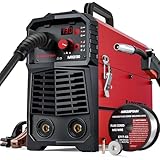
For most indoor fabrication, thin sheet metal, and fast repair work, a wire welder is the better choice; for outdoor repairs, dirty steel, thick plate, or maximum portability, a stick welder usually wins.
The phrase “wire welder” covers two different processes: gas-shielded MIG welding, which uses solid wire and a shielding-gas cylinder, and flux-cored arc welding (FCAW), which uses self-shielded tubular wire and needs no gas. That distinction matters as much as the comparison between wire and stick.
As an Amazon Associate we earn from qualifying purchases at no extra cost to you.



What we cover
Wire Welder vs Stick: The Quick Decision
| Project requirement | Best choice | Why |
|---|---|---|
| Thin sheet metal, automotive panels, brackets | Gas-shielded MIG | Stable arc, low heat settings, and less slag make clean welds easier. |
| Outdoor work in wind | Self-shielded flux-core or stick | Neither depends on an exposed shielding-gas cloud. |
| Dirty, rusty, or lightly prepared steel | Stick | Coated electrodes tolerate surface contamination better than solid MIG wire. |
| Long welds and repeated production work | Wire welder | Continuous wire feeding avoids frequent electrode changes. |
| Remote repairs with limited equipment | Stick | The power source and electrode holder are simple, compact, and gas-free. |
| Beginner learning basic steel fabrication | Wire welder | Trigger control and continuous wire feed are usually easier to coordinate. |
Head-to-Head Comparison
| Factor | Wire welder | Stick welder |
|---|---|---|
| Typical setup time | 5–15 minutes for machine, polarity, wire, and gas; 2–5 minutes for self-shielded flux-core | 2–5 minutes for machine, leads, electrode, and ground clamp |
| Common input power | 120 V machines often provide 90–140 A; 240 V machines commonly provide 180–250 A | 120 V machines often provide 80–140 A; 240 V machines commonly provide 180–250 A |
| Practical mild-steel range | Approximately 24-gauge to 1/4 inch with common hobby machines; thicker work may need multiple passes | Approximately 1/8 inch to 1 inch or more, depending on amperage, electrode, joint, and passes |
| Common wire or electrode sizes | 0.023, 0.030, and 0.035 inch wire | 3/32, 1/8, and 5/32 inch electrodes |
| Outdoor performance | Good with self-shielded flux-core; poor with gas-shielded MIG in wind | Good, provided the electrodes stay dry |
| Cleanup | Little or no slag with solid MIG; slag removal with flux-core | Slag must be chipped and brushed after each pass |
| Consumable interruptions | Wire spool can run for a long time; feed liner and contact tip eventually wear | Electrode must be replaced frequently, especially on long welds |
Setup Speed and Ease of Use
A wire welder generally gets a beginner welding sooner. After loading a spool, installing the correct drive-roll groove, selecting polarity, connecting gas if required, and setting voltage and wire speed, the operator pulls the trigger and maintains a fairly consistent arc length. A 10-pound spool of 0.030-inch wire can provide many hours of intermittent hobby use.
Stick setup is faster in one sense: there is no wire-feed system, gas regulator, or cylinder to arrange. Connect the electrode holder and work lead, select the correct polarity, insert an electrode, and weld. However, striking and maintaining the arc takes more practice. The electrode becomes shorter while welding, so the operator must continuously adjust hand position and arc length. Slag also has to be removed between passes.
Self-shielded flux-core sits between the two. It has wire-feed convenience but avoids a gas cylinder. The tradeoff is more smoke, spatter, and slag than solid-wire MIG.
Portability and Outdoor Performance
Stick is usually the most portable option. A compact inverter stick machine may weigh roughly 8–15 pounds, excluding cables, and needs only an electrode holder and ground clamp. There is no cylinder to transport, secure, or protect from damage.
A wire setup can remain portable, but the complete system is larger: welder, gun, spool, liner, contact tips, and possibly a 40- or 80-cubic-foot shielding-gas cylinder. A small gas cylinder may add 25–50 pounds when full, depending on cylinder size. This matters when repairing gates, trailers, farm equipment, or machinery away from the workshop.
Wind is the critical outdoor issue. Gas-shielded MIG can lose shielding when even a moderate breeze disturbs the gas envelope, producing porosity that may not be visible until the weld is tested or cut. A windbreak can help, but it must not create a confined area where fumes accumulate. Self-shielded flux-core and stick generate their own shielding gases and are better choices outdoors, although strong wind can still affect the weld.
Penetration and Material Thickness
Stick has the advantage when thick steel and joint penetration are priorities. Electrodes such as E6010 and E6011 provide a forceful arc that can dig through mill scale and reach the root of an open joint. E7018 is widely used where a stronger, low-hydrogen weld is required, but it demands better storage and surface preparation than general-purpose electrodes.
Wire welders are excellent on thin and medium-gauge material because the arc can be started and stopped quickly, and smaller wire diameters allow lower current. Typical 0.023-inch solid wire is useful for thin sheet, while 0.030- and 0.035-inch wire suit general 1/8-inch to 1/4-inch mild-steel fabrication. A small 120-volt machine may weld 1/4-inch steel with careful joint preparation and multiple passes, but it is not equivalent to a high-output 240-volt machine.
Neither process should be selected by thickness alone. Joint design, bevel angle, root gap, electrode or wire type, amperage, duty cycle, and the number of passes all affect whether the weld fuses properly. A machine advertised at 200 amps may only sustain that output for a limited duty cycle. For repeated thick-plate work, compare the rated amperage at a 60% duty cycle or higher rather than relying on the maximum number.
Consumable Costs and the Real Cost per Weld
Wire often costs more per pound than basic stick electrodes, but it produces less waste because there are no short electrode stubs. Solid wire also avoids slag cleanup, which reduces labor on projects with many inches of weld.
Consider a simple example. Suppose a project requires 20 feet of fillet weld. If the weld uses about 0.18 pounds of deposited metal per foot, the joint needs approximately 3.6 pounds of deposited metal. At an estimated 85% deposition efficiency for solid MIG wire, about 4.2 pounds of wire is required. Stick welding may have roughly 60–70% deposition efficiency after accounting for stubs and slag, requiring approximately 5.5–6 pounds of electrodes for the same deposited weld metal.
Using general market ranges, solid wire may cost about $4–$8 per pound, while common mild-steel stick electrodes may cost about $3–$7 per pound. That puts the consumable portion of this example near $17–$34 for wire or $17–$42 for stick, before shielding gas and electricity. MIG adds gas consumption, commonly around 20–35 cubic feet per hour indoors, plus cylinder rental or refill costs. Flux-core avoids gas but may cost more per pound and requires additional cleanup.
Durability and Ownership Realities
- Wire welders: Contact tips, drive rolls, gun liners, and the nozzle are normal wear parts. Bird-nesting usually comes from excessive spool tension, a worn liner, the wrong drive-roll pressure, or a blocked tip.
- Stick welders: Leads, electrode holders, and ground clamps wear from dragging and heat. Inverter machines also need protection from conductive dust and moisture.
- Flux-core wire: Keep the spool dry and sealed when not in use. Moisture can increase porosity and make the arc unstable.
- Low-hydrogen electrodes: E7018 electrodes must be stored according to the manufacturer’s instructions. Damp electrodes can increase the risk of hydrogen-related cracking in susceptible welds.
- Both processes: Clean the steel to bright metal where practical, inspect cables regularly, maintain a dry work area, and verify the machine’s duty cycle before long welds.
Choose by Your Situation
| Your situation | Recommended process | Suggested starting configuration |
|---|---|---|
| Occasional indoor projects under 1/4 inch | Wire welder | 120 V MIG/flux-core machine, 0.023- or 0.030-inch wire |
| Frequent shop fabrication and long welds | 240 V wire welder | 180–250 A machine with 0.030- or 0.035-inch wire |
| Outdoor repairs and farm or trailer work | Stick or self-shielded flux-core | 160–200 A inverter with E6011/E6013 or suitable flux-core wire |
| Thick structural steel and open-root joints | Stick | 200 A or higher machine with an electrode selected for the joint and code requirements |
| Limited budget and minimal accessories | Stick | Basic inverter, leads, helmet, clamps, and several electrode sizes |
| Clean appearance and minimal post-weld work | Gas-shielded MIG | Solid wire, appropriate shielding gas, and a stable indoor workspace |
Bottom Line
Choose a wire welder if speed, thin material, clean-looking welds, and repeated indoor fabrication matter most. Choose stick if you work outdoors, need strong penetration on thicker steel, want the smallest equipment package, or regularly weld material that cannot be cleaned perfectly.
For many workshops, the most useful long-term answer is not either-or: a wire machine handles everyday fabrication, while a compact stick-capable inverter covers outdoor repairs and heavier work. If you can buy only one machine, match its rated output and process to the thickest material and least controlled location you expect to weld—not merely to the projects you do most often.