What's inside
As an Amazon Associate I earn from qualifying purchases. This post may contain affiliate links at no extra cost to you.
For most people shopping for the best welder for home use, the answer is a 110–120V flux-core or MIG-capable machine in the 140A class — the Hobart Handler 140 and Forney Easy Weld 140 FC-i being the two benchmarks — because they plug into a standard household outlet, store on a shelf, and handle everything from exhaust brackets to gate hinges. The right pick depends on your garage’s wiring, how thick your typical material is, and whether you’re willing to run shielding gas. Below is a practical ranking built on those real-world constraints, not spec-sheet hype.
As an Amazon Associate we earn from qualifying purchases at no extra cost to you.

What we cover
What Actually Limits a Home Welder
Four constraints shape nearly every home workshop decision:
- Outlet requirements: A true 120V welder runs on a standard 15A circuit, but it tops out around 90–140A output — fine for sheet metal to about 3/16″. Anything thicker usually demands a 240V circuit and often a dedicated breaker.
- Ventilation: Flux-core produces noticeably more fumes than gas-shielded MIG. Welding in a closed garage in winter is a real factor — plan a window fan position before you buy, not after.
- Noise: Welders themselves are quiet; the fans aren’t. Inverter machines with oversized cooling fans run around 70dB — louder than a conversation, quieter than an angle grinder. Your grinder will annoy the neighbors first.
- Storage footprint: Small welders for home use weigh 15–30 lbs and fit under a workbench. A 240V machine plus a gas bottle plus a cart becomes furniture — measure your corner first.
Quick Comparison: Specs That Matter in a Garage
| Model | Input | Process | Max Output | Duty Cycle | Weight | Best For |
|---|---|---|---|---|---|---|
| Forney Easy Weld 140 FC-i | 120V | Flux-core only | 140A | 30% @ 90A | 19 lbs | Cheapest serious entry, no gas needed |
| Hobart Handler 140 | 120V | MIG + flux-core | 140A | 20% @ 90A | 57 lbs | All-around home MIG work, long service life |
| Lincoln Electric Easy MIG 140 | 120V | MIG + flux-core | 140A | 20% @ 90A | 50 lbs | Alternative benchmark, widely supported parts |
| Miller Millermatic 141 | 120V | MIG + flux-core | 140A | 20% @ 90A | 51 lbs | Auto-set controls, premium build |
| YesWelder MIG-205DS | Dual 120/240V | MIG/flux/stick/TIG lift | 205A | 60% @ 160A (240V) | ~25 lbs | Multiprocess flexibility, future-proofing |
| Titanium Unlimited 200 | Dual 120/240V | MIG/flux/stick | 200A | 25% @ 200A (240V) | ~33 lbs | Budget dual-voltage with room to grow |
Duty cycle deserves a note: “20% @ 90A” means two minutes of welding per ten minutes at that amperage. For home projects — short beads on a fence bracket, tacking a trailer repair — you’ll almost never hit it. It only matters if you’re laying long continuous welds on thicker stock.
Picks by Situation
Tightest budget, no gas wanted: Forney Easy Weld 140 FC-i
This is the entry point for a good welder for home use when cost drives the decision. Flux-core only, infinitely adjustable wire speed and amperage dials (many budget units offer only two fixed settings — the Forney’s variable control is why it’s recommended over generic alternatives). It runs on any outlet, weighs under 20 lbs, and welds 24-gauge up to 1/4″ in a single pass with good technique. Skip it if you plan to weld auto-body sheet metal regularly — flux-core’s spatter and coarser control make thin work harder than gas MIG.
The standard home MIG pick: Hobart Handler 140 or Lincoln Easy MIG 140
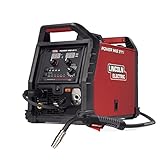
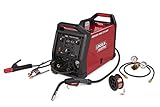
Either is a safe “buy once” mig welder for home use. Both run gas MIG for clean auto-body and furniture work, or swap to flux-core for outdoor jobs where wind would blow shielding gas away. The Hobart’s five-position voltage tap versus Lincoln’s four is a minor difference; in practice, part availability and price at your local supplier should decide it. Both are transformer-based — heavier (50+ lbs) than inverter units but famously durable, with a decade-plus service life being common.
Growing shop, thicker material: dual-voltage multiprocess
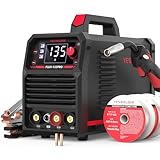
If your panel can support it, a 120/240V dual-input machine like the YesWelder MIG-205DS or Titanium Unlimited 200 is the smartest welder for home use long-term. Run it on 120V today, wire a 240V outlet later and unlock 180–200A for 1/4″+ plate. The multiprocess capability (stick mode especially) is genuinely useful for outdoor repairs where MIG wire feed and gas are a hassle.
Sheet metal and auto-body only: Miller Millermatic 141
Miller’s Auto-Set asks for material thickness and wire diameter, then dials voltage and wire speed automatically. For beginners chasing clean welds on 20–22 gauge body panels — where the wrong setting burns through instantly — that automation earns its price premium. It’s also the most refined arc of the 140A class, which shows in less grinding afterward.
Decision Matrix: Match Your Situation
| Your situation | Pick | Why |
|---|---|---|
| Under ~$250, occasional repairs, outdoor work | Forney 140 FC-i | No gas bottle to buy or store; flux-core tolerates wind |
| Mixed indoor projects, want clean welds, $400–650 | Hobart 140 / Lincoln 140 | Gas MIG quality on sheet metal; flux-core option retained |
| Will eventually weld 1/4″ or thicker, panel supports 240V | YesWelder 205DS or Titanium 200 | Dual voltage avoids buying twice |
| Beginner doing auto-body, quality over price | Millermatic 141 | Auto-Set reduces burn-through learning curve |
| Apartment/condo, no garage, balcony storage | Forney 140 FC-i or a small stick welder | Compact, no gas cylinder (often prohibited in leases) |
The Real Cost of Getting Started
The welder is roughly 60% of your actual outlay. A realistic first-project budget for a mid-range MIG setup:
- Machine: $400–600 (mid-range 140A MIG)
- Auto-darkening helmet: $60–150
- Gloves, jacket or apron, chipping hammer, wire brush: $60–100
- Gas bottle (80 cu ft C25 mix, filled): $150–250 including cylinder purchase/refill
- Consumables (wire, tips, nozzles): $40
Skipping gas with flux-core cuts roughly $200 and the cylinder storage hassle — a legitimate reason to choose it, not just a compromise. Cost per use works out well either way: a $700 complete setup used only twice a year costs under $18 per session over twenty years, before resale value (Hobart and Miller units commonly resell for 50–60% of new price).
Ownership Realities Listings Don’t Mention
- Contact tips wear first. Budget a 10-pack; a worn tip causes erratic arcs beginners blame on the machine.
- Drive rollers need matching wire diameter. Switching between .030″ and .035″ wire without flipping the roller groove causes feeding problems — the most common “my welder is broken” complaint.
- Liner cleaning matters. Blow out the gun liner with compressed air every few spools; metal dust buildup causes the same feeding symptoms.
- Extension cords are a trap. A long, thin 120V cord starves the welder under load. If you must extend, use a short 12-gauge cord rated for 15A+.
- Dedicated circuit preferred. Sharing a garage circuit with a freezer compressor means nuisance breaker trips mid-weld.
FAQ
Can I weld aluminum with a home welder?
With a spool gun attachment, some 140A machines handle thin aluminum, but it’s marginal. Realistically, aluminum MIG wants 200A+ or a TIG machine — another argument for dual-voltage multiprocess if aluminum is in your plans.
Is flux-core good enough for automotive work?
For frames, brackets, and exhaust — yes. For visible body panels — no; the spatter and heat control make it impractical. Use gas MIG there.
How thick can a small welder for home use actually weld?
A 120V 140A machine handles up to about 3/16″ comfortably in a single pass, and 1/4″ with proper joint prep and multiple passes. Manufacturer claims of thicker single-pass capability are optimistic for beginner technique.