What's inside
- What kind of laser cuts aluminum?
- Practical aluminum thickness by laser power
- Why aluminum is difficult to cut
- Which assist gas gives the cleanest edge?
- Can a 20W laser cut metal?
- Choosing a machine by your situation
- Setup details that determine the result
- Ownership costs and common failure points
- Related Guides
- What kind of laser cuts aluminum?
- Practical aluminum thickness by laser power
- Why aluminum is difficult to cut
- Which assist gas gives the cleanest edge?
- Can a 20W laser cut metal?
- Choosing a machine by your situation
- Setup details that determine the result
- Ownership costs and common failure points
- Related Guides
As an Amazon Associate I earn from qualifying purchases. This post may contain affiliate links at no extra cost to you.
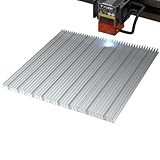
Yes, you can laser cut aluminum, but practical results require a metal-cutting fiber laser, adequate power, nitrogen or clean compressed air, and settings matched to the alloy and thickness; a typical 20W diode or small engraving laser will not cut aluminum sheet.
As an Amazon Associate we earn from qualifying purchases at no extra cost to you.


What we cover
- What kind of laser cuts aluminum?
- Practical aluminum thickness by laser power
- Why aluminum is difficult to cut
- Which assist gas gives the cleanest edge?
- Can a 20W laser cut metal?
- Choosing a machine by your situation
- Setup details that determine the result
- Ownership costs and common failure points
- Related Guides
What kind of laser cuts aluminum?
For aluminum sheet and plate, the usual choice is a continuous-wave fiber laser operating near 1,070 nm. These machines focus more efficiently on reflective metals than most hobby machines and are built with protection against reflected light returning toward the laser source.
- Fiber laser: The correct technology for production aluminum cutting. Common powers range from 1,000W to 12,000W or more.
- CO2 laser: Can cut aluminum with sufficient power, but aluminum reflects its wavelength strongly and requires careful setup. It is less common for new metal-cutting purchases.
- Diode laser: Useful for engraving painted or anodized aluminum, not for cutting ordinary aluminum sheet.
- Pulsed fiber marker: A 20W or 30W unit can mark bare or anodized aluminum and may machine extremely thin foil over many passes, but it is not a substitute for a sheet-cutting laser.
So, the answers to “can a laser cutter cut metal?” and “can a laser cut through metal?” are both yes—but only when the machine’s laser type, power, optics, motion system, and gas delivery are designed for that metal. A laser cutter can cut steel, stainless steel, brass, and aluminum, but each material needs its own speed, focus, frequency, and gas settings.
Practical aluminum thickness by laser power
The table below gives conservative working ranges for a modern fiber laser using a nitrogen assist gas, a suitable cutting head, and production-quality settings. Maximum advertised thickness is not the same as a thickness that will cut quickly, squarely, and repeatedly.
| Fiber laser power | 5052 aluminum: practical range | 6061 aluminum: practical range | Typical sheet-cutting use |
|---|---|---|---|
| 500W | Up to about 2 mm | Up to about 1.5–2 mm | Thin panels, labels, brackets |
| 1,000W | About 3–4 mm | About 3 mm | General thin-sheet fabrication |
| 2,000W | About 5–6 mm | About 4–5 mm | Medium brackets and enclosures |
| 3,000W | About 8–10 mm | About 6–8 mm | Regular fabrication and structural parts |
| 6,000W | About 12–15 mm | About 10–12 mm | Thicker plate and higher throughput |
These figures are not universal specifications. Cut quality depends on alloy temper, sheet flatness, nozzle diameter, lens focal length, assist-gas pressure, pierce strategy, and the machine’s actual—not merely rated—power. A 6061-T6 plate can behave differently from annealed 6061, while 5052 is often more forgiving for thin and medium sheet work.
Why aluminum is difficult to cut
Reflectivity and back reflection
Aluminum reflects a large portion of the laser beam, especially when its surface is clean, bright, and perpendicular to the beam. That creates two problems: less energy is absorbed by the workpiece, and reflected energy can travel back into the cutting head or fiber source. Modern fiber machines use protective windows, monitoring, and optical designs intended for reflective metals, but operators still need a machine specifically rated for aluminum.
Scratched, oxidized, painted, or anodized surfaces may absorb energy differently from polished mill-finish sheet. Do not assume that a setting that works on one aluminum panel will transfer directly to another.
Heat moves away quickly
Aluminum conducts heat rapidly and melts at a relatively low temperature compared with steel. The laser must deliver enough concentrated energy to maintain a stable melt zone, while the gas must eject that melt before it freezes along the kerf. Too little power or too much speed produces an incomplete cut; too much heat can enlarge the kerf, warp thin sheet, or leave heavy dross.
Molten aluminum can cling to the underside
Because aluminum melts into a fluid, sticky pool, the bottom edge can collect dross even when the top surface looks clean. Correct focus position, nozzle alignment, gas pressure, and pierce settings matter as much as wattage.
Which assist gas gives the cleanest edge?
High-pressure nitrogen generally produces the cleanest, brightest aluminum edge. It displaces oxygen and prevents the cut edge from becoming heavily oxidized or darkened. It also reduces the risk of an oxide layer interfering with subsequent welding, coating, or anodizing.
| Assist gas | Edge appearance | Advantages | Trade-offs |
|---|---|---|---|
| Nitrogen | Bright, low-oxidation edge | Best general finish; good for welding and finishing | Higher gas and equipment cost; often needs substantial pressure |
| Clean, dry compressed air | Acceptable but more oxidized | Lowest operating cost; useful for prototypes and thin sheet | Moisture or oil contaminates the cut; more dross is possible |
| Oxygen | Darker, oxidized edge | Can support piercing and cutting in some setups | Usually not the cleanest choice; edge chemistry changes |
Air can be a sensible budget option when the part will be painted or when appearance is secondary. Use a dryer, coalescing filter, and oil-free compressor. Moisture in the air line can cause inconsistent cutting and damage sensitive components over time.
Can a 20W laser cut metal?
A 20W diode laser generally cannot cut bare aluminum sheet. It may mark dark anodized aluminum or remove paint from a coated panel, but the aluminum underneath reflects most of the beam and carries heat away too quickly. A 20W pulsed fiber marker can engrave aluminum and may cut very thin shim stock with many slow passes, but it is normally intended for marking rather than production cutting.
If your regular work is 0.5–3 mm aluminum, look at a properly enclosed fiber cutting machine in roughly the 500W-to-1,000W class rather than choosing a 20W engraver based on its advertised wattage. “20W” on a diode or pulsed marker and “1,000W” on a continuous-wave cutter describe different applications as well as different power levels.
Choosing a machine by your situation
| Your situation | Practical choice | Why |
|---|---|---|
| Occasional engraving on anodized panels | 10–30W diode or pulsed fiber marker | Lower cost and simpler ownership; do not expect sheet cutting |
| Prototype parts up to 2 mm | 500W fiber cutter with air or nitrogen | Enough capacity without paying for thick-plate throughput |
| Frequent 3–6 mm 5052 and 6061 work | 1,000–2,000W fiber cutter | Better speed, piercing reliability, and production margin |
| Regular 8–12 mm plate | 3,000–6,000W fiber cutter | Higher power maintains cut speed and reduces marginal edge quality |
| Clean parts for welding or finishing | Fiber cutter with nitrogen system | Minimizes oxidation and post-cut cleanup |
Setup details that determine the result
- Confirm the alloy and thickness. Record whether the material is 5052, 6061, cast plate, or an unknown recycled sheet.
- Use the manufacturer’s aluminum parameter set as a starting point. Adjust speed, power, focus, and gas pressure together rather than changing only one setting.
- Check nozzle centering. An off-center nozzle directs gas unevenly and commonly creates dross on one side of the cut.
- Set the correct focal position. Thin sheet often needs a different focus position from thick plate; a poorly focused beam produces a wide or tapered kerf.
- Use a cautious pierce routine. Aluminum can reflect strongly during piercing. A staged pierce with a delay and suitable height protects the nozzle and cutting head.
- Inspect both faces. Judge the top edge, bottom dross, kerf taper, and hole quality. A part that separates is not automatically a production-quality cut.
Ownership costs and common failure points
The first consumables to wear are usually the protective window, nozzle, and sometimes the ceramic nozzle holder. Aluminum spatter can contaminate the nozzle, while dust and smoke can cloud the protective window. Inspect the window frequently, keep the nozzle clean, and replace damaged or discolored parts before they affect the beam path.
Other recurring costs include nitrogen or compressor electricity, chiller maintenance, extraction filters, assist-gas fittings, and occasional autofocus or capacitive-height-sensor repairs. A low purchase price can become expensive if the machine has poor gas control, limited service support, or no reliable parameter library for reflective metals.
For most buyers, the decision is simple: choose a 20W-class marker for aluminum identification and engraving, a 500W-to-1,000W fiber cutter for thin occasional sheet, and a 2,000W-or-higher fiber cutter when aluminum cutting is frequent or thicker than 3–4 mm. For the cleanest edge, use dry nitrogen; for the lowest operating cost, use properly filtered compressed air and accept more oxidation and cleanup.