
Key takeaways
- Find the best weld on trailer coupler for your trailer tongue. Compare A-frame and straight-channel couplers by ball size, capacity, and weld-on fit today.
What's inside
As an Amazon Associate I earn from qualifying purchases. This post may contain affiliate links at no extra cost to you.
The best weld on trailer coupler is the one that matches your trailer tongue, your hitch ball, and the weight you tow, and then stays put because it was welded correctly. A coupler is the socket on the front of a trailer that drops over the hitch ball on the tow vehicle and locks in place, and a weld-on model is made to be permanently joined to the steel tongue rather than held on by bolts alone. That permanent joint is the whole point for many trailer builders and owners who weld, because a well-made weld spreads load across the tongue, leaves no bolts to work loose, and gives a clean, low-profile connection that follows the shape of the frame.

Choosing well matters because the coupler is the single link between trailer and tow vehicle. If the ball size is wrong, the coupler will not seat. If the capacity is too low, the coupler is the weak point in the setup. If the tongue style is wrong, the coupler will not sit correctly. Start with tongue style, ball size, and gross trailer weight, then choose a coupler built for that combination.
For most light to medium utility trailers with a 2-inch ball and an A-frame tongue, the CURT 25210 is a solid starting point, with a 5,000-pound gross trailer weight capacity and a Posi-Lock latch that is simple to adjust. For a heavier A-frame trailer that still uses a 2-inch ball, the NBJINGYI 7,000-pound Class III A-frame coupler offers a higher capacity in the same ball size, with a heavy-duty forged head. For a straight 2-inch channel tongue, the NBJINGYI straight coupler rated at 3,500 pounds is the direct match, with a zinc-plated steel body and a quick-lock latch. Each suits a different tongue and load. Confirm the mounting method in the manufacturer instructions for your exact trailer, because weld-on fit depends on tongue dimensions as much as on the coupler itself.
What we cover
Quick Picks
Our Short List of 3

All 3 Picks at a Glance
| Product | Specs | Action |
|---|---|---|
| CURT 25210 Black A-Frame Trailer Coupler (B004IY5HES) | Check price on Amazon | |
| NBJINGYI 2-Inch Class III A-Frame Coupler (B07BLQZDVX) | Check price on Amazon | |
| NBJINGYI Straight Trailer Coupler for 2-Inch Ball and 2-Inch Channel Tongue (B07BDFC714) | Check price on Amazon |
How to Choose
Match the Coupler to Your Tongue Style
The first decision is tongue style, and it narrows the field fast. An A-frame tongue has two angled rails that meet at the front of the trailer, forming a triangle, and an A-frame coupler is shaped to sit over that point and join to both rails. A straight-channel tongue has a single straight tube or channel running forward from the trailer frame, and a straight coupler slides over or welds to the end of that tube. Measure the tongue where the coupler will sit, and note the width of the channel if it is a straight tongue. A coupler made for a 2-inch channel will not fit a 3-inch channel, and an A-frame coupler will not sit squarely on a single straight tube. If you are replacing a coupler, measure the old one and the tongue together before you cut or weld anything.
Match the Ball Size Exactly
Ball size is not a range to estimate. A coupler made for a 2-inch ball must be used with a 2-inch ball. A ball that is too small leaves play inside the socket, which can cause clunking, wear, and uncoupling. A ball that is too large will not seat fully, and the latch will not close correctly. Every coupler in this guide is made for a 2-inch ball, the common size for light and medium trailers, but do not assume your trailer uses that size. Check the size stamped on your current coupler and the ball on your tow vehicle, and make sure the two match.
Check Gross Trailer Weight and Tongue Weight
Capacity has two numbers that both matter. Gross trailer weight is the total weight of the loaded trailer, and the coupler rating must be at least that high. Tongue weight is the downward force the loaded trailer puts on the hitch, usually around a tenth of the gross weight for a balanced load, and the coupler rating for tongue weight must also cover it. The CURT 25210 lists a 5,000-pound gross trailer weight capacity and a 700-pound tongue weight capacity. The NBJINGYI A-frame coupler lists a 7,000-pound capacity, and the NBJINGYI straight coupler lists a 3,500-pound gross weight capacity. Choose a coupler whose ratings cover your loaded trailer with margin, not your empty trailer weight alone, and step up a capacity class if you are close to the limit.
Understand What Weld-On Means for Installation
A weld-on coupler is intended to be welded to the trailer tongue, which makes the quality of the weld part of the safety of the connection. The steel must be clean, the fit must be tight before welding, and the weld must run where the manufacturer directs, with enough penetration to join the coupler and the tongue as one piece. This is work for a welder who is competent with the thickness of steel involved. If you are not that welder, have the coupler fitted and welded by a shop that does trailer work, and ask them to check alignment before the weld is finished. A coupler welded on crooked will not track straight and will wear the ball and socket unevenly. After welding, clean and inspect the joint, protect it against rust, and check the latch and socket for free movement before the trailer is loaded.
Look at the Latch Design
The latch is the part you touch every time you hitch and unhitch. A Posi-Lock latch, as fitted to the CURT 25210, uses a bolt within the latch mechanism to adjust the fit and hold the coupler on the ball, and it is designed to be lockable. A quick-lock latch, as fitted to the NBJINGYI models, uses a spring-loaded lever to close quickly over the ball. Either design must close fully, hold the underjaw securely around the bottom of the ball, and accept a safety pin or coupler lock where a hole is provided. Work the latch by hand, check that it moves smoothly without binding, and check that the adjustment, where present, lets you take up slack as the ball and socket wear.
Consider Steel, Finish, and Corrosion Protection
Trailer couplers live outdoors, often near water, road salt, mud, and gravel, so material and finish matter. The couplers in this guide are made from steel, with gloss black powder coat on the CURT model and zinc plating on the NBJINGYI straight coupler. Powder coat gives a tough outer layer, while zinc plating helps resist corrosion, which is useful on boat trailers. No finish lasts forever if it is chipped, so inspect the coupler regularly, touch up bare steel, and keep the socket and latch clean and lightly lubricated as the manufacturer directs. The rating stamped on the coupler is still the number to trust for capacity, not the look of the metal alone.
Check Safety Pin, Lock, and Chain Provisions
A coupler should give you a way to secure it once it is on the ball. Look for a hole for a safety pin through the latch and a provision for a coupler lock. The CURT 25210 is described as having a lockable latch, and the NBJINGYI straight coupler is described as having pre-drilled safety holes for a lock. Use those provisions every time you tow, and check that your safety chains are rated for the trailer, crossed under the tongue, and attached to the tow vehicle. A pin or lock is not a substitute for a correct ball size or capacity, but it keeps a latch from opening if it is bumped on the road.
The Best Weld on Trailer Coupler Reviewed
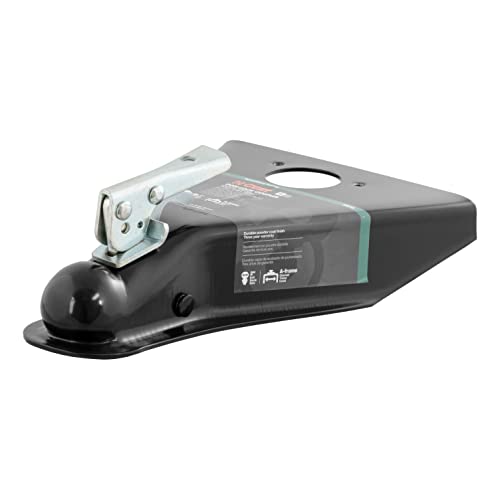
CURT 25210 Black A-Frame Trailer Coupler (B004IY5HES)
The CURT 25210 is an A-frame coupler for a 2-inch hitch ball, with a listed gross trailer weight capacity of 5,000 pounds and a tongue weight capacity of 700 pounds. It is made from steel with a gloss black powder-coat finish, and it uses a Posi-Lock latch that is adjustable with a bolt inside the latch mechanism. The coupler is described as lockable, which gives an owner a straightforward way to secure it on the ball, and CURT describes its couplers as carrying a limited lifetime warranty. Its dimensions are listed as 4 by 10 by 13.75 inches, which is a useful check against the tongue it will sit on.
This coupler suits an owner with an A-frame utility trailer, a small boat trailer, or a recreational trailer that uses a 2-inch ball and stays within a 5,000-pound loaded weight. It suits a replacement where the old coupler was the same A-frame style and ball size, and a builder who wants a standard-pattern A-frame coupler with a simple adjustable latch.
Skip this coupler if your loaded trailer exceeds 5,000 pounds, if your tongue weight exceeds 700 pounds, if your ball is not 2 inches, or if your tongue is a straight channel rather than an A-frame. Confirm the weld-on mounting instructions before you buy, because the listing describes this as an A-frame coupler without giving a separate weld-only instruction in the summary, and the fit must be checked against the tongue dimensions.
NBJINGYI 2-Inch Class III A-Frame Coupler (B07BLQZDVX)
The NBJINGYI 2-inch Class III A-frame coupler is rated at 7,000 pounds, which puts it a step above the 5,000-pound coupler above while keeping the same 2-inch ball size. That combination — same ball, higher capacity — is useful when the tow vehicle already has a 2-inch ball and the trailer is heavier than a light utility trailer but still within the 2-inch ball range. The listing describes a heavy-duty forged head, a powder-coated black finish, and a quick-lock latch for utility and equipment trailers. The item weight is listed at 3 kilograms, and the brand lists the manufacturer part number as JY-TC-08.
This coupler suits an owner with a heavier A-frame trailer who wants more capacity without changing to a larger ball size, where the loaded weight sits between 5,000 and 7,000 pounds. The forged head and quick-lock latch suit regular use, where the coupler is hitched and unhitched often. It also suits a replacement where the old coupler was rated lower than the load now carried, provided the tongue, ball, and safety chains are all rated to match.
Skip this coupler if your trailer uses a straight channel tongue, if your ball is larger than 2 inches, or if your loaded trailer exceeds 7,000 pounds. Do not choose it simply because the capacity number is higher if your trailer is light. Confirm the mounting dimensions and the weld-on method in the manufacturer instructions, and confirm that the ball, safety chains, and trailer frame are all rated for the load.
NBJINGYI Straight Trailer Coupler for 2-Inch Ball and 2-Inch Channel Tongue (B07BDFC714)
The NBJINGYI straight trailer coupler is the straight-tongue option in this guide, made for a 2-inch ball and a 2-inch channel tongue, with a gross weight capacity of 3,500 pounds. It is made from zinc-plated steel, which is a practical finish for a coupler that will see water and weather, and it uses a quick-lock latching system with a spring-loaded lever. The listing describes pre-drilled safety holes for a lock, and it presents the coupler as a fit for boat, utility, and equipment trailers with a straight tongue. Its straight body is made to sit on the end of a 2-inch channel, which is a common tongue size for small and medium trailers.
This coupler suits an owner with a straight-channel trailer who needs a direct replacement or a new coupler for a build, especially a boat trailer owner who values zinc plating for corrosion resistance. It suits a light utility trailer, a small boat trailer, or an equipment trailer that stays within 3,500 pounds loaded, and a user who wants a quick-lock latch that can be operated without tools.
Skip this coupler if your tongue is an A-frame, if your channel is wider or narrower than 2 inches, if your ball is not 2 inches, or if your loaded trailer exceeds 3,500 pounds. It is a light to medium-duty coupler, and choosing it for a heavier trailer would put the coupler below the load it must carry. Confirm the weld-on mounting method for your tongue in the manufacturer instructions.
What to Check Before You Buy
Before you order, run through a short check that prevents the most common mistakes. First, confirm the tongue style and measure it, including the channel width and the length available for the coupler body. Second, confirm the ball size on the tow vehicle and the size stamped on the old coupler. Third, work out the loaded weight of the trailer, including cargo, and check both the gross trailer weight rating and the tongue weight rating. Fourth, read the manufacturer mounting instructions for the exact model, confirm whether it is welded, bolted, or either, and confirm who will do the welding.
Fifth, check the latch, safety pin hole, and lock provision, and make sure you have a pin or lock that fits. Sixth, check the finish and the condition of the steel on arrival, and do not fit a coupler that arrives bent, cracked, or with a latch that binds. Seventh, clean the weld, inspect it, protect bare steel, and test the latch and socket with the ball before you load the trailer. Finally, check the ball, ball mount, safety chains, trailer lights, and trailer brakes where fitted, because a new coupler does not fix a worn ball or an underrated chain.
FAQ
What size ball does a weld-on trailer coupler need?
It needs the exact ball size stamped on the coupler. All three couplers in this guide are made for a 2-inch ball. A 2-inch ball in a coupler made for a larger ball will have play, and a larger ball will not seat in a 2-inch coupler. Replace them as a matched pair if you change size.
Can I weld a trailer coupler myself?
You can if you are a competent welder for the steel thickness involved and you follow the manufacturer instructions for fit and weld placement. The joint carries the full towing load, so the weld must have proper penetration and the coupler must be aligned before welding. If you are not confident, have a trailer shop fit and weld it.
How do I know if my trailer needs an A-frame or a straight coupler?
Look at the tongue from the front. If two rails meet in a point, it is an A-frame tongue and it needs an A-frame coupler. If a single tube or channel runs straight forward, it is a straight-channel tongue and it needs a straight coupler made for that channel width. Measure the channel width before you buy.
What happens if the coupler capacity is lower than my loaded trailer weight?
The coupler becomes the weak point in the towing setup, and it should not be used for that load. Choose a coupler rated at or above the loaded gross trailer weight and the tongue weight, and make sure the ball, safety chains, and trailer frame are also rated for that load. Do not tow a trailer that exceeds the lowest-rated component in the chain.
How often should I inspect a weld-on trailer coupler?
Inspect it before every tow and more thoroughly at least once a season. Before a tow, check that the latch closes fully, the safety pin or lock is in place, and the socket seats correctly on the ball. Seasonally, check the weld for cracks, the steel for rust, the latch for wear, and the ball for damage. Replace a coupler that shows cracking, bent steel, or a latch that will not hold.
Bottom Line
The best weld on trailer coupler for your trailer is the one that fits your tongue, matches your 2-inch ball, and covers your loaded weight with margin. For an A-frame trailer up to 5,000 pounds, the CURT 25210 is a straightforward, widely used choice with an adjustable Posi-Lock latch. For a heavier A-frame trailer up to 7,000 pounds on the same 2-inch ball, the NBJINGYI Class III A-frame coupler gives extra capacity with a forged head and a quick-lock latch. For a straight 2-inch channel tongue up to 3,500 pounds, the NBJINGYI straight coupler is the direct match, with zinc-plated steel and a quick-lock latch suited to boat and utility use. Measure first, confirm the weld-on instructions for the model you choose, have the weld done properly, and inspect the coupler before every tow.
Disclosure: As an Amazon Associate, we may earn from qualifying purchases.
Related guides
More from Amazon
Programs that pair well with the guide above. Offers and eligibility are set by Amazon and may change.
A free business account with business pricing and bulk-buying tools for work, shop or home office.
Create a business accountFree shipping on eligible items, Prime Video and more. Eligible new members can start with a free trial.
Start a Prime free trialAudiobooks and podcasts to listen to on the go. Eligible new members can start with a free trial.
Try Audible freeAd-free music streaming. Eligible new subscribers can start with a free trial.
Try Music Unlimited freeAs an Amazon Associate we earn from qualifying purchases.
Write Your Review
No reviews yet. Be the first to share your experience!