
Key takeaways
- The best weld on tie downs are forged weld-on D-rings with a stated working load limit and breaking strength. Compare two weld-on anchors for trailers and flatbeds and learn how to choose and weld them safely.
What's inside
As an Amazon Associate I earn from qualifying purchases. This post may contain affiliate links at no extra cost to you.
A tie down point is only useful if it is still there when the load shifts. Bolted and screwed anchors have their place on wood decks and thin panels, but on a steel trailer frame, a steel flatbed, or a steel truck bed, the strongest permanent option is an anchor that becomes part of the structure itself. Weld on tie downs are forged steel D-rings held in a weld-on clip or bracket. You position the clip where you actually need the pull, weld it to the frame or bed, and the ring is then free to pivot so a strap, rope, or chain hook can line up with the direction of the load.

That permanence is both the appeal and the responsibility. A weld-on anchor cannot be moved with a wrench, and its real strength depends as much on the weld and the steel underneath as on the ring itself. A forged ring with a high breaking strength means little if it is attached with a short, cold weld to thin, dirty metal. This guide therefore covers both the rings, with their stated load figures taken from their listings, and the choosing and welding decisions that decide whether those numbers are reached in practice.
Only true weld-on products are included here. Bolt-on D-rings, surface-mount plates that attach with screws, recessed pan fittings, and stake pocket inserts were all left out, even when their ratings looked attractive, because they solve a different problem. Every pick below is a forged D-ring supplied with a weld-on clip, intended to be welded to steel.
Disclosure: As an Amazon Associate, I earn from qualifying purchases.
What we cover
Quick Picks
- Best heavy-duty weld-on anchor: DC Cargo Mall Weld-On D-Ring Tie-Down Anchors, 5/8 inch, 4 pack — A forged alloy steel ring with an 18,900 lb assembly breaking strength and a 6,300 lb working load limit, a rotating ring, and a weld-on clip included. Choose this size for flatbeds, equipment trailers, and heavier machinery loads.
- Best bulk weld-on set for a full trailer build: Mytee Products Heavy Duty Weld-On Forged D Ring, 1/2 inch, 12 pack — A forged carbon steel ring sold as a pack of twelve, with a 12,000 lb breaking strength in the listing. Choose this format when you are fitting out a whole trailer or bed with matched anchor points rather than adding one or two.
1. DC Cargo Mall Weld-On D-Ring Tie-Down Anchors, 5/8 Inch, 4 Pack
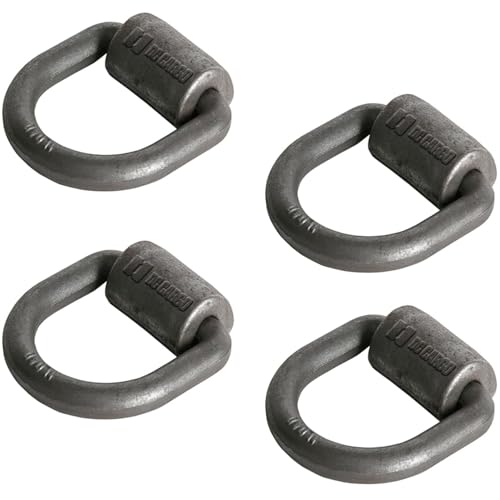
The DC Cargo Mall 5/8 inch weld-on D-ring is the heavier of the two picks and the one that fits most serious flatbed and equipment trailer work. The ring is forged steel, supplied with a weld-on clip, and the listing describes a rotating design, so the ring can pivot in its clip and align itself with the pull instead of forcing a strap or hook to bend sideways over a fixed edge. That pivoting matters in real use, because loads are rarely strapped in a perfectly straight line from the anchor, and a ring that can move reduces the twisting and edge loading that a rigid eye would pass into the weld.
The numbers are stated clearly. The listing gives an assembly breaking strength of 18,900 lb and a working load limit of 6,300 lb. Use the second number for planning. Breaking strength is the load at which the assembly is expected to fail, while the working load limit is the maximum load the anchor should see in normal service. The listing also gives useful dimensions: a 5/8 inch ring diameter, a width of about 4-1/4 inches, an inner length of about 3-1/8 inches, and an overall length of about 4-1/4 inches. Check that inner opening against your own hooks and strap fittings before you weld anything, because a hook that only just fits on the bench will be awkward to use in the dark with gloves on.
The surface is described as raw, paintable steel. That is the right format for a weld-on part, because coatings in the weld zone have to come off before welding anyway, and a bare finish lets you clean, weld, and then prime and paint the anchor with the surrounding frame. The manufacturer also states that these rings are tie-down anchors only and are not suitable for overhead lifting. Take that seriously: a tie-down rating is not a lifting rating, and these rings should never be used as a hoist point.
Specifications
- Type: Weld-on forged D-ring tie-down anchor with weld-on clip
- Ring diameter: 5/8 inch
- Pack size: 4 rings
- Material: Forged alloy steel, grey raw finish
- Assembly breaking strength: 18,900 lb
- Working load limit: 6,300 lb
- Width: About 4-1/4 inches
- Inner length: About 3-1/8 inches
- Mounting: Weld the clip to a steel trailer, flatbed, truck bed, dock, or warehouse structure
- Use limit: Tie-down only, not for overhead lifting
Pros
- Highest working load limit in this guide, at 6,300 lb per anchor
- Rotating, pivoting ring lines up with straps and hooks coming from different angles
- Weld-on clip is included, so no separate bracket has to be fabricated
- Bare, paintable finish is well suited to welding and then coating with the frame
- Dimensions and both load figures are stated in the listing, which makes load planning possible
Cons
- A 5/8 inch ring is oversized for light utility trailers, where it adds weight without adding usable safety
- Four anchors may not be enough for a long flatbed, so a second pack may be needed for even spacing
- Requires proper welding to sound steel; it is not a quick fit accessory
2. Mytee Products Heavy Duty Weld-On Forged D Ring, 1/2 Inch, 12 Pack
The Mytee Products 1/2 inch weld-on D-ring is aimed at a different job: fitting out an entire trailer, flatbed, or truck bed with a matched set of anchors in one go. It is sold as a pack of twelve forged rings, each supplied for weld-on mounting with a clip, which suits builders and repair shops who place anchors along both rails, across the front, and at the rear in a single session. Welding twelve separate anchors from mixed sources is a common source of inconsistency on a trailer, and a matched pack avoids having three different ring sizes and three different ratings on the same deck.
The listing title gives a breaking strength of 12,000 lb for this 1/2 inch ring, and the product details list forged carbon steel as the material, a load capacity of 12,000 pounds, and a pack weight of 10.8 pounds for the twelve. Mytee also sells the same weld-on family in other diameters, including a 3/8 inch version listed at 9,000 lb breaking strength and a 3,000 lb working load limit, which is a useful reminder to confirm the exact diameter on the listing you order rather than assuming every ring in a range shares one rating. For this 1/2 inch pack, plan your loads from the rating printed for the specific ring you receive, keep the working load well below the breaking figure, and treat the breaking strength as a failure point, never as a target load.
In practical terms, a 1/2 inch forged ring is the middle ground for general cargo: motorcycles, side-by-sides, mowers, building materials, and mid-weight machinery on a steel deck. The opening accepts common flat hooks, wire hooks, and chain grab hooks without the bulk of a larger ring, and the clip lets you weld the bracket flat to a frame rail, crossmember, or steel bed floor. As with the larger ring, preparation decides the result: grind back to clean metal, position the clip so the ring pivots freely, and check that pivot again after cooling.
Specifications
- Type: Weld-on forged D-ring tie-down anchor with weld-on clip
- Ring diameter: 1/2 inch
- Pack size: 12 rings
- Material: Forged carbon steel
- Breaking strength: 12,000 lb, as stated in the listing
- Load capacity listed: 12,000 pounds
- Manufacturer part number: D-Ring12-Wx12-AMZ
- Pack weight listed: 10.8 pounds
- Mounting: Weld the clip to a steel trailer, truck, flatbed, or similar steel structure
- Use limit: Tie-down only, not for overhead lifting
Pros
- Twelve matched anchors in one pack suit a complete trailer or bed fit-out
- 1/2 inch size fits a wide range of common hooks and strap fittings
- Forged carbon steel construction in a simple, proven clip-and-ring format
- Buying a matched set keeps ring size and rating consistent across the whole deck
Cons
- The listing record available for this pack states the breaking strength more clearly than a separate working load limit, so confirm the working load limit for the exact item before planning heavy loads
- Twelve rings is more than a small utility trailer needs, so single-trailer owners may have spares left over
- Requires proper welding to sound steel, and all twelve anchors need the same careful preparation to perform consistently
Weld-On, Bolt-On, and Why the Difference Matters
Weld-on anchors earn their strength from fusion with the structure. When the clip is properly welded to a frame rail or a steel bed, load passes from the ring into the clip, through the weld, and into a large area of the parent metal. There are no bolts to loosen, no nuts hidden under a deck to corrode unseen, and no holes drilled through a rail, which can themselves become stress points. For a permanent steel trailer that will carry similar loads for years, that is a genuine advantage.
The trade-offs are permanence and skill. Placement has to be decided before the first arc, because moving a welded anchor means cutting, grinding, and repairing the surface. Welding introduces heat, so nearby wiring, brake lines, fuel lines, wood decking, and paint need protection or removal first. The anchor is also only suitable for steel thick and sound enough to take the weld and the load. Welding a heavy ring to thin, rusted sheet creates a strong ring attached to weak metal that can tear out. If your deck is wood, aluminium, or thin sheet over light framing, a properly backed bolt-on or recessed anchor designed for that material is the safer choice.
How to Choose Weld On Tie Downs
Start with the working load limit, not the breaking strength. Breaking strength is a laboratory failure figure. The working load limit is the service figure, and for the DC Cargo Mall ring above it is one third of the breaking strength. Add up the cargo weight, consider how many anchors will actually share the load in the direction it could move, and keep the load on each anchor at or below its working load limit. Different anchors restrain forward, rearward, sideways, and vertical movement, so four anchors does not mean every load is shared equally by all four.
Match ring diameter to the load and the fittings. A 3/8 inch ring suits lighter cargo, a 1/2 inch ring covers most general trailer work, and a 5/8 inch ring suits heavier equipment and flatbed use. Larger is not automatically better: an oversized ring can be a poor fit for small hooks, adds weight, and tempts users to attach it to steel that is too thin for the rating. Check the inner dimensions against your largest hook and your strap fittings.
Confirm it is genuinely weld-on. Look for a forged ring supplied with a weld-on clip or bracket and a listing that describes welding as the installation method. If the listing talks about bolts, screws, backing plates with fasteners, or no-drill installation, it is a different product, however similar the ring looks in a photograph.
Check the finish and the material. Forged steel is the standard here because forging produces a dense, strong ring without a weak joint. A raw or lightly finished surface is easier to prepare for welding than a thick coating, which still has to be removed from the weld zone.
Plan the layout before welding. Place anchors so straps run at sensible angles, avoid positions where a ring will sit under a tyre or be crushed by a ramp, and keep rings clear of lights, wiring, and moving parts. Space anchors so small and large loads can both be secured without straps crossing sharp deck edges unprotected.
Respect the use limit. Weld-on D-rings in this category are tie-down anchors. They are not lifting eyes, not recovery points unless separately rated and engineered for that purpose, and not a substitute for a properly rated hitch, coupler, or safety chain attachment.
Welding and Installation Notes
Clean the clip and mounting surface back to bright metal, removing paint, rust, scale, oil, and any zinc coating near the joint, with appropriate fume control and respiratory protection, since fumes from coated steel are hazardous. Clamp the clip in position, confirm the ring pivots freely, and tack it before the full weld. Weld in accordance with the maker guidance and a procedure suitable for the thickness of both parts. Short, rushed welds on only the easiest side of the clip are a common failure point; the weld needs to develop the clip all around where the design intends it to be joined.
Let the anchor cool, check that the ring still moves, remove slag and spatter, then prime and paint the bare steel, including the weld, to slow corrosion. Inspect weld-on anchors during regular trailer checks for cracked welds, a bent ring, a distorted clip, and corrosion at the joint. Any anchor that has been overloaded or shows cracking should be cut off and replaced, not straightened and reused.
If you are not confident your welds can develop the full strength of the anchor, have the work done by a qualified welder. A tie-down system is a safety system, not a cosmetic accessory.
FAQs
How many weld on tie downs does a trailer need?
It depends on deck length and the loads carried, but the anchors must let you restrain cargo against forward, rearward, sideways, and upward movement with sensible strap angles. Many steel trailers use anchors along both sides plus at the front and rear. Weld in a well-planned set during a build or repair rather than discovering on the road that no anchor sits where a strap needs to run.
Can weld on D-rings be used for lifting?
No, not unless a specific product is separately rated and marked for lifting, which the tie-down rings in this guide are not. The DC Cargo Mall listing states that its rings are for tie-down anchors only and are not suitable for overhead lifting. Use proper lifting eyes and hardware rated for lifting for any hoist work.
What is the difference between breaking strength and working load limit?
Breaking strength is the load at which the assembly is expected to break. Working load limit is the maximum load it should carry in normal use, and it is much lower. For the 5/8 inch DC Cargo Mall ring, those figures are 18,900 lb and 6,300 lb. Always plan tie-down loads using the working load limit.
Can I weld a D-ring to any part of a trailer?
No. Weld only to steel that is thick, clean, and structurally sound, such as a suitable frame rail, crossmember, or steel bed structure, and only where the load can spread into that structure. Do not weld rated anchors to thin sheet, heavily rusted metal, or non-structural trim and expect the listed rating to apply.
Do weld on tie downs rust?
The rings and clips are steel, and the weld area is left bare by welding, so corrosion protection after installation is part of the job. Clean the finished weld, then prime and paint it along with the surrounding metal, and touch up damaged coating as part of regular trailer maintenance.
Conclusion
For most steel trailer and flatbed builds, the choice comes down to size and quantity. The DC Cargo Mall 5/8 inch weld-on D-ring, with a 6,300 lb working load limit and an 18,900 lb assembly breaking strength, is the pick for heavier equipment and flatbed work where each anchor has to do serious work. The Mytee Products 1/2 inch weld-on D-ring in a pack of twelve is the pick for fitting out a whole trailer or bed with matched, general-purpose anchors rated at 12,000 lb breaking strength in the listing.
Whichever ring you choose, the rating on the listing is only the starting point. Clean steel, a sound mounting location, a complete weld, corrosion protection afterwards, and loads planned against the working load limit are what turn a forged ring into a tie down point you can rely on.
Related guides
More from Amazon
Programs that pair well with the guide above. Offers and eligibility are set by Amazon and may change.
A free business account with business pricing and bulk-buying tools for work, shop or home office.
Create a business accountFree shipping on eligible items, Prime Video and more. Eligible new members can start with a free trial.
Start a Prime free trialAudiobooks and podcasts to listen to on the go. Eligible new members can start with a free trial.
Try Audible freeAd-free music streaming. Eligible new subscribers can start with a free trial.
Try Music Unlimited freeAs an Amazon Associate we earn from qualifying purchases.
Write Your Review
No reviews yet. Be the first to share your experience!