
Key takeaways
- Find the best vibration meter for motors, pumps and shop machinery. Compare five handheld picks with full specs, pros and cons, plus simple choosing tips.
As an Amazon Associate I earn from qualifying purchases. This post may contain affiliate links at no extra cost to you.
As an Amazon Associate we earn from qualifying purchases.
A shop full of rotating equipment talks to you long before it breaks down. Motors hum rougher, a pump develops a shake you can feel through the floor, and a compressor loosens its own mounts. A handheld vibration meter turns that gut feeling into a number you can log, compare month to month, and act on while a bearing swap is still a planned job instead of a midnight emergency.
The best vibration meter for most workshops measures three things: velocity for overall machine condition, acceleration for early bearing and gear wear, and displacement for slow, heavy equipment. Below are five handheld meters that cover those jobs in different ways, from a spectrum-capable diagnostic tool to simple route meters. Our take on each one weighs the published specifications and included accessories against real inspection work around welders, grinders, pumps, fans, and compressors.
Disclosure: This post contains affiliate links. If you buy through links on this page, we may earn a commission at no extra cost to you.
Quick picks
- Best for deeper diagnostics: TPI 9071 Smart Vibration Meter — spectrum view and bearing condition guidance
- Best for saving readings to a PC: ZOEYEC VM-6360 — wide ranges, data cable and software in the box
- Best classic route meter: VM6320 — analogue output and a full probe kit
- Best for simple spot checks: VVV-Group VM-420 — three parameters plus a high-frequency bearing band
- Best for dark machine cabinets: VVV-Group VM-422 — rotating color screen, built-in flashlight, and onboard memory
TPI 9071 Smart Vibration Meter

The TPI 9071 is the most capable tool in this group, built less like a simple gauge and more like a screening analyzer. Its cabled accelerometer uses a magnetic mount, so the sensor stays planted on the bearing housing while you read the color OLED in your hand. Built-in ISO alarms flag overall severity, and Bearing Damage Unit readings size up bearing condition without extra math.
What sets it apart in practical notes is the 800-line spectrum view with zoom and cursor, plus band filters that separate 1X unbalance, 2X misalignment, and 3X looseness energy. That points you toward a likely fault instead of a bare number, and IP67 sealing suits dusty fab shops.
Specs
- Sensor: cable-mounted accelerometer with magnetic base, BNC connection
- Display: full-color OLED with 800-line spectrum view, zoom, and cursor
- Guidance: ISO alarms, Bearing Damage Unit (BDU) readings, 1X/2X/3X fault-band filters
- Housing: sealed to IP67
- Size and weight: approx. 200 x 60 x 26 mm; 280 g (meter only, without magnet)
Pros:
- Spectrum view helps identify the fault type, not just the severity
- Cabled magnet sensor gives repeatable placement on bearing housings
- Sealed housing shrugs off dust and splashes
Cons:
- More capability than a quick pass-or-fail route needs
- The cabled sensor is one more item to coil and carry
ZOEYEC VM-6360 Digital Vibration Meter
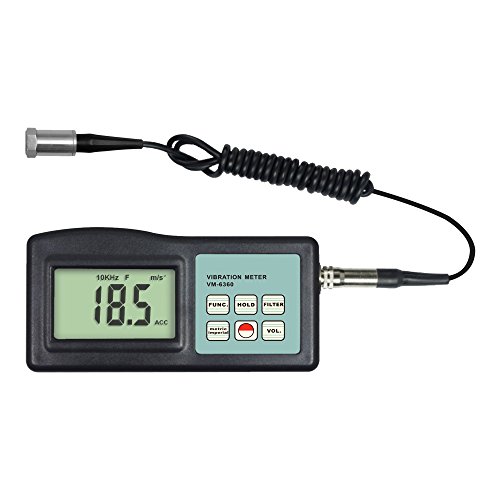
The VM-6360 covers the widest ground here. Velocity runs to 400 mm/s and displacement to 4.0 mm, so it handles everything from a small bench grinder to a large, slow air handler. Acceleration extends to 10 kHz in its extended mode, where early bearing defects show up first.
It also thinks about what happens after the route: an RS-232C data cable and software come in the case, so readings move to a PC for simple trending instead of living on a clipboard. Units switch between metric and imperial at a button press.
Specs
- Acceleration: 0.1 to 400 m/s² equivalent peak; 10 Hz to 1 kHz, extended 10 Hz to 10 kHz
- Velocity: 0.01 to 400 mm/s true RMS; 10 Hz to 1 kHz
- Displacement: 0.001 to 4.0 mm equivalent peak-peak; 10 Hz to 1 kHz
- Accuracy: ±5% of reading + 2 digits
- Sensor: piezoelectric accelerometer with cable and magnetic base
- Outputs: analogue AC output; RS-232C data cable and software included
- Power: 4 x AAA batteries (not included)
- Size and weight: 124 x 62 x 30 mm; 120 g (without batteries)
Pros:
- Widest velocity and displacement ranges in this group
- PC link hardware included in the box
- Compact, light body for long routes
Cons:
- Batteries not included, so grab AAAs before the first route
- Serial-style PC connection may need an adapter on newer computers
VM6320 Digital Vibration Meter

The VM6320 follows the classic route-meter pattern maintenance crews have used for years: a piezoelectric sensor, three measurement modes, and a plain, readable LCD. It is built for periodic measurements in line with ISO 2954, for checking imbalance, misalignment, and looseness on rotating machines.
The kit is the appeal: magnetic seat, cone probe, and spherical probe cover flat housings, curved surfaces, and tight spots, all in a carrying case. An analogue AC output feeds the raw signal to a scope or logger, and max-hold freezes the peak so you can pull the sensor away and still read it.
Specs
- Sensor: piezoelectric accelerometer
- Acceleration: 0.1 to 200 m/s² equivalent peak; 10 Hz to 1 kHz and 10 Hz to 10 kHz
- Velocity: 0.01 to 200 mm/s true RMS; 10 Hz to 1 kHz
- Displacement: 0.001 to 2.0 mm equivalent peak-peak; 10 Hz to 1 kHz
- Accuracy: within 5%
- Output: analogue AC output, 0 to 2.0 V peak full scale
- Power: 4 x AA batteries
- Size and weight: 160 x 68 x 32 mm; 181 g (without batteries)
Pros:
- Analogue output pairs with scopes and data loggers for a closer look
- Two probe shapes plus a magnet cover most mounting situations
- Simple FUNC, HOLD, and FILTER controls are easy to learn
Cons:
- No onboard storage; readings go on paper or out the analogue port
- Plain monochrome display is basic next to color-screen rivals
VVV-Group VM-420 Digital Vibration Meter

The VM-420 is the straightforward pick for shops that want a number, not a project. It measures acceleration, velocity, and displacement with a piezoceramic shear-type sensor, and ships with long and short probe heads for recessed bearing caps or flat motor feet.
Its high-frequency acceleration band, 1 kHz to 15 kHz, is the feature worth noting at this level: that is where worn bearings first announce themselves, well before overall velocity climbs. A backlit LCD and AC output round it out for monthly spot checks on pumps, fans, and compressors.
Specs
- Acceleration: 0.1 to 199.9 m/s² peak
- Velocity: 0.1 to 199.9 mm/s RMS
- Displacement: 0.001 to 1.999 mm peak-peak
- Frequency: acceleration 10 Hz to 1 kHz (LO) and 1 kHz to 15 kHz (HI); velocity and displacement 10 Hz to 1 kHz
- Accuracy: ±10%
- Sensor: piezoceramic accelerometer (shear type) with long and short probe heads
- Power: 9V battery
- Size and weight: 180 x 70 x 30 mm; 390 g
Pros:
- High-frequency band helps flag bearing wear early
- Long and short probes handle flat and recessed measuring points
- Simple layout suits occasional users and shared shop tools
Cons:
- ±10% accuracy is the loosest in this group
- No memory, so trending depends on your own logbook
VVV-Group VM-422 Digital Vibration Meter

The VM-422 takes the same three-parameter measurement set and wraps it in a friendlier body. The color screen rotates automatically, so the reading stays upright on a vertical pump casing or a horizontal motor. A built-in flashlight earns its keep in dark machine cabinets and under equipment.
Onboard memory stores readings as you walk a route, and dual measurement buttons trigger a reading from either side of the body, handy when reaching around guards or pipework. It runs on two AAA cells and travels in a molded plastic case with short and long probe heads.
Specs
- Acceleration: 0.1 to 199.9 m/s²
- Velocity: 0.1 to 199.9 mm/s
- Displacement: 0.001 to 1.999 mm
- Frequency range: 10 Hz to 4 kHz
- Accuracy: ±10%
- Display: color screen with automatic rotation; built-in flashlight and backlight
- Power: 2 x AAA batteries
- Size and weight: 180 x 70 x 30 mm; 640 g
Pros:
- Rotating color screen stays readable at awkward angles
- Flashlight helps in cabinets and under machines
- Memory keeps a whole route of readings on the meter
Cons:
- Heaviest meter in this group
- Frequency range is narrower than the VM-420 high band
- ±10% accuracy trails the tighter tools here
How to choose the right vibration meter
Match the parameter to the job. Velocity in mm/s RMS is the everyday measure of overall machine condition, and the one severity charts are built around. Acceleration, especially in a high-frequency band, exposes bearing and gear problems early. Displacement suits slow-turning, heavy equipment. Every pick above covers all three.
Check the frequency range. Most machinery faults live between 10 Hz and 1 kHz, which every meter here covers. If bearing condition is a priority, look for an extended acceleration band reaching 10 kHz or beyond, or a dedicated bearing-condition function like the TPI 9071 provides.
Think about sensor mounting. Repeatability beats raw precision: readings taken at the same point, direction, and mounting trend beautifully even on a basic meter. Magnets give the most consistent contact on clean, flat steel. Probe tips reach painted, curved, or recessed spots but depend on a steady hand, and cabled sensors help when the point sits behind guards or pipework.
Decide how readings will live. A notebook works for a handful of machines, but onboard memory or a PC link pays off once a route covers dozens of assets, because the trend line matters more than any single reading. Also weigh the basics: case, battery type, and screen readability.
Frequently asked questions
What does a vibration meter actually measure?
It measures how a machine part moves, expressed three ways. Velocity shows how fast the movement is and reflects overall condition. Acceleration shows how sharply it changes and reveals high-frequency faults such as worn bearings. Displacement shows how far the part travels, which matters most on slow, heavy equipment.
Which reading should I watch on motors and pumps?
Velocity in mm/s RMS is the standard watch item for motors, pumps, fans, and compressors. Compare it with ISO severity guidance and with that machine’s own history: a reading that doubles over two routes deserves attention even if it looks modest on a chart.
Is a magnet mount or a probe tip more repeatable?
On clean, flat steel, a magnet mount wins: it applies the same contact every visit, so readings stay comparable. A probe tip is the fallback for curved, painted, or tight surfaces. Either way, mark the point, keep the direction consistent, and measure under similar load and speed each time.
How often should shop machinery be checked?
Monthly routes suit critical machines such as the main compressor and primary pumps; less critical equipment can go quarterly. Add a check after any repair or belt swap, and whenever a machine sounds different or runs hotter.
Conclusion
For most welding and fabrication shops, the VM-6360 balances range, light weight, and a PC link for trending. Crews who want fault clues instead of bare numbers should look at the TPI 9071, while the VM6320 remains a dependable classic route meter. The VM-420 and VM-422 cover simple spot checks, the 422 adding a friendlier screen, a flashlight, and memory. Whichever meter you pick, use it on a schedule: the best vibration meter is the one that builds a history for every machine you depend on.
Related guides
More from Amazon
Programs that pair well with the guide above. Offers and eligibility are set by Amazon and may change.
A free business account with business pricing and bulk-buying tools for work, shop or home office.
Create a business accountFree shipping on eligible items, Prime Video and more. Eligible new members can start with a free trial.
Start a Prime free trialAudiobooks and podcasts to listen to on the go. Eligible new members can start with a free trial.
Try Audible freeAd-free music streaming. Eligible new subscribers can start with a free trial.
Try Music Unlimited freeAs an Amazon Associate we earn from qualifying purchases.

Write Your Review
No reviews yet. Be the first to share your experience!