
Key takeaways
- Compare the best decibel meter picks for welding shops, from simple handheld readers to a Type 2 kit with a calibrator, and learn how to choose well.
What's inside
As an Amazon Associate I earn from qualifying purchases. This post may contain affiliate links at no extra cost to you.
As an Amazon Associate we earn from qualifying purchases.
What we cover
Why a Welding Shop Needs a Real Sound Level Meter
A welding shop is loud in layers. An angle grinder screams, a plasma cutter hisses and pops, the air compressor cycles on without warning, and hammer work on a steel table rings through the whole building. Stacked together across a full shift, they add up to the kind of exposure that quietly damages hearing over months and years.
Guessing is the problem. A sound that feels merely annoying at arm’s length can measure well into the range where hearing protection stops being optional. Phone apps are not the answer either: phone microphones are built for voices, they clip on loud peaks, and two phones side by side can disagree by a wide margin.
A dedicated meter solves this in seconds. Hold it where your ears work, read it while the loudest task runs, and you have a number you can act on: move the task, add a barrier, or make muffs mandatory at that bench. The five meters below cover everything from quick spot checks to documented workplace surveys.
Disclosure: This post contains affiliate links. If you buy through links on this page, we may earn a commission at no extra cost to you.
Quick Picks
- Tadeto Digital Sound Level Meter — best all-round pick for everyday shop checks, with A and C weighting.
- BAFX Products Decibel Meter — the simplest option here, with long run time on a single 9V battery.
- Protmex PT6708 Sound Level Meter — adds an analog bar graph and fast/slow response.
- RISEPRO HT-80A Decibel Meter — a compact pocket meter for fast walk-around checks.
- Extech 407732-KIT Sound Level Meter Kit — the serious choice for documented surveys, a Type 2 meter bundled with its own calibrator.
Tadeto Digital Sound Level Meter
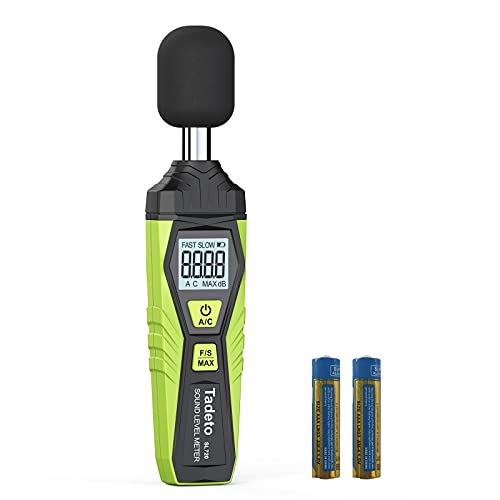
The Tadeto is the meter we would hand to a shop owner who wants honest numbers without a learning curve. It covers the full span of a workshop, from a quiet office corner to a grinder at full song, and reports in both A weighting for exposure checks and C weighting for the flatter picture of a machine with a deep rumble. The four-digit backlit display reads cleanly in any light, and MAX hold keeps the peak on screen after a cut, so you see the worst moment, not a blur of numbers.
Specs
- Range: 30 to 130 dB
- Accuracy: ±2.0 dB
- Resolution: 0.1 dB
- Weighting: A and C
- Power: 2 x AA batteries (included)
- ASIN: B09G6HLNVV
Pros:
– Wide range covers quiet rooms and loud grinding
– A and C weighting in one handheld body
– Backlit screen reads well anywhere in the shop
Cons:
– Accuracy is a step behind Type 2 instruments
– No data logging or computer connection
BAFX Products Decibel Meter
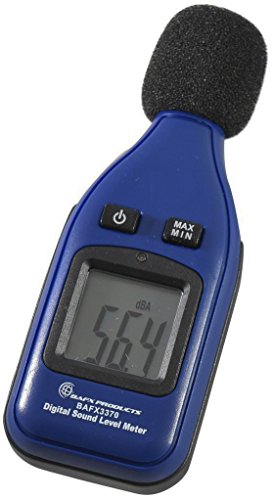
The BAFX meter has been a workshop staple for years because it removes every barrier between you and a reading. There are effectively two controls: power, and a MAX/MIN button. Turn it on, point it at the work, and the large backlit display shows the level along with the highest and lowest values captured during the session. Its single A weighting matches how human ears perceive sound, the scale that matters for hearing protection decisions. A 9V battery delivers up to 30 hours of use, so it can live in a toolbox drawer for months. Our take: a spot-check tool, not a survey instrument, and all the better for it.
Specs
- Range: 30 to 130 dBA
- Accuracy: ±1.5 dB
- Resolution: 0.1 dB
- Weighting: A
- Power: 1 x 9V battery (included), up to 30 hours
- Model: BAFX3370
- ASIN: B00ECCZWWI
Pros:
– Dead simple to use, almost no setup
– Long battery life suits occasional checks
– MAX/MIN capture shows a task’s loudest moment
Cons:
– A weighting only, no C-weighted machine checks
– Not certified for formal compliance records
Protmex PT6708 Sound Level Meter

The Protmex PT6708 suits the fabricator who wants to see how a sound behaves, not just where it peaks. Beside the digital readout, the large backlit screen carries an analog bar graph that moves with the sound, making fluctuating sources like a cycling compressor easier to judge at a glance. Fast response follows sudden bangs and pops, while slow response smooths readings into a steadier average. It offers A and C weighting, auto and manual ranging, and a SONE display for perceived loudness, all in an anti-slip orange body that meets IEC651 Type 2 requirements, with batteries and a pouch included.
Specs
- Range: 30 to 130 dB (A), 35 to 130 dB (C)
- Accuracy: ±1.5 dB
- Resolution: 0.1 dB
- Weighting: A and C
- Time weighting: Fast (0.125 s), Slow (1 s)
- Display: Backlit LCD plus analog bar graph
- Power: 4 x AAA batteries (included)
- ASIN: B0CTQR1GR4
Pros:
– Bar graph makes changing noise easy to follow
– Fast and slow response, A and C weighting
– SONE display adds a perceived-loudness view
Cons:
– No logging, so survey notes are manual
– Larger body than the pocket meters here
RISEPRO HT-80A Decibel Meter

The RISEPRO HT-80A is the meter that lives in a shirt pocket or the top tray of a roll cab. At just 107 grams it is the lightest tool here, yet it covers the same broad span as the bigger handhelds, split across dual ranges so quieter spaces get a finer reading. Backlight, MAX/MIN memory, data hold, and automatic power off cover the essentials. Note on selection: the VLIKE meter planned for this slot could not be verified with a confirmed Amazon listing, so we substituted the RISEPRO HT-80A, a well established pocket meter in the same class. It reads A weighting only with a fast response, so treat it as a scout for quick checks rather than a survey instrument.
Specs
- Range: 30 to 130 dB, dual ranges
- Accuracy: ±1.5 dB
- Weighting: A
- Time weighting: Fast (125 ms)
- Functions: MAX/MIN, data hold, auto off, backlight
- Power: 1 x 9V battery (not included)
- ASIN: B01EZZ8B5Q
Pros:
– Smallest and lightest meter in this guide
– Dual ranges give finer readings in quiet areas
– Pouch included for toolbox storage
Cons:
– A weighting and fast response only
– Battery is not included in the box
Extech 407732-KIT Sound Level Meter Kit
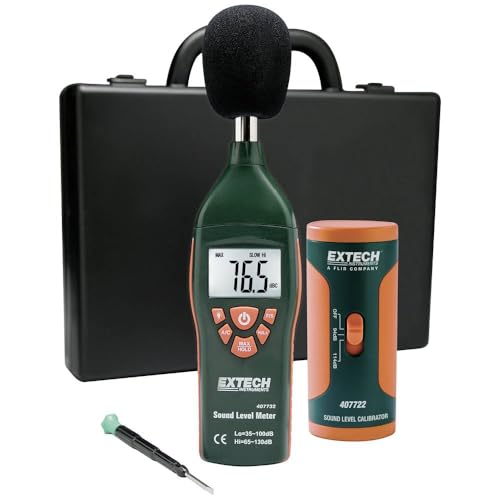
The Extech kit is in a different league, and it is the one to choose when readings may end up in a safety file. The 407732 meter meets ANSI and IEC 651 Type 2 standards, measures across two ranges from quiet rooms to the loudest shop tasks, and holds live and maximum values on a backlit display. What lifts the kit is the bundled 407744 calibrator, which produces a known 94 dB tone so you can verify the meter before a survey, the step that turns a number into evidence. A windscreen, batteries, and a hard case complete the package. Our take: more than a one-person shop needs, but the correct tool for any business documenting a safety program.
Specs
- Range: 35 to 130 dB in two ranges
- Accuracy: ±1.5 dB
- Weighting: A and C
- Standard: ANSI and IEC 651 Type 2
- Kit: 407732 meter, 407744 94 dB calibrator, windscreen, hard case
- Power: 9V batteries (included)
- ASIN: B0039FB7EQ
Pros:
– Type 2 accuracy suited to documented surveys
– Bundled calibrator verifies readings before use
– Hard case keeps the whole kit together
Cons:
– Bulkiest option here, a kit not a pocket tool
– More features than a casual user will touch
How to Choose the Right Meter for Your Shop
Start with the job, not the gadget. If you only need to know which bench needs ear muffs, a simple A-weighted handheld like the BAFX or RISEPRO is enough, because hearing risk is judged on the A scale. If you also want to understand machine noise, especially low rumble from compressors and fans, choose a meter with C weighting as well, like the Tadeto or Protmex. The gap between the A and C readings tells you how much low-frequency energy is present.
Next, think about proof. Readings taken for a safety program or an insurance file carry more weight when they come from a Type 2 instrument checked against a calibrator the same day. That is the Extech kit’s whole reason to exist. Casual before-and-after checks, such as checking a grinder moved behind a screen, do not need that formality.
Response speed matters more than most buyers expect. Fast response catches impact noise from hammering, dropped steel, and cutoff wheels. Slow response gives a calmer average for steady sources like a running welder fan. A meter with both settings handles the full mix of a fabrication shop.
Finally, sweat the practical details. A backlit screen matters in dim shops, and MAX hold matters when you work alone and cannot watch the display mid-cut. Battery type matters too: AA and AAA cells are easy to keep in a drawer, while 9V meters often run far longer per battery. Keep the windscreen on near fans, because moving air across the microphone reads as noise.
Frequently Asked Questions
How loud does a welding shop get, and when is hearing protection needed?
A running angle grinder commonly measures around 95 to 105 dBA at the operator’s ear, and plasma cutting lands in a similar zone. Sustained exposure at or above 85 dBA across a shift is the level where hearing protection becomes necessary. A meter takes the guesswork out: measure at ear position during real work, and set your shop rules from the number you find.
Can a phone app replace a dedicated meter?
For a rough sense of whether a room is quiet or loud, an app is fine. For decisions about hearing protection, it is not. Phone microphones are tuned for speech, handle sudden peaks poorly, and vary widely between models. A dedicated meter uses a purpose-built condenser microphone and a defined weighting network, so its readings are repeatable and comparable between shops.
What is the difference between A and C weighting?
A weighting filters the measurement to match human hearing, trimming low and very high frequencies the ear barely notices, and it is the scale used for exposure and hearing risk. C weighting is much flatter, keeping more low-frequency content, which suits judging machinery rumble and a source’s true level. Meters that offer both give the fullest picture.
How should I take a reading for a fair result?
Hold the meter at ear height for the person doing the work, point the microphone toward the source, and keep your body from blocking the sound. Keep the windscreen fitted, read during a typical work cycle rather than a single loud moment, and note the MAX value and the steady level. Repeat at each workstation, because two benches in the same shop can differ by a surprising amount.
Conclusion
Grinding, plasma cutting, and compressor placement get easier to manage once you can put a number on the noise. The Tadeto is our default recommendation for most workshops, the BAFX and RISEPRO cover fast and simple checks, the Protmex adds a bar graph and response control for deeper looks, and the Extech kit stands ready when a reading has to be documented and defended. Pick the meter that matches the questions you actually ask, and let the numbers, not your ears alone, decide when the muffs go on.
Related guides
More from Amazon
Programs that pair well with the guide above. Offers and eligibility are set by Amazon and may change.
A free business account with business pricing and bulk-buying tools for work, shop or home office.
Create a business accountFree shipping on eligible items, Prime Video and more. Eligible new members can start with a free trial.
Start a Prime free trialAudiobooks and podcasts to listen to on the go. Eligible new members can start with a free trial.
Try Audible freeAd-free music streaming. Eligible new subscribers can start with a free trial.
Try Music Unlimited freeAs an Amazon Associate we earn from qualifying purchases.
Write Your Review
No reviews yet. Be the first to share your experience!