
Key takeaways
- Find the best wire tracer for your shop with five tone and probe kits compared for tracing data, phone, coax and hidden low-voltage runs fast.
As an Amazon Associate I earn from qualifying purchases. This post may contain affiliate links at no extra cost to you.
As an Amazon Associate we earn from qualifying purchases.
Every workshop has a mystery run: a thermostat lead that vanishes into a wall, a speaker wire with no label at either end, or a bundle of identical gray cables where only one matters. Guessing means pulling and opening boxes you did not need to open. A tone generator and probe kit ends the guessing: clip the generator onto one end, it puts a signal on that conductor, and the probe sings louder as you sweep the bundle until you hold the exact wire you need.
In a fabrication shop that job shows up often, from control wiring and phone drops to network runs and camera coax. The best wire tracer for your bench depends on whether you mostly chase low-voltage lines, or also need to follow live circuits safely.
Disclosure: This post contains affiliate links. If you buy through links on this page, we may earn a commission at no extra cost to you.
Quick picks
- Best all-around: Klein Tools VDV500-820 — five cadences, continuity and polarity checks, probe worklight.
- Best for long runs: Fluke Networks Pro3000 — loud tone, very long reach, five SmartTone patterns.
- Best for live circuits: Triplett 3388 Fox and Hound HotWire — traces energized lines up to 250 VAC.
- Best compact kit: Extech TG20 — simple transmitter and non-contact probe for phone and bundle work.
- Best classic pro kit: TEMPO 701K-G — high-power generator and proximity LED.
The 5 best kits compared
1. Klein Tools VDV500-820 Tone and Probe PRO Kit

The Klein VDV500-820 is the kit we would hand to a tech who traces a little of everything. Its generator puts out five distinct cadences, so you can tone two runs and still tell them apart in a crowded bundle. Angled Bed of Nails clips stay put while you walk to the far end, and the RJ11 plug drops into a phone jack or, on the center pins, a data jack. In our take, it is the easiest daily driver here.
The probe adds an adjustable-volume speaker, a headphone jack for loud bays, a worklight, and a replaceable tip that will not short neighboring contacts. The generator also handles continuity and polarity checks with labeled LEDs. It is for non-energized wiring only.
Specs
- Model: VDV500-820 Tone and Probe PRO Kit
- Cable types: Ethernet, telephone, speaker, coax, video, and data
- Connectors: RJ45, RJ11, and RJ12, plus Angled Bed of Nails clips
- Tones: 5 distinct cadences
- Power: 9V battery powered
- Probe extras: Adjustable volume, 3.5 mm headphone jack, worklight, replaceable tip
- Weight: 1.28 pounds
- ASIN: B07VYN98QV
Pros:
– Five cadences make multi-run tracing less confusing
– Continuity and polarity LEDs add quick fault checks
– Worklight and headphone jack suit dark, noisy shops
Cons:
– For non-energized circuits only
– Headphones are not included
2. Fluke Networks Pro3000 Tone Generator and Probe Kit

Fluke Networks built its name on test gear that survives daily field use, and the Pro3000 carries that reputation into analog toning. Its strength is reach and clarity: the generator sends a loud tone that stays identifiable over very long runs, which matters when a cable crosses a large building. SmartTone gives you five distinct tones, and changing the tone at the generator end confirms you found the right pair without walking back.
Our take is that the Pro3000 suits anyone who tones often and hates faint signals. It connects to RJ jacks with its male RJ11 plug and handles bare pairs with clips, while the probe uses a replaceable tip and a loud speaker. It works on non-active networks only.
Specs
- Model: Pro3000, part number 26000900
- Technology: SmartTone with 5 distinct tones
- Reach: Up to 10 miles in maker testing on suitable cable
- Use: Tone and trace wire on non-active networks
- Power: 9 volt alkaline batteries
- Included: Tone generator and unfiltered probe
- ASIN: B000FTADX0
Pros:
– Exceptionally loud, clear tone for long runs
– SmartTone change confirms the correct pair from the far end
– Simple, rugged controls with replaceable probe tip
Cons:
– For non-active networks only
– Unfiltered probe picks up more ambient noise in busy panels
3. Triplett 3388 Fox and Hound HotWire Live Wire Tracing Kit

Most tone kits here must stay off live power wiring. The Triplett 3388 is the exception, and that difference earns it a place on any bench that deals with building wiring. Its Fox transmitter and Hound receiver trace wires from 0 to 250 VAC and follow runs up to 1,000 feet, including conductors hidden in walls and shallow buried runs. Adjustable sensitivity helps you narrow from a whole wall to a single line.
In practical notes, the useful extras are TrueTrace indication, which confirms you are locked onto the right conductor, plus probe headlights for dark boxes. Warble or pulsed tones with selectable pitch help when neighboring circuits bleed signal. Respect the instructions around energized work, and this is the kit for when the breaker stays on.
Specs
- Model: 3388 Fox and Hound HotWire
- Voltage range: Traces wires from 0 to 250 VAC
- Reach: Up to 1,000 feet
- Sensitivity: Adjustable on the receiver
- Tones: Warble or pulsed, with selectable pitch
- Probe extras: LED headlights, signal-strength indication, earphone jack
- Power: 9V battery powered
- ASIN: B0046SPMG4
Pros:
– Traces live circuits where the other kits here cannot be used
– Adjustable sensitivity helps isolate one line in a wall
– Headlights and selectable tones aid work in tight boxes
Cons:
– Live work demands extra care and strict adherence to instructions
– Larger learning curve than a basic low-voltage kit
4. Extech TG20 Wire Tracer Kit and Tone Generator
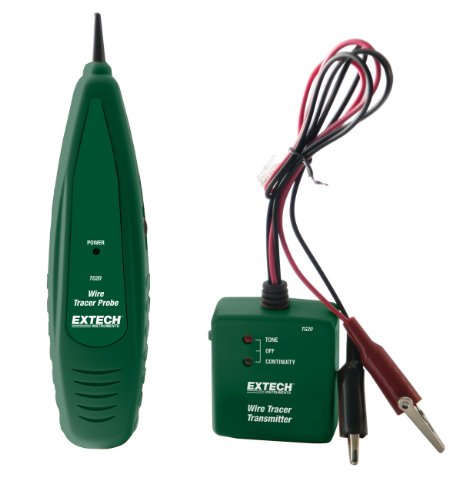
The Extech TG20 keeps things simple, and for many small shops that is exactly right. The transmitter ends in an RJ11 connector and includes alligator clips, so you can tone a jack, bare leads, or a single conductor. The non-contact probe picks the signal up through insulation, so you identify the right cable without stripping anything.
Our take is that the TG20 fits occasional tracing best: labeling phone drops, sorting speaker leads, or finding which run goes to which room. It also checks phone line operation and offers a continuity test, with adjustable sensitivity for dense bundles. Its compact size means it actually lives in the toolbox.
Specs
- Model: TG20 Wire Tracer Kit
- Detection: Non-contact amplifier probe, audible identification
- Transmitter connections: RJ11 connector and alligator clips
- Functions: Wire identification in a group, phone line check, continuity test
- Controls: Adjustable sensitivity on the probe
- Power: Battery powered, 9 volts DC
- Included: Probe, transmitter, alligator clips, and two 9V batteries
- Use limit: Non-energized circuits only
- ASIN: B00APD16D2
Pros:
– Very easy to learn, with transmitter and probe ready to work
– Non-contact probe protects insulation and speeds up sorting
– Clips plus RJ11 cover both bare wire and phone jacks
Cons:
– Non-energized circuits only, with modest capability for long runs
– Fewer tone options than the pro kits
5. TEMPO Communications 701K-G Tone Generator and Probe Kit

TEMPO treats the 701K-G as an industry-standard kit, and using it shows why. The 77HP-G generator drives a strong warbling signal through voice, data, video, and security wiring, while the 200EP-G probe adds a feature we wish every probe had: an LED proximity indicator that glows brighter as you close in on the correct pair. That visual cue is gold in a loud bay.
The rest is field-ready: a modular plug, alligator leads, RJ11 and RJ45 pieces, and a socket adapter in a woven case. The generator supports polarity and continuity checks, and the probe brings adjustable gain, a worklight, and a headphone connection. For a classic analog kit with no fuss, this is our take for the long haul.
Specs
- Model: 701K-G, listed as 701K-G-BOX
- Generator: 77HP-G high-power tone generator
- Probe: 200EP-G amplifier probe with LED proximity indicator
- Voltage protection: Up to 150 volts as listed for the generator
- Power: Battery powered; each unit uses a 9V battery
- Included: Modular plug, alligator leads, RJ11 and RJ45 pieces, socket adapter, case
- Probe extras: Adjustable gain, LED worklight, headphone support, replaceable tips
- ASIN: B083Z7V7C2
Pros:
– Proximity LED gives visual confirmation in loud areas
– High-power tone handles voice, data, video, and security runs
– Complete lead and adapter set in a durable case
Cons:
– Analog only, with no digital toning modes
– Two similar warble tones can take practice to tell apart
How to choose
Start with the circuit, not the brand. If every run you trace is dead low-voltage wiring — network, phone, speaker, coax, or intercom — any analog kit here will work, and you should never connect one to live power wiring. If you must follow energized circuits, choose a kit built for live tracing, like the Triplett above, and follow its manual without exception.
Next, think about distance and density. Short runs need only a basic kit. Long runs reward a louder generator, multiple cadences, and adjustable gain, because signal bleeds into neighboring pairs. In dense bundles, pair-confirming features — a changing tone or a proximity LED — save more time than volume alone.
Then check connections. RJ11 and RJ45 plugs speed up jack work, and clips handle bare conductors. In noisy, dark shops, prioritize a headphone jack, a strong speaker, and a worklight. Daily users should also favor replaceable tips and a sturdy case.
FAQs
Can I use a tone generator on a live electrical circuit?
Only with a kit specifically designed and labeled for live tracing. Most kits, including the Klein, Fluke, Extech, and TEMPO models here, are for non-energized wiring only, and connecting one to live power can damage the tool and create a hazard. For energized circuits, use a live-circuit tracer like the Triplett 3388 and follow its instructions exactly.
What is the difference between a wire tracer and a circuit breaker finder?
A tracer follows a specific conductor end to end, even through bundles and walls, by listening for a signal injected onto that wire. A breaker finder is narrower: its transmitter plugs into an outlet and its receiver scans a panel to identify which breaker feeds it. Shops that rewire low-voltage systems usually need the tracer first.
How far will a tone signal travel?
It depends on generator strength, cable type, and termination. Basic kits handle typical in-building runs, pro kits list reach around 1,000 feet, and the Fluke Pro3000 lists tone reach in miles on suitable open cable in maker testing. In real walls and bundles, expect less, and use adjustable sensitivity to stay locked on.
Do I need digital toning, or is analog enough?
For most shop wiring — phone, speaker, coax, control leads, and patch runs — analog toning is enough and faster to learn. Digital toning helps on active data networks, where an analog signal can be hard to hear or should not be injected at all. A solid analog kit with several cadences covers nearly every other job.
Conclusion
A tracer kit earns its toolbox space the first time it turns an hour of guessing into five minutes of certainty. Choose the Klein for balanced low-voltage work, the Fluke for long runs, the Triplett for live circuits, the Extech for simple sorting, and the TEMPO for a classic pro kit. Match the kit to your circuits, and it will still give clear answers years from now.
Related guides
More from Amazon
Programs that pair well with the guide above. Offers and eligibility are set by Amazon and may change.
A free business account with business pricing and bulk-buying tools for work, shop or home office.
Create a business accountFree shipping on eligible items, Prime Video and more. Eligible new members can start with a free trial.
Start a Prime free trialAudiobooks and podcasts to listen to on the go. Eligible new members can start with a free trial.
Try Audible freeAd-free music streaming. Eligible new subscribers can start with a free trial.
Try Music Unlimited freeAs an Amazon Associate we earn from qualifying purchases.

Write Your Review
No reviews yet. Be the first to share your experience!