What's inside
As an Amazon Associate I earn from qualifying purchases. This post may contain affiliate links at no extra cost to you.
The best metal cutting bandsaw for beginners is usually a compact, corded horizontal saw with a quick-adjust vise, clear angle markings, and a blade that is easy to replace; for occasional home-shop work, the WEN BA4664 is a practical starting point, while a portable band saw makes more sense if storage space or cutting long stock matters most.
As an Amazon Associate we earn from qualifying purchases at no extra cost to you.

What we cover
Beginner-friendly metal-cutting bandsaws at a glance
These models cover different shop needs rather than forming a single ranking. Capacity and weight can vary by configuration, so confirm the current manufacturer specifications before buying. Prices are broad U.S. market ranges, not quotes.
| Model | Style | Maximum capacity* | Blade | Approx. weight | Typical price range | Best fit |
|---|---|---|---|---|---|---|
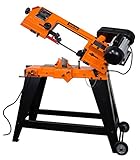
| WEN BA4664 | Horizontal/vertical benchtop | About 4 × 6 in. rectangular stock | 64½ × ½ in. | About 55 lb | $200–$350 | First fixed saw for small-shop projects |
| VEVOR 4 × 6-inch metal bandsaw | Horizontal/vertical benchtop | About 4 × 6 in. rectangular stock | Typically 64½ × ½ in. | Roughly 55–65 lb, depending on version | $200–$400 | Budget buyers comfortable checking setup carefully |
| JET HVBS-56M | Horizontal/vertical benchtop | About 5 × 6 in. rectangular stock | About 64½ × ½ in. | About 115 lb | $700–$1,000 | More frequent use and a sturdier shop setup |
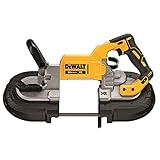
| DEWALT DCS374B | Portable cordless | Up to 5 in. round or rectangular stock | About 32⅞ × ½ in. | About 13 lb, tool only | $300–$500, tool only | On-site cuts and easy storage |
*Capacity depends on stock shape and cut orientation. A saw’s published maximum does not guarantee a clean, convenient cut at that size. Verify the exact model, included blade, and current specifications before purchase.
Choose by your shop situation
- Occasional cuts, limited budget: Start with a 4 × 6-inch benchtop saw such as the WEN BA4664. It offers a defined cutting area and can be bolted to a bench or stand. Budget time for setup and blade adjustment.
- Tight storage or work away from the bench: Choose a portable saw such as the DEWALT DCS374B. It is easier to put away and can cut stock that would be awkward to bring to a fixed saw. The trade-off is that the operator must guide the tool, so holding square, repeatable angles takes practice.
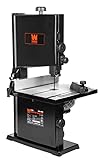
- Regular shop use and heavier stock: A heavier benchtop machine such as the JET HVBS-56M is more substantial, but it needs a solid stand and more room. Its extra capacity is only useful if your projects actually need it.
- Lowest purchase price: A VEVOR 4 × 6-inch saw may suit a careful buyer willing to inspect alignment, tension, and vise movement on arrival. Compare the exact version: product names can cover configurations that differ.
What matters most for a first-time owner
Blade changes and setup
A small horizontal saw is often easier to learn on because the work rests in a vise while the saw head lowers through it. Before buying, check that the blade guard opens without awkward disassembly and that the tensioning handle is accessible. A blade change still involves threading the blade around the wheels, seating its teeth correctly, setting tension, and checking tracking. “Quick release” does not remove those steps.
Most compact 4 × 6 saws use a common blade length near 64½ inches, but tooth pitch matters as much as length. For thin-wall tubing, choose a finer pitch so several teeth engage the wall at once. For thicker solid stock, a coarser pitch can clear chips more effectively. Using too few teeth on thin material can snag it; too many on thick material can clog and cut slowly.
Vise adjustment and angle cuts
Look for a vise that opens smoothly, clamps stock near the blade, and can be adjusted without lifting or twisting the work. For a miter cut, a swivel-head design may pivot the saw head while the vise stays put; other machines require rotating the vise or work. Either arrangement can work, but readable angle marks and a positive way to lock the setting make repeat cuts easier.
Do not trust the printed scale alone for precision work. Make a test cut in scrap, check it with a square or angle finder, then correct the setup before cutting the final piece. A small error in the angle setting can become obvious when two cut ends must meet.
Footprint and cut quality
A benchtop saw needs more room than its base suggests: allow space for the head to descend, the workpiece to extend beyond the vise, and long stock to be supported. A portable saw saves bench space, but it needs a stable clamping arrangement and a practiced hand for square cuts. If your stock is long, plan supports at the same height as the vise so it cannot sag or twist.
Cut quality depends on more than the machine. A sharp, appropriate blade; secure clamping; correct blade tension; and a controlled feed all help produce straighter cuts and longer blade life. For a cut that wanders, first check whether the stock is firmly clamped and the blade is sharp and tracking correctly. Pushing harder usually makes the problem worse.
Setup routine that prevents common beginner problems
- Secure the saw. Bolt a benchtop model to a stable surface. Vibration can affect cut quality and loosen the work in the vise.
- Check the blade and guards. Confirm the teeth face the correct direction, the blade is seated on the wheels, and guards are in place before powering on.
- Square the vise. Clamp a piece of scrap, make a short test cut, and check the cut face against the stock. Adjust the vise or head if needed.
- Set the work and feed gently. Clamp near the cut, support long stock, and let the blade do the work. For thin-wall tubing, use a finer-tooth blade and avoid excessive pressure.
- Clean after cutting. Disconnect power before clearing chips. Brush metal chips from the vise and blade area; do not use your hand. Keep chips out of moving parts and check blade tension and condition regularly.
Real ownership costs and trade-offs
The purchase price is only part of the cost. Blades are consumables, and the wrong pitch or poor tension can shorten their life. Keep a spare compatible blade on hand if a project depends on the saw. Also budget for a stable stand or bench, stock supports, and—where appropriate—a cutting fluid suited to the material and saw. Follow the manufacturer’s guidance, especially for portable saws that may not be designed for flood coolant.
On entry-level machines, common sources of frustration are a vise that needs careful squaring, a blade that is tensioned or tracked incorrectly, and chips accumulating around the wheels. These are usually manageable maintenance issues, not reasons to force a cut. Stop if the blade wanders, slips, or makes an unusual sound; inspect the setup before continuing.
Bottom line
For a beginner making occasional cuts in a home shop, a compact 4 × 6-inch horizontal saw is generally the easiest format to learn because the vise holds the work and the saw head controls the cut. Choose the WEN BA4664 as a budget-oriented starting point, consider the JET HVBS-56M for more frequent use and a sturdier setup, and choose a portable model such as the DEWALT DCS374B when storage and mobility outweigh hands-free repeatability. Whichever style you buy, prioritize a secure vise, accessible blade changes, and room to support the stock—not just the largest advertised capacity.