What's inside
- Best Gasless MIG Welder for Home Repairs and Fabrication
- Quick comparison of the leading choices
- Why the Forney Easy Weld 140 FC-i is the best overall pick
- Head-to-head: what changes between the choices?
- Decision matrix: match the machine to the job
- Wire feeding, penetration, and spatter
- Sheet-metal control is where cheap machines struggle
- Outdoor usability and limitations
- Ownership costs and maintenance
- Final recommendation
- Best Gasless MIG Welder for Home Repairs and Fabrication
- Quick comparison of the leading choices
- Why the Forney Easy Weld 140 FC-i is the best overall pick
- Head-to-head: what changes between the choices?
- Decision matrix: match the machine to the job
- Wire feeding, penetration, and spatter
- Sheet-metal control is where cheap machines struggle
- Outdoor usability and limitations
- Ownership costs and maintenance
- Final recommendation
As an Amazon Associate I earn from qualifying purchases. This post may contain affiliate links at no extra cost to you.
What we cover
- Best Gasless MIG Welder for Home Repairs and Fabrication
- Quick comparison of the leading choices
- Why the Forney Easy Weld 140 FC-i is the best overall pick
- Head-to-head: what changes between the choices?
- Decision matrix: match the machine to the job
- Wire feeding, penetration, and spatter
- Sheet-metal control is where cheap machines struggle
- Outdoor usability and limitations
- Ownership costs and maintenance
- Final recommendation
Best Gasless MIG Welder for Home Repairs and Fabrication
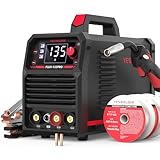
The Forney Easy Weld 140 FC-i is the best gasless MIG welder for most home repairs because it combines a useful 140-amp ceiling, simple polarity changes, compact size, and enough control for mild-steel brackets, garden equipment, trailer repairs, and light fabrication.
A flux-cored welder is often called a gasless MIG welder, although the terminology is technically loose. It uses continuously fed wire like a MIG machine, but self-shielded flux-cored wire produces its own shielding gas. That makes it more practical outdoors than a conventional MIG setup, but it also creates more smoke, slag, and spatter.
As an Amazon Associate we earn from qualifying purchases at no extra cost to you.


Quick comparison of the leading choices
| Welder | Output and supply | Wire size | Approx. weight | Best suited to |
|---|---|---|---|---|
| Forney Easy Weld 140 FC-i | 25–140 A, 120 V | 0.030–0.035 in flux-cored | 19 lb | General home repair and light fabrication |
| Lincoln Electric Handy MIG | Up to about 88 A, 120 V | Flux-cored and small solid wire | About 26 lb | Light repairs and beginners |
| Hobart Handler 125 EZ | 25–125 A, 120 V | 0.030–0.035 in flux-cored | About 26 lb | Simple flux-core work in a workshop |
| Lincoln Electric POWER MIG 211i MIG | Up to about 210 A, 120/230 V | Flux-cored and solid MIG wire | About 41 lb | Frequent fabrication and thicker steel |
Published specifications can vary slightly by production version and region. The useful distinction is not maximum amperage alone: the larger 120/230-volt machine has substantially more headroom, while the compact 120-volt models are easier to store and run from an ordinary household outlet.
Why the Forney Easy Weld 140 FC-i is the best overall pick
The Forney is a strong middle ground for a home user who wants a dedicated welder MIG gasless setup without buying a bottle, regulator, and gas hose. Its 140-amp class output is enough for many single-pass repairs on steel around 1/8 inch thick, with properly prepared joints and suitable wire. Thicker sections may require beveling, multiple passes, preheating, or a larger machine.
Its continuously variable voltage and wire-speed controls are more useful than a few fixed heat settings. You can reduce heat for thin sheet metal, then increase it for a fillet weld on heavier material. The spool compartment accepts common 1 lb spools, and the machine is light enough to move between a garage and driveway.
The limitation is duty cycle. A compact 120-volt gasless MIG welding machine is intended for intermittent work, not uninterrupted production. At high output, expect to make welds in sections and allow cooling time. This is not a defect; it is the trade-off for a small transformer or inverter, a household plug, and a low purchase price.
Head-to-head: what changes between the choices?
Forney Easy Weld 140 FC-i versus Lincoln Handy MIG
The Lincoln is attractive for occasional repairs because its controls and setup are uncomplicated. However, its lower maximum output leaves less margin on thick brackets, mower decks, and structural-looking repairs. Choose it when storage space and simplicity matter more than penetration capacity. Choose the Forney when you expect to weld regularly or want finer control over wire speed.
Forney versus Hobart Handler 125 EZ
The Hobart has a reputation as a straightforward workshop machine and is well matched to users who value a conventional, durable layout. Its stepped settings can be easy to understand, but they offer less precise adjustment than continuously variable controls. For thin sheet metal, the ability to tune wire speed and voltage more gradually can reduce burn-through.
Compact 120-volt machines versus Lincoln POWER MIG 211i MIG
The POWER MIG 211i MIG is the better fabrication tool if you have a suitable 230-volt circuit and regularly weld thicker steel, long seams, or multiple parts. Its extra output and duty cycle reduce waiting between passes. It is heavier, costs more, occupies more space, and is excessive for a few household repairs each year.
Decision matrix: match the machine to the job
| Your situation | Recommended class | Reason |
|---|---|---|
| Under $300, occasional repairs | 90–125 A, 120 V | Lowest ownership cost and adequate for light steel |
| Regular home projects, beginner to intermediate | 130–140 A, 120 V | Better penetration and more useful adjustment range |
| Thin automotive or appliance sheet | Variable-control inverter, 120 V | Lower minimum output helps limit burn-through |
| Weekly fabrication or steel over 1/4 inch | 180–210 A, preferably 230 V | Higher duty cycle and greater heat reserve |
| Frequent outdoor repairs | Self-shielded flux-core machine | No shielding-gas bottle to transport or protect from wind |
Wire feeding, penetration, and spatter
Wire feeding is the first practical test for any mig welder gasless setup. The drive rolls must match the wire, the tension must be firm without flattening the wire, and the liner must be clean. A typical 0.035-inch flux-cored wire needs a knurled drive roll; a smooth MIG roll can slip. Kinks, a dirty liner, or excessive spool-brake tension cause the motor to surge and produce an unstable arc.
For general mild steel, 0.030-inch wire is easier to control on thinner material, while 0.035-inch wire carries more current and is useful on heavier sections. Follow the wire manufacturer’s polarity instructions. Many self-shielded wires use electrode-negative polarity, but not all products do.
Flux-core generally penetrates well and tolerates less-than-perfect outdoor conditions, but it produces more spatter than solid wire with shielding gas. Keep the contact tip about the distance recommended for the wire, use a consistent travel angle, and remove slag between passes. Anti-spatter spray can help, but it cannot compensate for incorrect settings or a long, wandering arc.
Sheet-metal control is where cheap machines struggle
Thin steel is often harder than thick steel. A high minimum amperage, excessive wire speed, or slow travel can burn holes before a puddle forms. For sheet metal, clean both sides, use short stitch welds, and move around the panel to limit heat buildup. A copper backing bar can support an edge and absorb heat where access allows.
Start below the manufacturer’s suggested range, make a short test bead on the same thickness of scrap, and increase wire speed or voltage in small steps. The correct setting produces a consistent crackling arc and a controlled puddle rather than repeated popping, large globules, or instant burn-through.
Outdoor usability and limitations
A gasless MIG welder is more wind-tolerant than a gas-shielded MIG machine because the flux creates shielding at the arc. It is not windproof. Strong airflow can still disturb the shielding, especially on a long stickout. A simple windbreak, dry wire, clean steel, and a short arc remain important.
Self-shielded flux-core also leaves a slag coating. Chip and brush it away before inspecting the bead or adding another pass. Never weld painted, galvanized, sealed, or fuel-contaminated material without proper preparation and ventilation. Welding fumes and ultraviolet radiation require suitable protection, and structural or vehicle-safety repairs deserve evaluation by a qualified professional.
Ownership costs and maintenance
The machine is only part of the cost. A rough home-repair budget might look like this:
- Flux-cored wire: roughly $10–$25 per 1 lb spool, depending on diameter and brand.
- Contact tips: approximately $1–$4 each.
- Flux-core nozzle or shroud: commonly $5–$15.
- Helmet, gloves, jacket, and ventilation equipment: often $100–$300 for a sensible basic setup.
As a worked example, if a 1 lb spool costs $18 and your settings consume about 0.4 lb for a repair, the wire portion is about $7.20 before wasted starts, grinding discs, and replacement tips. Beginners may use considerably more wire because of failed starts and excess spatter.
Clean the nozzle frequently, replace a worn contact tip when the wire becomes erratic, keep the spool dry, and blow dust from the machine’s air vents when it is unplugged. The consumables usually wear before the welder itself. Common avoidable mistakes include fitting the wrong drive roll, reversing polarity, welding over mill scale, setting excessive tension, and running long beads until the thermal light activates.
Final recommendation
For most homeowners, the Forney Easy Weld 140 FC-i is the best gasless MIG welder because it offers a useful output range, variable control, manageable weight, and enough capability for frequent repairs without requiring a 230-volt circuit. Pick a lighter 90–125 amp machine for rare, thin-material work, or step up to a 180–210 amp 230-volt model when fabrication, thicker steel, and duty cycle matter more than portability.