What's inside
- Quick comparison: which DeWalt cut-off tool fits the job?
- Best DeWalt 3 inch cut off tool: DCS438
- Battery choice: the real difference between a DeWalt 20V cut off tool and a corded saw
- When a 14-inch DeWalt chop saw is the better buy
- Head-to-head decision matrix
- Disc selection, guard adjustment and cutting technique
- Durability and ownership costs
- Final verdict
- Quick comparison: which DeWalt cut-off tool fits the job?
- Best DeWalt 3 inch cut off tool: DCS438
- Battery choice: the real difference between a DeWalt 20V cut off tool and a corded saw
- When a 14-inch DeWalt chop saw is the better buy
- Head-to-head decision matrix
- Disc selection, guard adjustment and cutting technique
- Durability and ownership costs
- Final verdict
As an Amazon Associate I earn from qualifying purchases. This post may contain affiliate links at no extra cost to you.
The best DeWalt cut-off tool for most portable metal work is the 20V MAX XR DCS438, while the corded D28730 is the better choice for repeated, straight cuts through larger stock.
What we cover
- Quick comparison: which DeWalt cut-off tool fits the job?
- Best DeWalt 3 inch cut off tool: DCS438
- Battery choice: the real difference between a DeWalt 20V cut off tool and a corded saw
- When a 14-inch DeWalt chop saw is the better buy
- Head-to-head decision matrix
- Disc selection, guard adjustment and cutting technique
- Durability and ownership costs
- Final verdict
Quick comparison: which DeWalt cut-off tool fits the job?
| Tool | Disc size | Power source | Approx. bare/tool weight | Useful cutting capability | Best for |
|---|---|---|---|---|---|
| DCS438 20V MAX XR | 3 in | 20V MAX battery | About 2.4 lb | About 3/8 in maximum depth, depending on wheel and material | Sheet metal, conduit, tile, bolts, small bar and pipe |
| D28730 | 14 in abrasive or suitable cutting wheel | 120V corded | About 33 lb | Up to roughly 5 in round stock with the appropriate wheel and setup | Shop-based steel, tubing, angle iron and production-style cutting |
| D28715 | 14 in | 120V corded | About 35 lb | Large-diameter stock and bundled workshop work | Frequent heavy cutting where a larger, sturdier machine is worthwhile |
DeWalt’s product range creates an important distinction: the DCS438 is a handheld 3-inch cut-off tool, whereas the D28730 and D28715 are bench-style 14-inch chop saws. They are not interchangeable. The small cordless tool wins for access and portability; the chop saws win for capacity, repeatability and sustained cutting.
As an Amazon Associate we earn from qualifying purchases at no extra cost to you.


Best DeWalt 3 inch cut off tool: DCS438
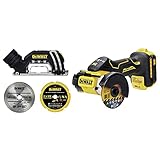
Searches for “DeWalt 3 inch cut off tool,” “DeWalt 3 cut off tool,” and “DeWalt 3 in cut off tool” generally refer to the DCS438. It is a compact DeWalt cordless cut off tool built around the 20V MAX battery platform, with a brushless motor and a 3-inch wheel.
Its approximately 3/8-inch cutting depth is enough for many repair and fabrication tasks: trimming threaded rod, cutting metal mesh, shortening conduit, removing rusted fasteners, slicing thin sheet, and making small cuts in tubing. A 3-inch disc also fits into spaces where a grinder or 14-inch saw cannot.
What the DCS438 does well
- Portability: there is no power cord, table or stand to position around the work.
- Access: the narrow head reaches between brackets, inside frames and near installed hardware.
- Guard adjustment: its adjustable guard can be positioned for different approach angles and improved protection from sparks and fragments.
- Low fatigue: its small disc and light body are easier to control during short cuts than a full-size grinder.
- Wheel flexibility: compatible cutting accessories can be selected for ferrous metal, stainless steel, masonry or other approved materials.
The limitations are just as important. The shallow cut means thick plate usually requires several passes or a different machine. A small disc loses effective diameter as it wears, so cutting depth decreases over the life of the wheel. It is also not the right tool for long, square production cuts or for forcing through heavy structural steel.
Battery choice: the real difference between a DeWalt 20V cut off tool and a corded saw
The DCS438 is sold as a tool-only model in many markets, so the battery affects both runtime and balance. A compact 20V MAX battery keeps the tool nimble for overhead or awkward work. A larger 20V MAX XR pack generally provides more usable energy and less voltage sag during demanding cuts, but adds weight.
| Battery situation | Practical choice | Why |
|---|---|---|
| Occasional cuts and maximum maneuverability | Compact 20V pack | Lower weight; suitable when each cut is short |
| Several cuts in tubing or sheet metal | Mid-size or XR 20V pack | Better reserve without making the tool excessively bulky |
| Continuous shop cutting | Use a 14-inch corded chop saw | No battery changes and substantially greater cutting capacity |
Exact runtime varies too much to promise a fixed number of cuts: wheel diameter, metal thickness, pressure, battery age and pauses all matter. As a planning example, if a compact pack delivers 20 minutes of active trigger time and each cut takes 12 seconds, the theoretical maximum is 100 cuts. Real work may produce only 40 to 70 cuts because positioning, cooling, wheel changes and harder sections consume time. This is why battery capacity matters more for repeated cuts than for repair work.
When a 14-inch DeWalt chop saw is the better buy
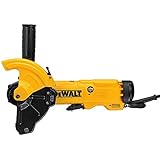
The D28730 and D28715 are appropriate when the workbench is the center of the job. Their large wheels and clamping systems make them substantially better for steel tube, angle stock, rebar and repeated cuts to common lengths. A vise holds the work, the base provides a stable reference, and the longer wheel radius gives far more capacity than the DCS438.
The D28730 is the more sensible general-purpose choice for many workshops because it provides large-stock capacity without requiring a cordless battery. The D28715 is worth considering when heavy, frequent cutting and a more substantial machine are priorities. Either saw needs a dedicated, stable location, adequate electrical supply and room for sparks and long stock.
These machines are faster for thick steel, but abrasive chop saws create more sparks, noise, heat and airborne debris than a small battery tool. For cleaner cuts, choose a wheel designed for the material, and do not assume every 14-inch blade is approved for every DeWalt saw or workpiece.
Head-to-head decision matrix
| Your situation | Recommended type | Reason |
|---|---|---|
| Small repairs, mobile service or work above shoulder height | DCS438 20V MAX XR | Light, compact and independent of an outlet |
| Existing DeWalt 20V batteries and occasional metal cutting | DCS438 tool-only kit | Lower entry cost when chargers and packs are already owned |
| Beginner making short cuts in thin stock | DCS438 with a compact battery | Easier to control, provided the shallow capacity is sufficient |
| Frequent cuts in large tube, angle iron or bar | D28730 or D28715 | Vise support and 14-inch capacity reduce effort and repetition |
| Limited floor or bench space | DCS438 | A handheld tool avoids permanent saw clearance requirements |
| Lowest long-term cost for high-volume cutting | Corded chop saw | No battery replacement cycle and less downtime between cuts |
Disc selection, guard adjustment and cutting technique
Use a wheel whose diameter, arbor, maximum RPM and material rating match the tool. Thin abrasive wheels generally remove less material and cut faster, while thicker wheels tolerate abuse better but generate more heat and kerf. A diamond wheel may be appropriate for certain materials, but only when the wheel manufacturer and tool instructions permit that application.
- Disconnect the battery or unplug the saw while installing the wheel.
- Inspect the wheel for chips, cracks, warping or a damaged center hole.
- Set the guard so the exposed portion of the wheel is only what the cut requires, with the opening directing sparks away from you.
- Clamp or support the work close to the cut. Unsupported sheet can vibrate, pinch the wheel and kick the tool sideways.
- Let the wheel reach full speed before contacting the metal.
- Use light, steady pressure. If the motor slows sharply, withdraw slightly and let the wheel recover rather than forcing it.
- Finish the cut without twisting the wheel, then wait for it to stop before setting the tool down.
Do not use the side of a cut-off wheel for grinding, and do not remove the guard to gain a few extra millimeters of access. Those shortcuts increase the chance of wheel breakage or loss of control.
Durability and ownership costs
On the DCS438, the first consumable to wear is normally the cutting wheel, not the motor. Cutting rusty, dirty or thick material accelerates wear. Keep spare wheels dry, discard any that have been dropped, and avoid storing them where they can be bent. The guard, spindle hardware and battery contacts also deserve periodic inspection.
Metal dust can enter vents and switches, so brush or blow debris away according to the manual after use; do not pack abrasive dust into the housing with high-pressure air at close range. Check that the guard moves and locks correctly, the battery seats firmly, and the wheel runs without unusual wobble or vibration.
For occasional work, a general market price in 2026 is typically in the lower-to-mid hundreds for a cordless tool kit depending on whether it includes a battery and charger. Corded 14-inch saws usually cost more initially and require more space, but can be cheaper per high-volume cut because they use inexpensive wheels and do not consume battery cycles.
Final verdict
Choose the DCS438 if you need a DeWalt 20V cut off tool for portable, controlled cuts up to roughly 3/8 inch deep. It is the strongest match for maintenance, installation and small fabrication. Choose the D28730 when a workshop needs repeated cuts through larger metal, and consider the D28715 when heavy use justifies a more substantial 14-inch machine. The correct choice depends less on brand loyalty than on the deepest material you cut, how often you cut it, and whether portability or throughput matters more.