What's inside
As an Amazon Associate I earn from qualifying purchases. This post may contain affiliate links at no extra cost to you.
What we cover
ARCCAPTAIN Plasma Cutters Compared: Specs, Consumables, and Value
For most home shops cutting mild-steel plate and sheet, the ARCCAPTAIN CUT50 is the practical starting point; choose a 55-amp model for more frequent work and thicker material, and a 60-amp model only if your air supply and electrical circuit can support it. The right arccaptain plasma cutter depends less on its maximum amp figure than on the thickness you need to cut cleanly, the duty cycle, and the quality of your compressed air.
Specifications can vary by model revision and seller listing, so verify the manual and nameplate for the exact unit before buying. The figures below are representative published specifications, not a guarantee of cut quality: speed, material, torch condition, air pressure, and electrical supply all matter.
As an Amazon Associate we earn from qualifying purchases at no extra cost to you.

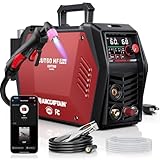
![ARCCAPTAIN iControl CUT55 MP [Non-HF] Plasma Cutter Machine, APP Control](https://m.media-amazon.com/images/I/51hLye1tq1L._SL160_.jpg)

Head-to-head: CUT50, CUT55, and CUT60
| Model family | Rated output | Published maximum cut* | Clean-cut planning range | Air and power considerations | Best fit |
|---|---|---|---|---|---|
| CUT50 | Up to 50 A | About 12 mm (1/2 in.) | Roughly 6–10 mm (1/4–3/8 in.) | Typically requires a 220–240 V supply and compressed air; check the specific version’s input and air-flow requirements. | Occasional repair, brackets, sheet, and moderate plate |
| CUT55 | Up to 55 A | About 15 mm (5/8 in.) | Roughly 8–12 mm (5/16–1/2 in.) | Usually a 220–240 V machine. Plan for a compressor that sustains the required flow, not just the stated pressure. | Regular fabrication with a little more thickness headroom |
| CUT60 | Up to 60 A | About 20 mm (3/4 in.) | Roughly 10–16 mm (3/8–5/8 in.) | Check the exact input voltage, breaker recommendation, air consumption, and duty cycle; the largest model puts the greatest demands on shop infrastructure. | Frequent plate work and cuts where speed matters |
*Maximum-cut figures commonly describe severance under favorable conditions, not a neat edge at production speed. Clean-cut ranges are conservative buying estimates and vary by steel, technique, and machine setup. Confirm all model-specific figures in the current manual.
What the amp difference means in practice
On thin sheet, all three can be more capable than their headline amperage suggests. A 50-amp machine can be a sensible choice for automotive patch panels, guards, and light brackets, where control and a clean start matter more than cutting the thickest stock. On thicker steel, extra amperage can let you move faster and reduce the temptation to crawl through the cut. That advantage disappears if the compressor cannot keep up or the circuit causes voltage drop.
Do not treat maximum severance as a daily working thickness. At the limit, a cut may be slow, angled, and heavily drossed. If you regularly cut 12 mm steel and want a usable edge, buying to the maximum-cut number leaves little margin. A higher-output model—or a different cutting process for sustained heavy plate—may be the better value.
Choose by job, not by the largest number
| Your situation | Likely fit | Why |
|---|---|---|
| First cutter; mostly thin sheet and occasional repairs | CUT50 | Lower initial cost and enough capacity for common light-shop tasks, assuming the version’s voltage suits your shop. |
| Weekly brackets, gates, and mixed plate up to around 10–12 mm | CUT55 | More working headroom without buying solely for occasional maximum-thickness cuts. |
| Frequent cuts in thicker plate, with a capable compressor and dedicated circuit | CUT60 | Higher output can improve pace and provide margin, provided the duty cycle and supply support the workload. |
| Small shop with limited electrical service or no compressor | Pause before choosing any of these | Confirm power and air requirements first; a machine that cannot be supplied properly is poor value at any price. |
Air supply: the hidden selection test
These are compressed-air cutters, so a compressor’s tank size alone does not establish compatibility. Check the cutter’s required pressure and air consumption, then compare its flow demand with the compressor’s delivered air at working pressure (often stated as CFM or L/min). A compressor may show a high pressure rating but still run out of airflow during a long cut. That can cause unstable arcs, poor edges, and extra wear.
Use a regulator and moisture filtration, drain the compressor tank, and keep the air hose and fittings from restricting flow. Water or oil in the line contaminates the torch and can make consumables fail early. For long cuts, give a marginal compressor time to recover rather than assuming a larger receiver tank fixes low sustained output.
Consumables and ownership costs
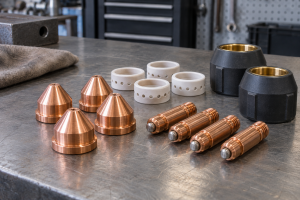
Expect consumables such as electrodes, cutting tips, and sometimes swirl rings or shields to wear. Exact torch and consumable compatibility depends on the supplied torch and model revision; match parts by torch identification and manual, not merely by the CUT-series name. Before purchase, check whether replacement parts are readily available and compare the cost of a compatible set. Prices vary by seller and kit contents, so a general market range is more useful than a single advertised bundle price.
A simple ownership estimate helps compare machines: if a consumable set costs $20–$40 and lasts for 100–300 cuts, its cost is about 7–40 cents per cut, before electricity, compressed air, and wasted material. That range is intentionally broad: short cuts, clean dry air, correct torch distance, and proper current can stretch consumable life; piercing thick metal, dragging the torch, or cutting with damp air can shorten it sharply. If you make 500 similar cuts a year, that illustrative range becomes about $35–$200 annually. Your actual count depends heavily on technique and cut length.
Consumables are often the first recurring wear item, but poor cuts are not automatically a sign that the machine is failing. Inspect the tip for an enlarged or irregular orifice and the electrode for a deep pit. Replace worn parts as a matched, torch-compatible set where the manual recommends it. Also check torch leads and connectors, clean dust from the machine’s vents, and avoid blocking its cooling airflow.
Set up for a cleaner cut
- Confirm the supply: Match the machine’s nameplate voltage and recommended circuit to the outlet. Avoid undersized extension cords, which can cause voltage drop and erratic performance.
- Prepare the air: Set pressure to the manual’s specification while air is flowing if instructed, and remove moisture and oil from the line.
- Choose a test piece: Use scrap of the same material and thickness. Set current and travel speed according to the manual, then adjust based on the cut rather than relying on maximum amperage.
- Keep torch technique consistent: Use the recommended standoff or drag tip, maintain a steady travel speed, and pierce with the torch angled as directed to limit spatter reaching the tip.
- Inspect before a long job: Check consumables, ground connection, and air delivery. A short test cut can reveal a supply or setup problem before it ruins a finished panel.
Which ARCCAPTAIN cutter is the better value?
The CUT50 is the value choice when most work is thin sheet or moderate plate and cutting is occasional. The CUT55 makes sense for a busier hobby shop that wants a little more capacity without stepping up simply for a maximum-cut claim. The CUT60 is worth considering when thicker material and cutting pace are regular needs—and the shop already has adequate power and air.
Before ordering, verify the exact model’s rated output, clean-cut guidance, duty cycle, input voltage, air consumption, included torch, and replacement-consumable fit. Those details determine whether the cutter suits your actual sheet-metal jobs; the model number alone does not.