Our Top Picks



What's inside
As an Amazon Associate I earn from qualifying purchases. This post may contain affiliate links at no extra cost to you.
Most welders do not buy the wrong helmet on purpose. They buy on price. Then they spend two years squinting through a muddy lens, flipping up to find the joint, and catching flash off the guy in the next bay. This welding helmet buying guide is for people who actually strike arcs, not for a spec sheet contest.
The helmet is the one piece of gear you wear every second of every weld. A bad one costs you weld quality now and eyesight later. A good one is boring. It darkens when it should, you can see the puddle and the joint ahead of it, and your neck still works at quitting time.
As an Amazon Associate we earn from qualifying purchases at no extra cost to you.
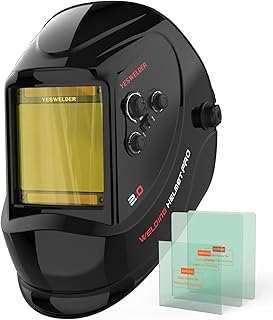




| Helmet type | Best for | Real tradeoff |
|---|---|---|
| Passive fixed shade | Repetitive production welds, backup hood | You drop it blind, so tacking is slow |
| Entry auto-darkening | Farm repair, hobby MIG and stick | Grainier lens, small window, two sensors |
| Variable shade 9-13, optical class 1/1/1/1 | Welding several days a week across processes | Costs more, pays back inside a year |
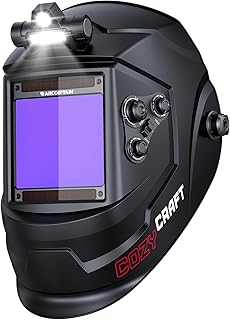
| Large view, four sensor true color | Pipe, structural, out-of-position, low-amp TIG | Heavier on your neck |
| Powered air (PAPR) | Stainless, galvanized, tanks and tight spaces | Big money, filters and batteries to manage |
What we cover
Welding Helmet Buying Guide: The Specs That Matter
Optical class
Find the four digit rating on the cartridge, something like 1/1/1/1. Those numbers cover clarity, light diffusion, shade uniformity across the lens, and how the view shifts when you look through it at an angle. Lower is better, 1 is best. A 1/1/1/2 lens is fine. No rating at all is a gamble, and a lens that distorts at the edges is why your out-of-position beads wander.
Switching speed and sensors
Every hood on the shelf claims 1/25,000 of a second. Treat it as table stakes. What separates cartridges is consistency: cheap ones get sluggish in a cold shop, so check the operating temperature range if your building is unheated in January. Two sensors handle open bench work. Four matter when your hand, the part, or a fixture shadows the arc, which is most pipe and structural work.
Window, weight and grind mode
Bigger windows help you see fitup without flipping up, and they add weight. Most auto-darkening hoods run roughly one to two pounds, and you feel every ounce by hour six. A grind mode that locks the lens light is worth having, because a hood that keeps triggering off sparks teaches you to grind bare faced. Solar assist with a replaceable lithium cell beats a sealed rechargeable that turns the helmet into scrap when it dies.
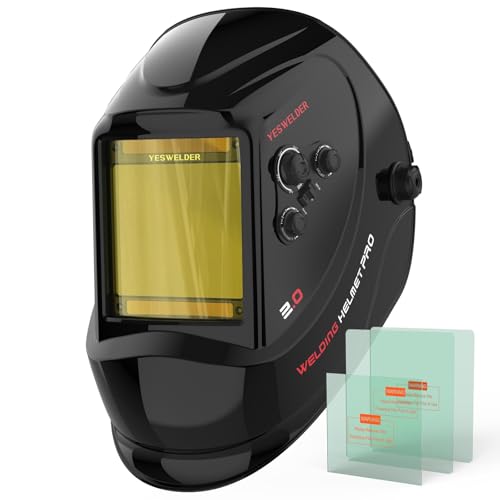
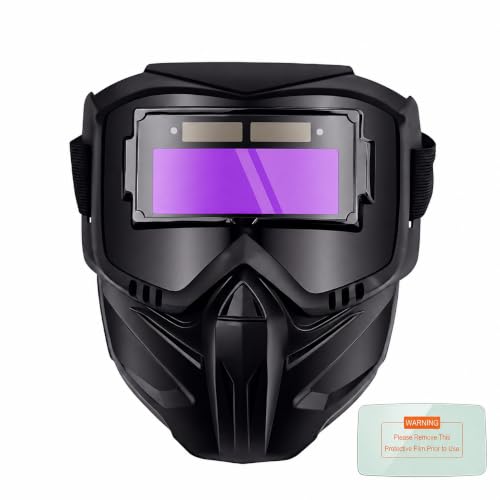
Entry-level auto-darkening helmet for hobby and farm work
A variable shade 9-13 hood with two sensors and a solar assist cell covers MIG, stick and most TIG for occasional work. Skip anything without an ANSI Z87.1 marking. Buy a ten pack of cover lenses with it, because the ones in the box will be pitted in a week.
Shade, Amperage and Material Thickness in Plain Terms
Thickness sets your amps. Amps set your shade. For mild steel on MIG, a working rule is one amp per thousandth of an inch: 1/8 inch plate is 0.125 inch, so start near 125 amps. Sheet at 0.060 inch wants about 60 amps and a light touch. Past roughly 1/4 inch you are into multiple passes and a bigger machine, not just a hotter knob. Brighter arc, darker lens.
| Process and current | Shade range | Notes |
|---|---|---|
| TIG under 50 A | 8 to 10 | Cartridge must be rated for low amp arcs |
| MIG or stick 60-150 A | 10 to 11 | Everyday shop range |
| MIG or stick 150-250 A | 11 to 12 | Spray transfer, heavy stick |
| Over 250 A and plasma | 12 to 13 | Serious infrared and skin burn |
Run the darkest shade that still lets you see the puddle. Guessing at the toe of the weld means go one lighter. Gritty, tired eyes at the end of the shift means go one darker. A compliant cartridge blocks UV and infrared even in the light state, so a hood that fails to darken still protects you from the invisible part of the arc. It does nothing about the visible flash, and that is what burns your cornea.
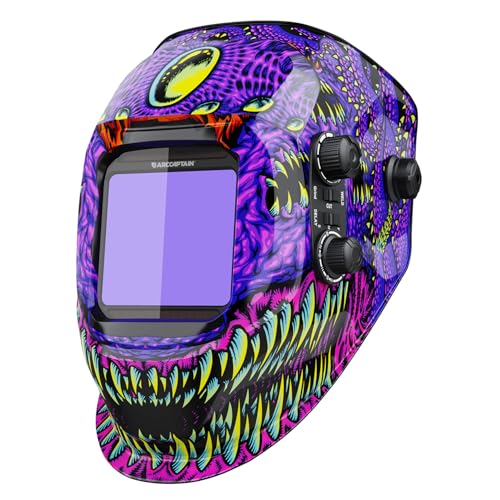
Mid-range true color helmet, four sensors
This is what most working welders should buy: optical class 1/1/1/1, four arc sensors, a large window, separate shade, sensitivity and delay controls, and a battery you can replace. Color neutral lenses really do make the puddle easier to read on aluminum and thin stainless. Compare cartridge specs between brands, not graphics.
Fit, Headgear and the Rest of Your PPE
Headgear is half the helmet. You want a ratchet with real range, an adjustable crown strap, and pivot stops so the hood does not overshoot or hang up on your chest overhead. Set the tension snug and stop. Do not crank the pivot knobs down: the torque your hand can put on those plastic bosses is more than they were built for, and the posts crack. Snug, then back off a quarter turn if it binds.
Wear safety glasses under the hood, every time. You flip up to check fitup, chip slag and wire brush, and that is when something finds your eye. On a jobsite, confirm hard hat adapter support before you buy. Cover the rest of you: FR cotton or leather sleeves, nothing synthetic that melts into skin, dry gloves, cuffs over the glove tops, pants over boots, no bare neck. UV reflects off walls onto bare arms.
- ✔ Auto-darkening lets you place the arc without flipping up
- ✔ One variable shade hood covers MIG, TIG, stick and plasma
- ✔ Grind mode keeps the shield on your face between passes
- ✔ Cover lenses make a good helmet last years
- ✘ Cheap cartridges slow down in the cold and fail without warning
- ✘ Large windows add weight and neck fatigue
- ✘ Sealed rechargeable batteries end the helmet’s life
- ✘ No helmet filters welding fume
Fume and Fire: What a Helmet Will Not Do
A welding hood is a shield, not a respirator. It filters nothing. Galvanized gives off zinc oxide and metal fume fever, which feels like the flu by dinner. Stainless and hardfacing can put hexavalent chromium and manganese in your lungs. Grind coatings back a couple inches from the joint, pull fume at the arc with extraction, and wear a fitted respirator when ventilation is not enough. Never weld on a sealed container or anything that held fuel.
Sparks and slag travel farther than people think and hide in cracks. Clear combustibles about 35 feet out, shield or wet down what will not move, keep an extinguisher in reach, and watch the area at least 30 minutes after the last arc. Cylinders chained upright, regulators out of the spatter, hot parts off wood.
Powered air (PAPR) welding helmet
If you run stainless, galvanized or coated steel most days, or you weld inside tanks, powered air handles fume and heat at once. It is a real spend and it adds filters and charging to your routine. Check the face seal and filter availability before you commit.
Frequently Asked Questions
Is an expensive welding helmet worth it? Weld more than a few hours a week and yes. You are paying for optical class, sensor coverage and a cartridge that behaves the same on weld one hundred as weld one. It shows up as fewer grind-outs.
Can one helmet cover every process? Mostly. A 9-13 variable shade handles MIG, stick and plasma. Low amp TIG under roughly 50 amps is the exception, so check the cartridge is rated to trigger down there before you buy.
My eyes burn after welding, now what? That is arc flash. Usual causes are a shade too light, a cartridge triggering late, welding with the hood up, or reflected arc from the next bay. Stay out of light, treat it like a sunburn, and see a doctor if vision changes. Then test the helmet before the next arc.
Buy the cartridge, not the graphics. Optical class 1/1/1/1, four sensors if your work is shadowed, a shade range that matches your amps, a replaceable battery, and headgear that fits your head. Then keep cover lenses on the shelf and change them before you start cussing at your welds.
Check prices on Amazon →