What's inside
- When aluminum stick welding makes sense
- Which aluminum electrodes and settings matter?
- Why aluminum is difficult with a stick welder
- How to set up an aluminum stick weld
- Aluminum stick welding versus TIG and spool-gun MIG
- Decision guide by situation
- Consumables, storage, and ownership realities
- Bottom line
- Related Guides
- When aluminum stick welding makes sense
- Which aluminum electrodes and settings matter?
- Why aluminum is difficult with a stick welder
- How to set up an aluminum stick weld
- Aluminum stick welding versus TIG and spool-gun MIG
- Decision guide by situation
- Consumables, storage, and ownership realities
- Bottom line
- Related Guides
As an Amazon Associate I earn from qualifying purchases. This post may contain affiliate links at no extra cost to you.
Yes, aluminum can be stick welded, but only with specialty aluminum electrodes, careful joint preparation, and enough heat control; for thin aluminum, TIG or spool-gun MIG is usually the easier and more reliable choice. Conventional mild-steel 6011, 6013, or 7018 rods will not produce a sound aluminum weld. Aluminum stick welding is best treated as a repair option for thicker, less appearance-critical parts rather than a universal fabrication method.
As an Amazon Associate we earn from qualifying purchases at no extra cost to you.


What we cover
- When aluminum stick welding makes sense
- Which aluminum electrodes and settings matter?
- Why aluminum is difficult with a stick welder
- How to set up an aluminum stick weld
- Aluminum stick welding versus TIG and spool-gun MIG
- Decision guide by situation
- Consumables, storage, and ownership realities
- Bottom line
- Related Guides
When aluminum stick welding makes sense
Aluminum can be welded with a stick welder when the machine has a suitable output range, the workpiece is thick enough to absorb heat, and you can obtain electrodes specifically marked for aluminum alloys. This process is also called shielded metal arc welding (SMAW).
It can be practical for:
- Field repairs where transporting a TIG machine or shielding-gas cylinder is inconvenient.
- Thick aluminum castings, brackets, housings, and agricultural or industrial parts.
- Occasional repairs where weld appearance is less important than restoring function.
- Outdoor work in conditions where a gas-shielded process is difficult to protect from wind.
It is a poor fit for thin sheet, long continuous seams, precision assemblies, and visible cosmetic welds. The flux coating creates substantial slag and fumes, the arc is harder to control than TIG, and aluminum transfers heat rapidly away from the joint. A weld that looks acceptable at the start can quickly become oversized, porous, or burned through as the parent metal gets hotter.
Which aluminum electrodes and settings matter?
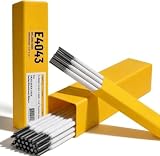
Use a commercially manufactured aluminum SMAW electrode, commonly based on an aluminum-silicon or aluminum alloy formulation. Electrode classifications and recommended polarity vary by manufacturer, so the package data should take priority over a generic chart. Do not assume that an electrode labeled “aluminum” is suitable for every alloy or position.
| Electrode diameter | Typical amperage range | More suitable for | Practical limitation |
|---|---|---|---|
| 3/32 in (2.4 mm) | 40–70 A | About 1/8–3/16 in aluminum with short welds | Easy to overheat thin edges; limited deposition |
| 1/8 in (3.2 mm) | 70–110 A | About 3/16–1/4 in material and general repairs | Requires good heat management and cleaning |
| 5/32 in (4.0 mm) | 100–145 A | 1/4 in and thicker sections | Too aggressive for most sheet and small inverter welders |
These are starting ranges, not universal settings. The correct amperage depends on the electrode formulation, joint design, aluminum thickness, welding position, and machine. Aluminum rods often have a short usable arc and may require more amperage than a steel rod of the same diameter. Many specialty aluminum electrodes are intended for direct current electrode positive (DCEP), but some products specify a different connection. Follow the electrode manufacturer’s polarity instructions.
A basic 120-amp machine may run a 3/32-inch aluminum rod, but it will have little reserve for a large joint or repeated passes. A 160- to 200-amp inverter gives more practical headroom, especially when using 1/8-inch electrodes. A machine’s stated maximum output is not the only factor: duty cycle matters because aluminum repairs can make the power source work hard.
Why aluminum is difficult with a stick welder
The main problem is the oxide layer. Aluminum melts at roughly 1,220°F (660°C), while aluminum oxide melts at approximately 3,700°F (2,040°C). The base metal can therefore become liquid while the oxide skin remains as a stubborn barrier. A flux-coated aluminum electrode helps disrupt and float away contamination, but it does not eliminate the need for careful preparation.
Aluminum also conducts heat quickly. Heat spreads away from the arc, so the puddle may initially seem too cold and then suddenly become fluid once the surrounding area reaches welding temperature. This produces two common errors: turning the amperage up too far, then burning through; or lingering in one spot while trying to establish a puddle, which can trap gas and flux residue.
The electrode coating and slag make visibility worse than with TIG. Starts can be difficult, arc length is less forgiving, and slag inclusions are possible if the joint is not cleaned between passes. The finished bead usually has a rougher appearance than a TIG weld and may require more chipping and brushing.
How to set up an aluminum stick weld
1. Identify the base metal and joint thickness
Whenever possible, determine whether the part is wrought aluminum, cast aluminum, or an alloy containing significant magnesium. Some alloys are prone to cracking or are unsuitable for fusion welding. If the component is structural, pressure-containing, safety-critical, or expensive to replace, confirm the repair procedure with a qualified welding professional rather than experimenting on the part.
2. Prepare the surface mechanically
Remove paint, oil, anodizing, and loose oxide at least 1 inch (25 mm) on both sides of the joint. Use a dedicated stainless-steel brush reserved for aluminum; a brush contaminated with steel can embed particles in the surface. Degrease with an appropriate solvent, allow it to evaporate, and avoid touching the cleaned area with bare fingers.
3. Fit and preheat carefully
Use a tight, well-supported joint with minimal gaps. For thicker sections, gentle preheating can make the puddle more consistent, but keep the aluminum below the limit specified by the electrode or repair procedure. A temperature-indicating crayon or infrared thermometer is preferable to guessing. Excessive preheat increases burn-through risk and can damage heat-treated material.
4. Strike, weld briefly, and clean between passes
Set the machine near the lower end of the electrode’s recommended range and make a short test bead on matching scrap. Use a short arc, avoid excessive weaving, and keep the electrode moving steadily. Short beads of roughly 1–2 inches are easier to control than a long uninterrupted pass. Let the part cool as needed, then remove slag completely with the correct tools before another pass.
Do not judge the joint by bead appearance alone. Look for incomplete fusion at the toes, pinholes, cracks, trapped slag, and a dark or dirty boundary. A destructive test on scrap—bending or breaking a sample—can reveal whether the weld is actually bonded through the joint.
Aluminum stick welding versus TIG and spool-gun MIG
| Process | Useful aluminum thickness | Control and finish | Equipment burden |
|---|---|---|---|
| Aluminum SMAW | Usually about 1/8 in and up; thicker is easier | Lowest control; slag and rougher beads | Low equipment complexity, no shielding-gas bottle |
| AC TIG | About 0.040 in to thick sections with suitable power | Highest control and cleanest appearance | Requires AC TIG machine, tungsten, gas, torch, and practice |
| Spool-gun MIG | About 1/8 in to heavier material, depending on machine | Fast deposition and good productivity | Requires aluminum wire, argon, and a compatible spool gun |
For thin aluminum, TIG is usually easier because the operator can add filler independently of the arc and precisely control heat with a foot pedal or amperage control. Its alternating-current arc also helps clean the oxide layer. Spool-gun MIG is often the better production choice: it deposits metal quickly and avoids feeding soft aluminum wire through a long standard MIG liner, though it needs an argon cylinder and careful wire-drive setup.
Stick welding may win when portability, low initial equipment cost, and outdoor usability matter more than finish or precision. TIG wins for thin sheet, visible work, and heat-sensitive joints. Spool-gun MIG wins for repeated repairs, longer welds, and higher production.
Decision guide by situation
| Your situation | Best first choice | Reason |
|---|---|---|
| One thick outdoor repair, limited equipment | Aluminum SMAW | Portable and does not require shielding gas |
| Thin sheet or tubing under 1/8 in | AC TIG | Better heat control and less burn-through |
| Several repairs each month | Spool-gun MIG | Faster welding and easier wire feeding |
| Cosmetic or precision fabrication | AC TIG | Cleaner, more controllable welds |
| Very limited budget but an existing 160-A stick machine | Specialty aluminum electrodes | Lowest additional equipment cost, if the material is thick enough |
Consumables, storage, and ownership realities
Aluminum stick electrodes are less forgiving of moisture, damaged coatings, and contamination than ordinary steel rods. Store them sealed according to the manufacturer’s instructions and discard rods with cracked or flaking flux. The stainless brush, chipping tool, solvent, and protective equipment are part of the process—not optional accessories.
The first things likely to wear or cause trouble are electrode coatings, contact surfaces on the work clamp, and cleaning tools. Poor ground connections can make the arc unstable. A dirty brush can re-contaminate every joint. Repeated overheating can also distort thin workpieces and weaken heat-treated aluminum even when the bead looks sound.
Bottom line
Can aluminum be welded with a stick welder? Yes, provided you use the correct aluminum electrode, follow its polarity and amperage instructions, prepare the oxide-free joint thoroughly, and work on material thick enough to tolerate the process. For occasional thick repairs, it is a useful capability. For thin aluminum, neat welds, or frequent fabrication, an AC TIG machine or a spool-gun MIG setup is normally the more practical investment.