What's inside
- Quick picks by workshop situation
- Plug types: what the numbers actually mean
- Match the welder, cable and circuit in the right order
- Worked example: sizing a 30A welder connection
- Decision matrix for buying the replacement
- Durability details that matter after installation
- Common mistakes with a welder 220v plug
- Final buying recommendation
- Quick picks by workshop situation
- Plug types: what the numbers actually mean
- Match the welder, cable and circuit in the right order
- Worked example: sizing a 30A welder connection
- Decision matrix for buying the replacement
- Durability details that matter after installation
- Common mistakes with a welder 220v plug
- Final buying recommendation
As an Amazon Associate I earn from qualifying purchases. This post may contain affiliate links at no extra cost to you.
The best 220v welder plug is the one that matches the welder’s nameplate input current, the branch-circuit breaker and wire size, and the receptacle configuration—not simply the machine’s advertised welding amperage.
In modern North American wiring, “220V” usually refers to a nominal 240V circuit. Before buying a plug or receptacle, read the welder’s installation instructions and nameplate for input voltage, maximum rated input current, recommended breaker size, conductor size and duty cycle. If those details conflict with a generic plug chart, follow the manufacturer’s instructions and have the circuit checked by a qualified electrician.
As an Amazon Associate we earn from qualifying purchases at no extra cost to you.


What we cover
- Quick picks by workshop situation
- Plug types: what the numbers actually mean
- Match the welder, cable and circuit in the right order
- Worked example: sizing a 30A welder connection
- Decision matrix for buying the replacement
- Durability details that matter after installation
- Common mistakes with a welder 220v plug
- Final buying recommendation
Quick picks by workshop situation
| Workshop situation | Common plug/receptacle choice | Typical circuit class | Why it fits |
|---|---|---|---|
| Portable MIG or stick welder drawing up to about 24–30A input | NEMA 6-30P and matching 6-30R | 240V, 30A, two-pole breaker; commonly 10 AWG copper | Compact, two hot conductors plus equipment grounding path; common for dedicated equipment circuits |
| General-purpose welder circuit drawing up to about 40–50A | NEMA 6-50P and matching 6-50R | 240V, 50A circuit; conductor size depends on code, insulation, installation method and welder instructions | Very common welder configuration and easy to identify |
| Welder that shares a correctly designed outlet with other 240V equipment | NEMA 14-50P and matching 14-50R, only when specified | 120/240V, 50A, four-wire circuit | Provides two hot conductors, neutral and equipment grounding conductor; useful only when the machine and circuit require all four conductors |
| Older installation or equipment explicitly marked for a three-wire 10-50 connection | NEMA 10-50P and matching 10-50R | Legacy three-wire arrangement | May match existing equipment, but it should not be substituted for a modern grounded installation |
The table shows common configurations, not universal sizing rules. A 50A receptacle does not make a 50A circuit safe, and a plug rated for a particular current does not prove that the wall wiring can support it.
Plug types: what the numbers actually mean
NEMA 6-30
A NEMA 6-30 plug has two angled hot slots and a grounding connection. It is a frequent choice for smaller 240V welders and is often the correct 30 amp 220v welder plug when the nameplate calls for a 30A branch circuit. Use it with a matching NEMA 6-30 receptacle, never by forcing it into a 6-50 outlet or using an unlisted adapter.
NEMA 6-50
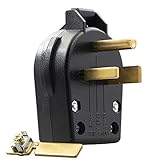
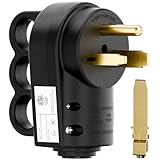
The NEMA 6-50 is one of the most recognizable welder plugs in North America. It is a two-pole, grounding configuration commonly found on MIG, TIG and stick welders. Choose it when the welder manufacturer supplies a 6-50P or specifies a 6-50R circuit. The 6-50 does not provide a neutral conductor, so it is not a substitute for a four-wire 14-50 connection.
NEMA 14-50
A 14-50 has two hot slots, a neutral slot and a grounding slot. It is appropriate only when the welder’s cord and instructions call for this four-wire configuration. Installing a 14-50 receptacle on a circuit that lacks a properly sized equipment grounding conductor is not a safe upgrade.
NEMA 10-50
A 10-50 is an older three-wire configuration with no separate equipment grounding conductor. It may appear on older welders or existing shop circuits, but it should not normally be selected for a new installation. Replacing an old outlet with a modern receptacle while leaving the underlying conductors unchanged can create a misleading appearance of safety.
Match the welder, cable and circuit in the right order
- Read the input rating. Distinguish welding output amperage from electrical input current. A “200A welder” may draw far less than 200A from the supply, depending on input voltage, efficiency and duty cycle.
- Identify the required plug pattern. Confirm whether the cord ends in a 6-30P, 6-50P, 14-50P or another listed configuration. If the machine arrives without a plug, use the manufacturer’s specified type rather than guessing from output amperage.
- Verify breaker and conductor requirements. A 30A circuit commonly uses 10 AWG copper conductors, while larger circuits may require 8 AWG or 6 AWG. The correct size depends on insulation temperature rating, cable type, conduit fill, ambient temperature, terminal ratings, local rules and welder-specific allowances.
- Check the receptacle rating. The receptacle, plug, breaker and conductors must work as one system. Do not install a 50A receptacle on a 30A circuit and assume the extra physical size provides useful capacity.
- Confirm the outlet location. Keep the receptacle away from grinding sparks, wet areas, hot workpieces, vehicle traffic and locations where the cord will be sharply bent. A surface-mounted industrial-grade receptacle with a proper enclosure can be more practical in a workshop than a fragile residential device.
Worked example: sizing a 30A welder connection
Suppose a welder’s instructions specify 240V input, a 30A two-pole breaker, a NEMA 6-30P plug and 10 AWG copper conductors. The matching installation is a dedicated 240V circuit with two insulated hot conductors and a correctly sized equipment grounding conductor, terminated in a listed 6-30R receptacle.
Do not calculate the setup from welding output alone. If the machine advertises 180A welding output, that number describes the current at the welding terminals, not the current entering the wall circuit. Likewise, a 30A plug does not mean the welder continuously consumes 30A: the actual load varies with process, material, voltage and duty cycle. The nameplate and installation manual control the decision.
If the existing outlet is a 6-50R, a 6-30P will not fit—and that incompatibility is useful. It prevents accidental connection to a circuit that may have the wrong breaker or conductor arrangement. Use a properly designed circuit or an electrician-approved change, not a loose adapter.
Decision matrix for buying the replacement
| Your priority | Best direction | What to look for | What to avoid |
|---|---|---|---|
| Lowest reasonable cost | Listed industrial-grade plug and receptacle in the specified NEMA pattern | Heat-resistant housing, secure terminals, strain relief and clear markings | Unmarked bargain devices or undersized terminals |
| Frequent mobile welding | Heavy-duty straight-blade plug with a flexible welding-rated cord | Large cord grip, abrasion-resistant jacket and terminals that accept the cable size | Repeatedly twisting the cord at the plug or using extension cords with unknown ampacity |
| Fixed shop installation | Industrial receptacle in a robust box or surface enclosure | Strong face, firm contact tension and protection from sparks and impact | Loose receptacles that allow the plug to sag or heat at the contacts |
| Multiple welders or future expansion | Separate correctly sized circuits, or a professionally designed distribution panel | Load calculation, labeling and suitable disconnecting means | Power strips, improvised splitters or assuming two machines can share one breaker |
Durability details that matter after installation
The first parts to wear are usually the plug blades, receptacle contacts, cord grip and screw terminals. Repeated unplugging can loosen contact tension; grinding dust can enter the face; heat can discolor plastic and oxidize terminals. A plug that feels unusually hot, smells of overheated plastic, shows browning, has pitted blades or fits loosely should be taken out of service.
Inspect the connection with the circuit de-energized. Check that the cord jacket is not cut, the strain relief holds the outer jacket rather than the individual conductors, and the receptacle has not pulled away from its box. Keep the connection dry and clear of metal filings. Never spray lubricant into a receptacle or file the plug blades to make an incompatible connection fit.
Extension cords deserve special caution. Use one only if the welder manufacturer permits it and its conductor size, length, insulation and plug configuration are suitable for the input load. Long, undersized cords cause voltage drop and heating. A short, properly sized cord is preferable to a long cord selected only because its plug fits.
Common mistakes with a welder 220v plug
- Confusing output amperage with input amperage.
- Using a 6-50P on a 30A circuit because the receptacle looks similar.
- Replacing a 6-30P with a 14-50P without changing the circuit design.
- Using a 10-50 connection in a new installation where a separate equipment grounding conductor is required.
- Installing a receptacle with a higher rating than the breaker and assuming that increases available power.
- Leaving terminals loose, which raises resistance and creates localized heat.
- Running welding leads and the input cord where hot slag can damage their insulation.
Final buying recommendation
For many compact welders, a properly installed NEMA 6-30 connection is the sensible choice when the manual specifies a 30A circuit. For common mid-size machines, NEMA 6-50 is often the right welder 220v plug and receptacle pair. Choose a 14-50 only when the welder and circuit require a neutral and four-wire connection, and treat an existing 10-50 installation as a condition to evaluate rather than an automatic model for new work.
Buy the plug and receptacle as a matched, listed pair, then verify the breaker, conductors, grounding path and installation method against the machine documentation and local electrical requirements. When any of those details are uncertain, stop at the purchasing stage and ask a qualified electrician to confirm the circuit before energizing the welder.