
Key takeaways
- Our hands-on notes on the best wheel chocks for shops and trailers, from solid rubber blocks to tandem stabilizers, plus sizing and material tips.
What's inside
As an Amazon Associate I earn from qualifying purchases. This post may contain affiliate links at no extra cost to you.
As an Amazon Associate we earn from qualifying purchases.
What we cover
Why a Good Chock Belongs in Every Shop
A wheel chock does one simple job, and it does it before anything can go wrong. Unhitching a trailer on a sloped apron, parking a project truck in a bay, or storing a camper for the winter all share one risk: a vehicle that rolls a few inches can damage equipment, shift a jack stand, or hurt someone. Brakes fail and couplers get bumped. A solid wedge against the tire removes most of that risk in seconds.
The best wheel chocks share a few traits: enough height to bite into the tire, a bottom that grips concrete, asphalt, and gravel, and a handle or rope so you can pull the chock free without putting your hand near a loaded tire. Dense rubber grips best and shrugs off oil and weather, hard plastic is light and easy to store, and steel expanding designs suit tandem-axle trailers. The five options below cover all of those approaches.
Disclosure: This post contains affiliate links. If you buy through links on this page, we may earn a commission at no extra cost to you.
Quick Picks
- Best all-around shop chock: MAXXHAUL 70472 Solid Rubber Wheel Chock, 2-Pack
- Best lightweight trailer pair: Camco 44471 Wheel Chock with Rope, 2-Pack
- Best multi-vehicle set: AFA Tooling Heavy Duty Rubber Wheel Chocks with Carry Handles
- Best frame-mounted option: CURT 22802 HD Wheel Chocks, 2-Pack with Mounting Bracket
- Best for tandem-axle stabilizing: BAL X-Chock 28012 Wheel Stabilizer, Pair
The Five Chocks, Up Close
1. MAXXHAUL 70472 Solid Rubber Wheel Chock, 2-Pack

If your shop stocks only one style, make it a solid rubber block like this one. The 70472 is a dense, one-piece wedge measuring 8 by 4 by 6 inches, tall enough for truck and trailer tires and heavy enough to stay where you kick it. Traction pads help it grip tire and floor, and the molded handle makes one-handed placement easy with gloves on.
In practical notes, this style survives being driven over, dropped on concrete, and left in the rain. Rubber does not crack like hollow plastic in cold weather, and it tolerates oil and solvent drips around a welding bay. The trade-off is bulk: a pair suits a truck bed box or shop corner better than a small trailer compartment.
Specs
- Material: Solid rubber
- Dimensions: 8 x 4 x 6 inches per chock
- Pack count: 2 chocks
- Item weight: 7.87 pounds for the pair
- Features: Built-in handle, non-slip traction pads, all-weather compound
- Model: 70472
- ASIN: B01CGU14T2
Pros:
– Dense rubber grips concrete, asphalt, and gravel well
– Tall 6-inch face suits larger truck and trailer tires
– Handle makes placement and removal quick and safe
Cons:
– Heavier and bulkier than plastic alternatives
– Black rubber can be easy to overlook in a dim bay
2. Camco 44471 Wheel Chock with Rope, 2-Pack

Camco takes the opposite approach: a light, hard-plastic chock for travel trailers and campers that need securing quickly, then stowing in a small compartment. The 44471 pair is molded from heavy-duty hard plastic with UV inhibitors, so it holds up outdoors without going brittle in the sun. Each chock suits wheels up to 26 inches in diameter, covering most travel and utility trailer tires.
The rope joining the pair earns this set its spot. Set one chock in front of the tire and one behind, and a single pull frees both without reaching under the rig. Our take: for lighter trailers on level ground, that convenience matters more than sheer mass. For heavy equipment on a grade, step up to solid rubber.
Specs
- Material: Heavy-duty hard plastic with UV inhibitors
- Fit: Wheels up to 26 inches in diameter
- Pack count: 2 chocks joined by rope
- Item weight: 1.5 pounds
- Features: Rope for paired removal, ribbed gripping surface
- Model: 44471
- ASIN: B071KY2K37
Pros:
– Very light and compact for trailer storage bins
– Rope lets you pull both chocks clear in one motion
– UV inhibitors help the plastic survive outdoor storage
Cons:
– Less grip and mass than rubber on steep or slick surfaces
– Sized for lighter trailers, not heavy shop equipment
3. AFA Tooling Heavy Duty Rubber Wheel Chocks with Carry Handles

AFA Tooling builds its chocks from nylon-reinforced rubber, positioned as tougher than plain rubber against tearing, chunking, and cracking. The face uses an aggressive ribbed design that bites into tire tread, and the bottom is textured to resist sliding on smooth floors. Each chock has a large molded handle with room to tie a rope through, so pairs can be tethered for fast pull-out.
The profile is a useful middle ground: 9.1 inches long, 3.7 inches wide, and 4.7 inches tall, long enough for a secure wedge and compact enough to toss behind a seat. The listing covers vehicles up to 4T gross weight, spanning cars, pickups, ATVs, and most single-axle trailers. In our take, this is the set to buy when one pair has to cover everything in the yard.
Specs
- Material: Nylon-reinforced rubber
- Dimensions: 9.1 x 3.7 x 4.7 inches per chock
- Vehicle fit: Cars, trucks, trailers, and RVs up to 4T gross vehicle weight
- Item weight: 3.4 pounds
- Features: Quick-grip ribbed face, textured anti-slip bottom, large carry handles with rope tie-off room
- Model: Wheel_chocks_rubber_handle_2pcs_set
- ASIN: B08NCKLC13
Pros:
– Reinforced rubber resists cracking and chunking over time
– Ribbed face seats with a kick, no hammering needed
– Handles double as rope tie-off points for paired use
Cons:
– Mid-height face is less ideal for very large tires
– Rubber compound has a strong odor when new
4. CURT 22802 HD Wheel Chocks, 2-Pack with Mounting Bracket

CURT solves the most common chock problem: storage. Dirty chocks roll around a truck bed or get left behind. The 22802 kit pairs two dense rubber chocks with a steel mounting bracket that attaches to the trailer frame with self-tapping screws, so the chocks live on the trailer, ready at every stop. Snap rings let you detach each chock quickly, and a wire lanyard keeps the clips from going missing.
The bracket wears a weather-resistant A-coat under a bold orange finish that is easy to spot during a walk-around. Practical notes: frame mounting suits trailers unhitched often, because the chocks stay with the rig rather than with whichever truck towed it last.
Specs
- Material: Dense rubber chocks, high-density steel bracket
- Pack count: 2 chocks plus frame mounting bracket
- Package weight: 12.03 pounds
- Features: Snap-ring attachment, wire lanyard for clips, self-tapping screws included, orange powder-coat finish over weather-resistant A-coat
- Model: 22802
- ASIN: B0CFWYVS1H
Pros:
– Bracket keeps chocks with the trailer at all times
– Nothing dirty to store inside the truck or camper
– Bright finish is easy to spot before driving off
Cons:
– Bracket install takes tools and a suitable frame rail
– Best suited to one dedicated trailer, not shared shop use
5. BAL X-Chock 28012 Wheel Stabilizer, Pair
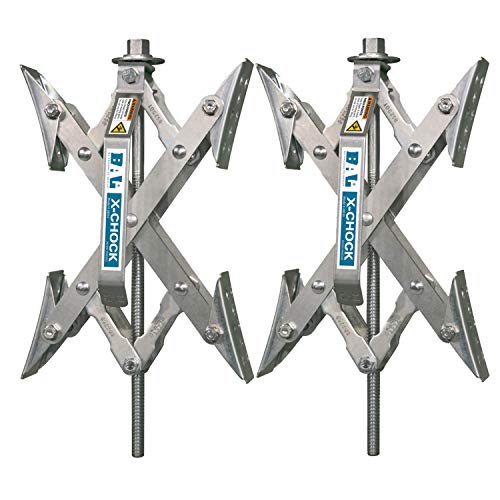
The X-Chock is a different tool for a specific job: tandem-axle trailers. Instead of wedging against the ground, a pair of these alloy-steel devices fits between the two tires on one side and expands, applying opposing force to both at once. That locks the wheels against shifting and calms the rocking inside a parked camper. Fit runs from 1-3/8 inches at the center point to 10 inches at the foot pads, covering most tandem spacing.
A plated ratchet wrench is included, and turning the drive nut extends or retracts the chock from a standing position. It can also be locked with a separate BAL padlock. Our take: an X-Chock complements ground chocks rather than replacing them on a grade, but for stabilizing a tandem rig, nothing else here does the same job.
Specs
- Material: Alloy steel
- Fit: Tandem tires, adjusts from 1-3/8 inches to 10 inches between contact points
- Pack count: 2 X-Chocks plus ratchet wrench
- Included wrench: 3/4-inch plated ratchet with comfort bumper
- Features: Expanding scissor action, lockable with BAL 28015 padlock (sold separately)
- Model: 28012
- ASIN: B002XLHUQG
Pros:
– Locks tandem tires against each other for real stability
– Set and removed from a standing position with the included wrench
– Slim profile fits tight tandem spacing
Cons:
– Only works on tandem-axle setups
– Not a substitute for ground chocks on a slope
How to Choose the Right Wheel Chocks
Match height to tire size. A useful rule of thumb is chock height around one quarter of the tire diameter. Too short, and a loaded tire can climb it; too tall, and it may not seat fully against the tread.
Pick material for your surface. Solid and reinforced rubber grip best on concrete, asphalt, and gravel, and tolerate oil, sun, and cold. Hard plastic wins on weight and storage size. Steel expanding designs are tandem specialists, not general shop duty.
Count what you actually need. Chock both directions: one in front of and one behind the tire, on at least one axle, and on both sides for trailers on any grade. A pair is the minimum; tandem rigs often need four ground chocks plus stabilizers.
Look for retrieval details. Handles, eyebolts, and ropes keep hands away from a loaded tire and make a chock far less likely to be left behind. Frame-mounted storage, like the CURT kit, solves the same problem a different way.
Place them correctly. Set chocks snugly against the tire, centered on the tread, on firm, level ground when possible. On a slope, chock the downhill side first. On soft ground, a wide board under the chock helps it keep its bite.
Frequently Asked Questions
How many wheel chocks does a trailer need?
Use a pair on one tire, one in front and one behind, every time you unhitch. On any slope, or with a heavier trailer, chock both sides. Tandem trailers benefit from chocks on both axles, or an expanding stabilizer used alongside ground chocks.
Can wheel chocks replace a parking brake?
No. Chocks are a backup, not a replacement. Use the parking brake, leave a manual transmission in gear, and then chock. Trailers have no brake of their own once unhitched, which is when most roll-away incidents happen.
Rubber or plastic chocks: which grip better?
Rubber, in nearly every practical comparison on hard surfaces. Its weight and softer compound conform to surface texture on concrete and asphalt, while plastic relies more on its ribbed shape. Plastic still suits light trailers where storage and weight matter more than maximum grip.
How do I chock a trailer on a slope safely?
Keep the trailer coupled while you set the downhill-side chocks snugly, chock both sides if the grade is noticeable, then unhitch. When leaving, hitch up first and remove chocks last. On soft ground or a steep grade, add boards under the chocks and consider a second pair.
Conclusion
For most shops, the MAXXHAUL 70472 is the default buy: dense rubber, a tall face, and a handle. Trailer owners who travel light will prefer the Camco 44471 rope pair, while the AFA Tooling set covers the widest mix of vehicles in one purchase. If your chocks keep vanishing, the frame-mounted CURT 22802 fixes the storage problem, and tandem owners should add the BAL X-Chock for stability ground wedges cannot provide. Match the design to your rig and ground, use them in pairs, and make chocking as automatic as setting the brake.
Related guides
More from Amazon
Programs that pair well with the guide above. Offers and eligibility are set by Amazon and may change.
A free business account with business pricing and bulk-buying tools for work, shop or home office.
Create a business accountFree shipping on eligible items, Prime Video and more. Eligible new members can start with a free trial.
Start a Prime free trialAudiobooks and podcasts to listen to on the go. Eligible new members can start with a free trial.
Try Audible freeAd-free music streaming. Eligible new subscribers can start with a free trial.
Try Music Unlimited freeAs an Amazon Associate we earn from qualifying purchases.



Write Your Review
No reviews yet. Be the first to share your experience!