
Key takeaways
- Find the best dent puller kit for your shop with five proven picks, from glue-tab lifters to a 5 lb slide hammer set, plus sizing and technique tips.
What's inside
As an Amazon Associate I earn from qualifying purchases. This post may contain affiliate links at no extra cost to you.
As an Amazon Associate we earn from qualifying purchases.
A pushed-in door, a hail-pocked hood, or a creased bedside can ruin the look of an otherwise solid truck, and body shops book out weeks for work that often needs no filler and no paint. That is exactly the gap a good best dent puller kit fills. Paintless dent repair, or PDR, works the metal back toward its original shape from the outside using glued tabs and controlled pulling force, so the factory finish stays intact. In a welding shop, these kits earn their keep on project cars, trucks, and trailers.
The five kits below cover the three pulling methods that matter: lifter tools that squeeze a dent out with slow leverage, T-bar slide hammers that pop metal back with short tugs, and a mechanical slide hammer set that also handles hubs and axles.
Disclosure: This post contains affiliate links. If you buy through links on this page, we may earn a commission at no extra cost to you.
What we cover
Quick picks
- Manelord Auto Body Dent Repair Kit — a complete 35-piece glue-pull setup with golden lifter and glue gun, best for first-time PDR work.
- GLISTON Auto Dent Puller Kit — an adjustable golden lifter with 21 tab sizes, best for mixed dent sizes.
- YOOHE Paintless Dent Repair Puller Kit — a compact T-bar slide hammer kit, best for hail marks and dings.
- Super PDR Car Dent Repair Kit — lifter, bridge, and slide hammer tools in one box, best for broader hood and fender dents.
- OTC 4579 9-Way Slide Hammer Puller Set — a 5 lb mechanical slide hammer with jaw pullers and a dent attachment, best for shops that also pull hubs and axles.
Manelord Auto Body Dent Repair Kit
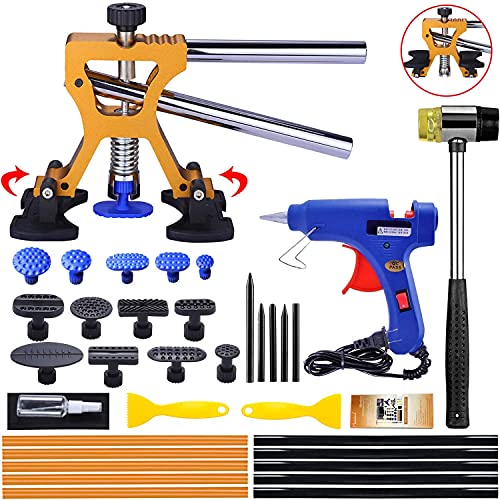
The Manelord kit is the classic starter package for glue pulling, built around a golden dent lifter that works on leverage rather than impact. You glue a tab to the center of the dent, hook the lifter over it, and squeeze the handles so the feet press on the panel while the tab draws the low spot up in small, controlled increments.
Thirty-five pieces cover the whole job: lifter, glue tabs, a 20W glue gun with sticks, rubber hammer and tap-down pens, glue scrapers, an alcohol bottle, and a cloth. In practical notes, it works best on shallow to medium dents where the paint is unbroken, using several light pulls per dent.
Specs
- Puller type: Golden dent lifter, leverage style
- Pieces: 35
- Material: Stainless steel with rubber contact feet
- Glue gun: 20W hot melt, glue sticks included
- Tabs: 18 glue puller tabs in assorted sizes
- Also included: Rubber hammer, tap-down pens, glue shovels, alcohol bottle, cloth
- ASIN: B07KP8M6KL
Pros:
– Complete box: gun, tabs, tap-down tools, and cleanup gear included
– Slow leverage pull is forgiving for beginners and kind to paint
– Works on car, truck, and motorcycle sheet metal, plus appliances
Cons:
– Slow on large, shallow hood dents
– Glue bond lets go on sharp creases, so deep damage is out of reach
GLISTON Auto Dent Puller Kit

GLISTON takes the same golden lifter idea and adds adjustment in both directions: the legs change width to straddle wider dents, and the center bar changes height to suit deeper ones. That matters, because a lifter that bridges too close to a dent edge will pull a ring into the panel instead of lifting the middle.
The tab selection is the other strong point. Twenty-one tab sizes let you match the tab footprint to the dent, which matters more than raw pulling force: a tab that is too small can stretch metal, while an oversized tab wastes glue strength on undamaged panel. Soft rubber feet protect the clear coat, and a glue gun is included.
Specs
- Puller type: Adjustable golden dent lifter
- Adjustment: Width and height adjustable legs and center bar
- Tabs: 21 sizes of strengthened glue tabs
- Material: Aluminum and plastic with rubber base pads
- Glue gun: Included, with professional adhesive glue sticks
- ASIN: B07DDBXX2H
Pros:
– Adjustable width and height suit small dings and larger dents alike
– Wide tab range makes it easier to match tab to dent size
– Rubber base helps protect the original paint
Cons:
– Plastic parts feel less durable than all-metal lifters
– No T-bar or slide hammer for dents that need an impact pull
YOOHE Paintless Dent Repair Puller Kit

The YOOHE kit skips the lifter entirely and centers on a 2-in-1 T-bar tool that works as a small slide hammer. You glue a tab to the dent, attach the T-bar, and slide the weight along the shaft so each short stroke delivers a quick, snappy pull. That impact style suits hail dents and dings where the metal still has spring in it and a slow squeeze just flexes the panel.
Sixteen glue tabs and six glue sticks come in the box, and the whole kit weighs under three and a half pounds. Practical notes: work in small hits, check the panel from a low angle after every few slides, and stop as soon as the dent reads level, because a slide hammer will pull a low spot into a high spot if you keep going. A glue gun is not included.
Specs
- Puller type: T-bar slide hammer, 2-in-1 design
- Pieces: 23 total (T-bar, 16 tabs, 6 glue sticks)
- Tabs: 16 black glue pulling tabs in graduated sizes
- Glue sticks: 3 yellow and 3 black, 7mm x 270mm
- Package weight: 1,480 g (about 3.3 lb)
- ASIN: B07BN9S5X2
Pros:
– Slide action pops shallow hail dents faster than a squeeze lifter
– Light, simple kit with little setup or learning curve
– Tabs release cleanly with an alcohol spray
Cons:
– No glue gun included, and only six sticks to start
– Impact pulling is easy to overdo on thin door skins
Super PDR Car Dent Repair Kit

Super PDR bundles the three puller styles into one heavier kit: a dent lifter for controlled squeezes, a bridge puller for wide, shallow work, and a 2-in-1 slide hammer T-bar for dents that need a snap. If you only want one box on the shelf for whatever rolls into the shop, this is the most versatile glue-pull kit here.
The bridge puller deserves a mention for hood and roof work: its feet spread the reaction load wider than a lifter, so broad, shallow dents come up more evenly. The kit also includes a glue gun, high-adhesion tabs and sticks, and a suction cup for the largest dents where glue is overkill. As with every glue system, prep matters: wipe the panel with alcohol and let the glue cool fully before pulling.
Specs
- Puller types: Dent lifter, bridge puller, and 2-in-1 slide hammer T-bar
- Item weight: 7.13 lb
- Package dimensions: 13.39 x 9.72 x 6.18 inches
- Model number: 004-0918
- Glue gun: Included, with high-adhesion tabs and glue sticks
- Extras: Suction cup for large shallow dents
- ASIN: B0DHD2P52F
Pros:
– Three pulling methods cover nearly any glue-pull job
– Bridge puller spreads load well on hoods, roofs, and trunk lids
– Suction cup handles big, soft dents without glue
Cons:
– Heavier, bulkier box than single-tool kits
– Hard pulls can snap the smaller tabs
OTC 4579 9-Way Slide Hammer Puller Set

The OTC 4579 is a different animal from the glue kits above. This is a traditional mechanical slide hammer set built around a 5 lb chrome-plated hammer, made for pulling rear axles, front-wheel-drive hubs, bearings, gears, and seals, with a dent puller attachment for sheet metal. In a shop that also does mechanical work, that dual role is why it belongs here.
For dent work, the method is old-school: attach the dent puller to a screw or stud set into the low area, then work the slide weight to walk the metal out, finishing with hammer and dolly work and, on a painted panel, filler and paint afterward. That makes it the pick for deeper damage on project vehicles where paint preservation is not the goal.
Specs
- Puller type: Mechanical slide hammer, 9-way configurations
- Hammer: 5 lb, chrome plated
- Attachments: Hub puller, axle puller, cross block, cone, internal/external jaws, grip wrench adapter, dent puller, hook
- Case: Blow-molded carrying case
- Total weight: 17.2 lb
- Model number: 4579
- ASIN: B0015DMNIS
Pros:
– Genuine pulling power for deep dents and stuck parts
– Nine configurations cover hubs, axles, bearings, gears, and seals
– Chrome-plated steel build made for years of shop use
Cons:
– Dent work with this method is not paintless and needs refinishing
– Heavy set, and overkill if you only fix door dings
How to choose
Start with the dent, not the tool. Shallow dings, hail marks, and soft door dents with unbroken paint are glue-pull territory: a lifter kit like the Manelord or GLISTON gives slow, controllable force that is hard to mess up. Dents with stubborn spring-back respond better to the snap of a T-bar slide hammer like the YOOHE. Wide, shallow hood dents favor a bridge puller, which the Super PDR kit includes alongside both other styles.
Choose a mechanical set like the OTC 4579 when the damage is deep, the panel is headed for filler and paint anyway, or you also need it for axles and hubs. No puller fixes everything: dents on a body line, at a panel edge, or where paint is cracked still need traditional bodywork, and aluminum responds differently from steel, so practice on a hidden spot first.
Finally, look at the consumables. Tabs and glue sticks are wear items, so a wide tab selection keeps a kit useful longer. A tap-down pen matters more than it sounds, because knocking down the high ring around a pulled dent is half of a clean result.
FAQs
Can a dent puller kit fix a dent on a crease or body line?
Usually not completely. Glue tabs struggle to hold on sharp creases, and stretched metal along a body line rarely returns to its exact shape with pulling alone. These kits can improve a creased dent, but a crisp factory line generally needs hammer and dolly work from behind the panel.
Will glue pulling damage my paint?
Done correctly, no. Tabs bond with hot melt glue that releases with isopropyl alcohol, and lifter feet are rubber-padded to protect the finish. The risk comes from rushing: pulling before the glue cools weakens the bond, and pulling too hard can crack compromised paint. Factory paint in good condition handles PDR well; older resprays are less predictable.
Slide hammer or lifter: which is better for hail damage?
For a panel covered in hail marks, a T-bar slide hammer is usually faster, because each dent needs only a few short pulls. A lifter gives finer control for final leveling. Many techs use both: slide hammer for bulk work, lifter and tap-down tools for finishing.
Do these kits work on aluminum or plastic panels?
Glue pulling works on aluminum, though aluminum has less memory than steel and needs more, gentler pulls. It does not work on plastic bumper covers, which flex instead of holding a tab bond; plastic dents are better handled with heat and pressure from behind.
Conclusion
For most users, the best dent puller kit is a glue system matched to the dents you actually see: the Manelord for a complete starter set, the GLISTON when dent sizes vary, the YOOHE T-bar for fast hail work, and the Super PDR for lifter, bridge, and slide hammer in one box. Add the OTC 4579 when your pulling jobs extend beyond panels to axles and hubs. Work clean, pull in small steps, and most shallow dents will come out with the factory paint untouched.
Related guides
More from Amazon
Programs that pair well with the guide above. Offers and eligibility are set by Amazon and may change.
A free business account with business pricing and bulk-buying tools for work, shop or home office.
Create a business accountFree shipping on eligible items, Prime Video and more. Eligible new members can start with a free trial.
Start a Prime free trialAudiobooks and podcasts to listen to on the go. Eligible new members can start with a free trial.
Try Audible freeAd-free music streaming. Eligible new subscribers can start with a free trial.
Try Music Unlimited freeAs an Amazon Associate we earn from qualifying purchases.
Write Your Review
No reviews yet. Be the first to share your experience!