What's inside
- Quick comparison of the leading 8-inch options
- Head-to-head: which grinder fits your work?
- Decision matrix by workshop situation
- Why speed range matters more than the label
- Tool rests, eye shields, and vibration: the details that decide ownership
- Setup and maintenance that improve sharpening results
- Final recommendation
- Quick comparison of the leading 8-inch options
- Head-to-head: which grinder fits your work?
- Decision matrix by workshop situation
- Why speed range matters more than the label
- Tool rests, eye shields, and vibration: the details that decide ownership
- Setup and maintenance that improve sharpening results
- Final recommendation
As an Amazon Associate I earn from qualifying purchases. This post may contain affiliate links at no extra cost to you.
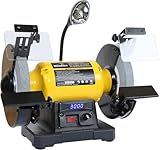
The best variable speed bench grinder for most home workshops is the WEN 4286 8-inch model, while the JET IBG-8VS is the stronger choice for frequent, demanding work and the Delta 23-197 remains worth considering when you find a well-supported unit at a sensible price.
A variable speed bench grinder is most useful when one machine must handle both heat-sensitive sharpening and general shop work. Slower speeds give you more control when sharpening chisels, plane irons, and turning tools; higher speeds remove burrs and reshape steel more quickly. The right choice depends less on the word “variable” and more on the usable speed range, wheel quality, vibration, rest design, and motor behavior under load.
As an Amazon Associate we earn from qualifying purchases at no extra cost to you.


What we cover
- Quick comparison of the leading 8-inch options
- Head-to-head: which grinder fits your work?
- Decision matrix by workshop situation
- Why speed range matters more than the label
- Tool rests, eye shields, and vibration: the details that decide ownership
- Setup and maintenance that improve sharpening results
- Final recommendation
Quick comparison of the leading 8-inch options
| Model | Wheel size | Speed range | Motor | Arbor | Best suited to |
|---|---|---|---|---|---|
| WEN 4286 | 8 x 1 in | 2,000–3,400 rpm | 3/4 hp | 5/8 in | General sharpening and light deburring |
| Delta 23-197 | 8 x 1 in | 1,725–3,450 rpm | 3/4 hp | 5/8 in | Sharpening with a particularly useful low setting |
| JET IBG-8VS | 8 x 1 in | 900–3,600 rpm | 1 hp | 5/8 in | Frequent workshop use and heavier deburring |
Specifications can vary by production run and regional documentation, so check the manual before buying replacement wheels or accessories. All three are 8-inch variable speed bench grinder designs, but their low-speed behavior is not equivalent. A machine that bottoms out around 2,000 rpm offers some control, whereas one that reaches approximately 900 rpm is much more comfortable for delicate edge work.
Head-to-head: which grinder fits your work?
WEN 4286: best value for an occasional workshop
The WEN 4286 is the practical pick when price, availability, and ordinary home-shop capability matter most. Its 3/4-hp motor is adequate for sharpening household tools, lawn-tool edges, drill bits, and small pieces of mild steel. The 2,000–3,400-rpm range is useful for reducing heat compared with a fixed-speed grinder, although it is not an especially slow machine.
Its main limitation is refinement. At this price level, expect to spend time dressing the wheels, checking flange seating, and adjusting the tool rests. Small rests and flexible eye shields can be made more useful with careful setup, but they are not a substitute for a large, rigid sharpening platform. This is the best variable speed bench grinder for light-to-moderate use when you do not need to remove a great deal of metal.
Delta 23-197: the sharpening-oriented choice
The Delta 23-197 is attractive because its lower operating point is close to the conventional 1,725-rpm speed used by many sharpening grinders. That makes it easier to control heat on high-carbon tool edges than a grinder whose minimum is 2,000 rpm or more. Its 8-inch wheels also provide a useful compromise: they offer a larger working circumference than a 6-inch grinder without taking as much bench space as a larger industrial unit.
Look carefully at condition and parts support, particularly if purchasing an older or remaining-stock machine. On a used example, inspect the power switch, speed control, wheel guards, rest hardware, and motor bearings before treating it as a bargain. A low purchase price can disappear after replacement parts, new wheels, and vibration repairs.
JET IBG-8VS: best for demanding, regular use
The JET IBG-8VS is the more substantial option for a professional or serious hobby workshop. Its 1-hp motor provides more reserve when a workpiece is pressed against the wheel, and its broader speed range makes it more versatile for both sharpening and deburring. The low end is especially useful for controlling heat, while the upper range accelerates material removal.
The trade-offs are cost, weight, and bench space. A heavier grinder is usually easier to keep stable, but it is less convenient to move. General market pricing for a new variable speed 8-inch grinder is often roughly $250–$600, with heavier industrial-style machines toward or above the top of that range. Budget for quality wheels rather than spending the entire budget on the motor.
Decision matrix by workshop situation
| Your situation | Recommended direction | Why |
|---|---|---|
| Sharpen a few tools monthly | WEN 4286 or similar 3/4-hp model | Enough power without paying for industrial capacity |
| Sharpen chisels and plane irons frequently | Low-speed model such as Delta 23-197 | More control and less aggressive heat buildup |
| Deburr steel parts every week | JET IBG-8VS or another 1-hp grinder | More torque reserve and a faster top setting |
| Small bench or shared workspace | Compact 8-inch, 3/4-hp grinder | Good capacity without the footprint of industrial equipment |
| New user learning freehand sharpening | Variable speed with a low minimum rpm | Slower wheel movement gives more reaction time |
Why speed range matters more than the label
Wheel surface speed changes with both rpm and diameter. An 8-inch wheel running at 3,450 rpm has an approximate edge speed of 7,225 feet per minute, calculated as:
8 inches × 3.1416 × 3,450 rpm ÷ 12 = approximately 7,226 feet per minute.
At 1,725 rpm, the same wheel runs at approximately 3,613 feet per minute. That reduction does not eliminate the need for water or frequent cooling, but it gives the operator more time to remove a small amount of metal without discoloring the edge. For deburring a weld or knocking down a sharp corner, the higher setting saves time. For sharpening a thin chisel, the lower setting is usually easier to manage.
Never exceed the maximum rpm printed on the wheel. The grinder’s speed control does not make an unsuitable wheel safe, and a wheel designed for a different diameter or material may have a different rated limit.
Tool rests, eye shields, and vibration: the details that decide ownership
A good tool rest should lock firmly, adjust close to the wheel, and provide enough surface area to support the work. Thin rests that flex when pressure is applied make consistent bevels difficult. For sharpening, a rest that can be set accurately to a repeatable angle is more valuable than a high no-load rpm.
Eye shields are useful for catching sparks and larger particles, but they do not replace safety glasses or a face shield. Shields should remain clear, stay securely positioned, and not force your hands into an awkward approach angle. Check that the guards do not interfere with the full range of rest adjustment.
Vibration is often blamed on the motor when the actual cause is an out-of-round wheel, damaged blotter, dirt between the flanges, or a grinder sitting on an uneven bench. An 8-inch wheel has more mass than a 6-inch wheel, so imbalance is noticeable. If vibration remains after dressing and correctly reseating the wheel, stop using the machine and inspect the bearings, shaft, and flanges.
Setup and maintenance that improve sharpening results
- Secure the grinder. Bolt it to a solid bench or a heavy board. Movement changes the bevel angle and increases the chance of catching the work.
- Inspect and ring-test suitable wheels. Do not install a cracked wheel. Use the correct bushings, blotters, guards, and flange size.
- Dress the wheel. A clean, flat face cuts more predictably and reduces localized heat. Dress lightly rather than removing unnecessary material.
- Set the rest close to the wheel. Keep the gap small and recheck it as the wheel wears. A large gap can catch a thin tool.
- Begin at a moderate or low speed. Touch the edge lightly and keep the tool moving. Do not hold one spot against the wheel.
- Cool the work frequently. A water container beside the grinder is useful, but do not splash water onto a wheel or electrical housing. Dip the tool, not the machine.
- Clean and inspect regularly. Remove metal dust from vents and guards, check the cord and switch, and listen for new bearing noise.
The wheel is commonly the first consumable to wear, especially if the grinder is used for both tool sharpening and dirty fabrication work. Keep separate wheels for different materials when practical. A coarse aluminum-oxide wheel is a common general-purpose choice for carbon steel; specialty wheels may be preferable for hardened steels or carbide, but they must match the grinder and the manufacturer’s instructions.
Final recommendation
Choose the WEN 4286 if you want an affordable, capable variable speed bench grinder for occasional sharpening and light deburring. Choose the Delta 23-197 when a genuinely useful low setting and sharpening control are the priority, provided parts and condition check out. Choose the JET IBG-8VS when the grinder will see frequent use, heavier contact, and more demanding workshop jobs.
For most buyers, an 8-inch variable speed bench grinder is the best all-around size: large enough for useful wheel life and stable operation, yet compact enough for a normal woodworking or fabrication bench. Whichever model you select, a rigid mounting surface, properly dressed wheels, accurate tool rests, and disciplined cooling technique will affect sharpening results more than a small difference in advertised horsepower.