
Key takeaways
- Find the best machinist straight edge for welding and shop layout, with five ground steel and aluminum picks for checking flatness, scribing, and setup.
As an Amazon Associate I earn from qualifying purchases. This post may contain affiliate links at no extra cost to you.
As an Amazon Associate we earn from qualifying purchases.
A warped table, a crowned weldment, or a mill bed that rocks on one corner will quietly ruin fit-up. That is why a good straight edge earns its bench space in a welding shop. Held against a surface with a light behind it, or paired with a thin feeler leaf, it shows gaps, humps, and dips that a tape and a good eye will miss. The same tool scribes layout lines, checks a ground joint before welding, and confirms a machined face stayed flat after heat went into it.
This guide covers five picks: a ground steel reference for inspection, compact machinist rules for everyday marking, and longer aluminum edges for machine setup and large weldments. Each was chosen for a published straightness tolerance and a durable build. For flatness on smaller parts, begin with the Starrett. For layout and measuring, the Mitutoyo and PEC Tools rules will see more daily use.
Disclosure: This post contains affiliate links. If you buy through links on this page, we may earn a commission at no extra cost to you.
Quick picks
- Best overall reference: Starrett 380-24 Steel Straight Edge, 24 inch — precision ground and ungraduated.
- Best compact machinist rule: Mitutoyo 182-204 Steel Rule, 6 inch — 3R graduations, pocket size.
- Best long graduated rule: PEC Tools 18 inch Rigid Machinist Rule — decimal and metric scales, made in the USA.
- Best for machine setup: Woodpeckers SERX Precision Straight Edge, 36 inch — freestanding vee-groove base.
- Best long shop edge: POWERTEC 71332 Aluminum Straight Edge, 38 inch — lightweight reach for large work.
The picks in detail
Starrett 380-24 Steel Straight Edge, 24 Inch

The 380 series is what most machinists picture when someone says straight edge: a thick slab of precision-ground steel with no graduations and no bevel, made to do one job. The 24-inch version is stiff enough to bridge a cylinder head or a freshly ground weld prep, yet easy to handle one-handed. Our take is simple — if flatness is the question, this is the reference you trust first.
Starrett grinds these edges to plus or minus 0.0002 inch per foot, so a sliver of light under the edge means the surface, not the tool, needs attention. The plain faces make a clean scribing edge for layout dye work. Keep it oiled and store it flat or hung, because a reference tool only stays a reference while its edge stays true.
Specs
- Length: 24 in (600 mm)
- Width x thickness: 1-13/32 in x 11/64 in (36 mm x 4.4 mm)
- Material: Steel, precision ground and finished
- Edges: Not beveled, not graduated
- Accuracy: Plus or minus 0.0002 in per foot
- Model: 380-24
- ASIN: B0006J4GKK
Pros:
– Ground to a tight per-foot tolerance for inspection
– Thick, stiff section resists flex over its span
– Plain edges suit flatness checks and scribing
Cons:
– No graduations, so a separate rule is needed to measure
– Steel needs oiling and careful storage
– Heavy for its size versus aluminum edges
Mitutoyo 182-204 Steel Rule, 6 Inch

The Mitutoyo 182-204 is a 6-inch machinist rule with a clean edge that doubles as a short reference for small ground faces, shim packs, and gasket surfaces. Its 3R graduation set packs fractional and decimal scales onto one small blade, handy for converting a layout dimension without walking back to the toolbox.
The blade is tempered stainless steel with a satin chrome finish, so etched marks stay readable under bright lighting without glare. At half an inch wide and 1/64 inch thick, it slips into a pocket and comes out a dozen times a day. Our practical notes: treat it as a measuring rule first and a reference second — for long flatness work, step up to the Starrett.
Specs
- Length: 6 in
- Width x thickness: 1/2 in x 1/64 in
- Material: Tempered stainless steel
- Finish: Satin chrome
- Graduations: 3R — 1/32, 1/64, 1/10, and 1/50 in
- Model: 182-204
- ASIN: B0002FS500
Pros:
– Four graduation scales on one compact blade
– Satin chrome finish cuts glare
– Stainless build shrugs off coolant and moisture
Cons:
– Too short for table or weldment checks
– Thin blade flexes if used as a prying edge
– Fine decimal scales take practice to read
PEC Tools 18 Inch Rigid Machinist Rule

PEC Tools builds this 18-inch rule in the USA from carbon steel, fully hardened and tempered, then finished in satin chrome. It is the longest graduated pick here, and that reach matters: it spans a gearbox cover, a wide flange face, or a full sheet layout line in one placement, while its ground edges still serve for short flatness checks.
One side works in decimal inch steps of 1/10 and 1/100, while the metric side reads in 0.5 mm and 1 mm steps, so switching between an inch drawing and a metric fixture takes seconds. The rigid section sits flat without curling and gives a scribe a firm fence. In our take, this is the rule that lives on the bench rather than in a drawer.
Specs
- Length: 18 in (450 mm)
- Width: 1.13 in
- Material: Carbon steel, fully hardened and tempered
- Finish: Satin chrome
- Graduations: 1/10 in, 1/100 in, 0.5 mm, and 1 mm
- Model: 562-018
- ASIN: B0F6D26R34
Pros:
– Decimal and metric scales cover mixed-unit drawings
– Hardened blade holds a clean edge
– Rigid section doubles for layout and checks
Cons:
– Carbon steel needs a light oil film in damp shops
– Falls short on long machine beds
– No hook or end stop for one-handed measuring
Woodpeckers SERX Precision Straight Edge, 36 Inch
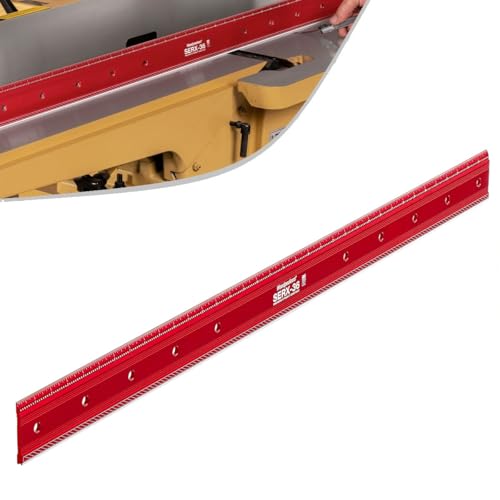
The SERX is machined from aluminum with an inverted vee-groove along its base edge, so it stands on its own while you work around it. Set it across a jointer bed or a fabricated frame, and the groove footing holds it upright while a feeler leaf or backlight shows where the surface rises or falls. For leveling a fixture table or checking a frame before final welds, that hands-free stance is a genuine time saver.
Woodpeckers machines the SERX to 0.0015 inch per foot and laser engraves the scale with a bright bar along the lower edge that makes low spots easier to spot. The graduated edge is beveled at 30 degrees, bringing marks close to the work. It is made in Strongsville, Ohio. Our take: it will not replace a ground steel reference for final inspection, but for setup across three feet of machine or weldment, it is the most practical tool here.
Specs
- Length: 36 in
- Material: Aluminum, precision machined
- Tolerance: 0.0015 in per foot
- Edge: 30-degree beveled graduated edge with laser-engraved scale
- Base: Inverted vee-groove profile, freestanding
- Model: SERX-36
- ASIN: B003S7C4S8
Pros:
– Stands on its own for hands-free checks
– Vee-groove base reveals humps and dips
– Beveled edge puts graduations close to the work
Cons:
– Aluminum edge needs care around sparks and burrs
– Tolerance is looser than ground steel references
– Long body needs a dedicated storage spot
POWERTEC 71332 Anodized Aluminum Straight Edge, 38 Inch
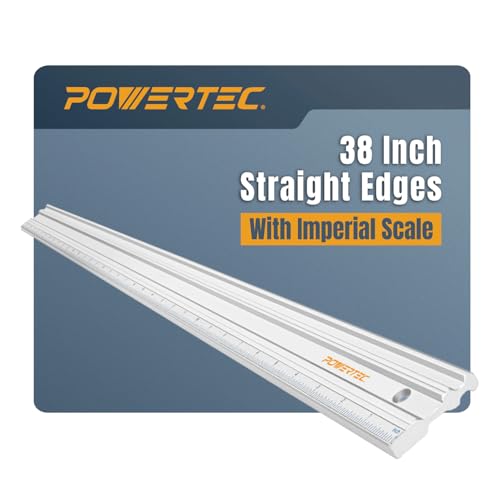
For a long weldment, a trailer frame, or a machine base, 38 inches of reach in a light aluminum body is useful. The POWERTEC 71332 is machined flat to within 0.003 inch over its full length, with a thick, ribbed profile that is easy to grip and stiff enough to span between supports without sagging. An anodized finish protects it from everyday handling.
A dual-sided inch and metric scale runs along the 2-inch-wide face, so the edge that checks a frame for twist can also lay out hole spacing or mark a cut line. A hanging hole keeps storage simple. Our practical notes: the tolerance suits fabrication and machine alignment well, but it is a shop edge rather than an inspection master, so confirm critical surfaces with the Starrett.
Specs
- Length: 38 in
- Width: 2 in, with 5/16 in measuring surface
- Material: Anodized aluminum
- Flatness: Machined to within 0.003 in over full length
- Graduations: Dual-sided inch and metric, 1/16 in steps
- Model: 71332
- ASIN: B07R6RK87W
Pros:
– Longest reach here, yet light to position
– Ribbed profile adds stiffness and grip
– Dual scales suit layout and checking
Cons:
– Loosest flatness tolerance of the five picks
– Aluminum face can dent if dropped
– Scale reads to 1/16 in only, coarse for fine layout
How to choose
Match length to the surface. An edge only tells the truth over the span it covers. Six- and 18-inch rules handle parts, flanges, and layout. A 24-inch ground edge covers most heads, plates, and tables. For frames, beds, and weldments, go to 36 inches or more.
Decide between a reference and a rule. An ungraduated ground edge, like the Starrett 380-24, exists purely to judge flatness. A graduated rule measures as well as checks, but it is a working tool rather than a master. Many shops keep both.
Read the tolerance honestly. Ground steel at 0.0002 inch per foot supports inspection work. Aluminum setup edges at 0.0015 to 0.003 inch are fine for aligning machines and fabrications, where the adjustment itself is rarely finer than that. Buying less accuracy than your fit-up needs will hide gaps until the joint is already tacked.
Pick a material for your shop. Hardened steel holds an edge longest but rusts without oil and feels heavy at long lengths. Stainless rules resist corrosion for pocket carry. Aluminum is light and kind to finished surfaces, yet it dents more easily and belongs away from grinding stations.
Think about edge style and care. A beveled edge brings graduations close to the work and makes light-gap checks easier to see. A square edge stands more steadily and scribes a cleaner line. Store your pick flat, hung, or in a case — never loose in a drawer of sockets — and check it now and then against a known flat surface.
FAQs
What is the difference between a straight edge and a machinist rule?
A straight edge is a reference tool: its edge is ground true so you can judge another surface against it. A machinist rule is a measuring tool with graduations. Some rules have edges true enough for light checking, but a dedicated reference holds a tighter tolerance and has no scales to wear.
How do I check a surface for flatness with one of these tools?
Set the edge on the surface and look for light underneath, or slide thin feeler leaves into any gap to measure it. Check lengthwise, crosswise, and on both diagonals, because a surface can read flat one way and still be twisted or crowned in another.
How long a straight edge do I need for welding fabrication?
For bench parts and joint prep, 18 to 24 inches covers most work. For fixture tables, frames, and machine bases, 36 inches or longer is the practical choice, since the edge should span the full surface in one placement.
How should I store a precision straight edge?
Keep it in a case, hung, or laid flat on a clean shelf, with a light film of oil on steel faces. Never use a reference edge as a pry, a scraper, or a cutting guide.
Conclusion
For a welding shop, the strongest pairing here is the Starrett 380-24 as the trusted reference and the PEC Tools 18-inch rule as the everyday layout tool. Add the Woodpeckers SERX or the POWERTEC 38-inch edge for full tables and frames, and keep the Mitutoyo 6-inch rule in a pocket for small checks. Choose by span and tolerance first, and care for the edge you buy.
Related guides
More from Amazon
Programs that pair well with the guide above. Offers and eligibility are set by Amazon and may change.
A free business account with business pricing and bulk-buying tools for work, shop or home office.
Create a business accountFree shipping on eligible items, Prime Video and more. Eligible new members can start with a free trial.
Start a Prime free trialAudiobooks and podcasts to listen to on the go. Eligible new members can start with a free trial.
Try Audible freeAd-free music streaming. Eligible new subscribers can start with a free trial.
Try Music Unlimited freeAs an Amazon Associate we earn from qualifying purchases.
Write Your Review
No reviews yet. Be the first to share your experience!