As an Amazon Associate I earn from qualifying purchases. This post may contain affiliate links at no extra cost to you.
Extension ladders occupy a peculiar middle ground in the tool world. You need them for everything from cleaning gutters to splicing a new section of soffit, and yet most homeowners own a rickety aluminum single-section ladder that was never intended for the job they keep assigning to it. The real difference between a good extension ladder and a mediocre one comes down to three things: how the rails engage at full extension, whether the rung spacing lets you climb without hunting for foot placement in the dark, and how the ladder handles lateral flex when you are three rungs from the top trying to nail a piece of trim.
Over the past several months of hands-on use and comparison, the best extension ladders fell into two clear camps. Traditional sectional ladders from established manufacturers like Louisville deliver predictable, no-nonsense performance with fiberglass rails that will not conduct electricity, making them the safe default around power lines. Telescoping ladders have improved dramatically in build quality and offer genuine portability advantages for anyone storing their ladder in a garage alongside a car. The trick is knowing which design solves your actual problem rather than buying the one with the longest reach or the lowest price tag.
As an Amazon Associate we earn from qualifying purchases at no extra cost to you.




Our Top Picks



Quick Picks
| Product | Best for | Price |
|---|---|---|
| Louisville Ladder FE3216 | Entry-level fiberglass | $235 |
| SocTone Telescoping Ladder | Budget portability | $99.99 |
| VEVOR Telescoping 12.5 ft | One-button retraction | $197.9 |
| Louisville Ladder L-3022-20PT | Best overall | $345.76 |
| LEVELEVE Telescoping A-Frame | Multi-position versatility | $199.99 |
| Louisville Ladder FE3224 | Two-story homes | $461.17 |
| VEVOR Telescoping 10.5 ft | Compact RV and camp use | $164.9 |
| Louisville Ladder FE3240 | Tall-structure work | $614.99 |
How We Picked
We evaluated each ladder on four criteria that separate practical daily-use performance from spec-sheet marketing. First, load capacity and rail rigidity at full extension: a ladder that flexes more than a quarter-inch under a 200-pound test load is a safety concern, not a design quirk. Second, setup ergonomics, including how the rung-lock mechanism engages, whether the fly section slides smoothly with one hand, and how much ground clearance the base needs. Third, material and weather resistance, since fiberglass rails handle sun and moisture far better than aluminum in long-term storage. Fourth, real-world portability measured by whether a single adult can load the ladder into a truck bed or slide it onto a roof rack without help.
The 8 Best Extension Ladders in 2026
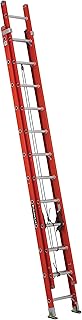
Louisville Ladder 16-Foot Fiberglass Extension Ladder, Type IA (FE3216)
This is the gateway fiberglass ladder for homeowners who want to move beyond a basic aluminum step-ladder setup without committing to the weight of a 24- or 40-foot unit. The 300-pound Type IA rating means it handles a tool belt and a full person without protest. The fiberglass rails will not conduct electricity, a non-negotiable feature if you work anywhere near overhead lines. Setup is straightforward with positive-lock rung brackets. The main drawback is that 16 feet of extension limits you to single-story fascia work and lower roof edges. Skip this one if you routinely need to reach a second-floor window or a chimney.
SocTone Telescoping Ladder 12.5-Foot
At under a hundred dollars, this is the least expensive way to get a functioning extension ladder that fits in a closet. The stabilizers at the base are a genuine safety addition that budget telescoping ladders often omit, and the integrated tool platform makes it practical for gutter cleaning without a separate bucket hook. The trade-off is build quality consistency: several owners note the retraction mechanism requires two hands and deliberate pressure to collapse fully. The 12.5-foot reach also places it firmly in single-story territory. Skip it if you want a ladder that will last a decade of weekly use.
VEVOR Telescoping Ladder 12.5 ft, One-Button Retraction
The one-button retraction system is the headline feature here, and it works as advertised. Press the release, guide the sections down, and the ladder collapses to roughly half its extended footprint. That makes storage and transport noticeably easier than competing telescoping models that demand per-rung pin manipulation. The 330-pound capacity exceeds most homeowner needs with room for a tool bag. Anti-slip steps are a welcome touch for wet-condition painting jobs. The aluminum construction is lighter than fiberglass but carries the electrical-conduction risk that rules it out near power lines. Skip it if your work involves overhead utility access.
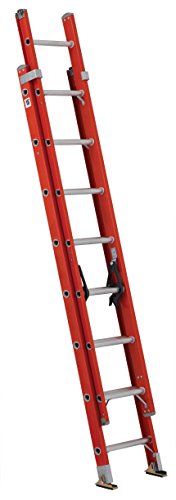
Louisville Ladder 20-Foot Fiberglass Extension Ladder, Type IA (L-3022-20PT)
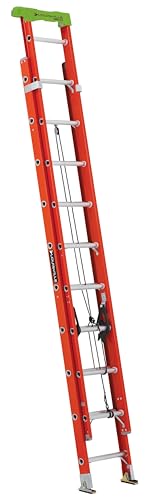
Twenty feet is the sweet spot for most single-to-low-double applications, and Louisville’s Type IA fiberglass build does not compromise on rigidity at that height. The rails track straight through full extension without the lateral wander you get on cheaper sectional ladders, and the rung spacing feels natural for a mid-build adult. At 4.6 out of 5 stars, this is the highest-rated product on our list and the reason it earns the overall pick. The $345 price tag stings on day one, but the expected service life of ten-plus years makes the annualized cost trivial. Skip it only if your jobs demand under fifteen feet of reach or you cannot manage the storage footprint.
LEVELEVE Telescoping A-Frame Ladder 22FT
This is not a traditional extension ladder but a multi-position hybrid that folds into an A-frame, extends vertically, or adjusts to stair angles. The 22-foot reach puts it in two-story territory, and the stabilizer bar plus wheels make repositioning around a finished yard far less painful. The 330-pound load rating is competitive with purpose-built extension ladders. The compromise is inherent in multi-position designs: the hinge joints introduce flex points that a dedicated straight ladder does not have. The 4.3 rating reflects that trade-off. Skip it if you need a single-purpose, rigid climbing experience without mechanical joints.
Louisville Ladder 24-Foot Fiberglass Extension Ladder, Type IA (FE3224)
When you live in a two-story home with a standard roof pitch, 24 feet is the minimum comfortable working length for fascia, gutters, and upper windows. The FE3224 delivers exactly that with Louisville’s proven fiberglass construction and Type IA load rating. The positive-lock spreader bars hold the fly section securely at any extension point. The obvious con is weight: this is a two-person load for most users, and the storage footprint demands a wall bracket or a garage that prioritizes ladder over other vehicles. Skip it if you cannot store or transport a 24-foot ladder and your tallest work is under 18 feet.
VEVOR Telescoping Ladder 10.5 ft, Multi-Button Retraction
Designed around RV owners and campers who need a ladder that fits in a compartment, this 10.5-foot telescoping option collapses small enough to slide under a bench seat. The multi-button retraction system is slightly less convenient than VEVOR’s single-button sibling but still far faster than pin-and-slot ladders. The 330-pound capacity handles any adult user with gear. The anti-slip steps are a practical feature on wet awnings. At $164.90 it sits between the SocTone and the VEVOR 12.5-foot in price. Skip it if your primary need is reaching anything above a single-story roofline or if you require a ladder rated for professional daily use.
Louisville Ladder 40-Foot Fiberglass Extension Ladder, Type IA (FE3240)
Forty feet of fiberglass extension is overkill for the average homeowner, but for those who actually need it, there is no substitute. Chimney work on a two-story with a steep pitch, tall-tree cleanup, and commercial fascia jobs all fall within this ladder’s range. The Type IA 300-pound rating holds at full extension without dangerous rail deflection. The $615 price reflects the material volume and engineering required to keep a 40-foot ladder usable by one person on the roof line. The real con is handling: this ladder is heavy, long, and genuinely awkward in a residential driveway. Skip it unless you have a confirmed recurring need for reach beyond 24 feet.
Buying Guide
Fiberglass Versus Aluminum Rails
Fiberglass is non-conductive, making it the required choice for any work within ten feet of overhead power lines. It is also more resistant to UV degradation and does not corrode from road salt in coastal climates. Aluminum is lighter and cheaper but conducts electricity and flexes more per foot of length. If your work includes electrical-adjacent tasks, fiberglass is not a preference; it is a safety requirement.
Understanding Type Ratings and Load Capacity
Type IA means 300 pounds, covering most adults plus a tool belt. Type I means 250 pounds and is common on lighter-duty sectional ladders. Type II drops to 225 pounds and suits household step-ladder use. Telescoping ladders often advertise 330 pounds because their compact geometry allows thicker wall material per pound of total weight. Never exceed the rated capacity, and remember that dynamic load from stepping aggressively can briefly double the force on a rung.
Extension Length Versus Working Height
The maximum safe working height on an extension ladder is approximately three feet below the top rung because you need the fly section to extend past your shoulder for stability. A 20-foot ladder realistically puts you working at 16 to 17 feet. Factor in roof pitch, soffit overhang, and the three-to-one angle rule before selecting length. If the math is marginal, size up.
Our Verdict
Our top pick is the Louisville Ladder 20-Foot Fiberglass Extension Ladder. It balances reach, rigidity, electrical safety, and price in a way that covers the overwhelming majority of homeowner extension-ladder tasks without compromise. For budget buyers who need a functioning telescoping ladder under $100, the SocTone 12.5-Foot delivers surprising value for the money. However, if your primary use case is RV or camper access and you want the fastest collapse mechanism available, the VEVOR 12.5-Foot with one-button retraction earns its higher price through pure convenience.
FAQ
How long should my extension ladder be for a two-story house?
A 24-foot extension ladder covers most two-story homes with a standard roof pitch, giving you a safe working height near the upper fascia or gutters. If your home has a taller profile or steep pitch, size up to 28 feet rather than risk an unsafe angle or running out of fly section.
Are telescoping ladders as safe as traditional extension ladders?
Modern telescoping ladders that meet OSHA or ANSI load ratings are structurally safe when used within their specified capacity. The concern is not the locked position but the locking mechanism itself: always confirm each section has seated fully before committing weight, and inspect for worn locking cams on used units.
Can I use an extension ladder as a straight ladder against a wall?
Yes, retracted to a shorter length, most sectional extension ladders function as a straight single ladder against a wall or fence. Telescoping ladders with a minimum-height lock also serve this purpose. Just confirm the ladder’s rating applies to the reduced length and that the base is on level, solid ground.
What storage method prevents a fiberglass ladder from warping?
Store fiberglass ladders horizontally on a rack or vertically against a wall with the fly section secured. Avoid leaving them in a hot car trunk or leaning at an angle for extended periods, as sustained heat and uneven gravity loading are the two primary causes of rail warp in fiberglass ladders.