Our Top Picks




What's inside
As an Amazon Associate I earn from qualifying purchases. This post may contain affiliate links at no extra cost to you.
Most beginners build the wrong shopping list. The whole budget goes to the machine. Nothing is left for a hood, gloves or a grinder, and the arc gets struck anyway. Flash burn, scorched jeans, a weld that snaps in the vise. The real list of welding tools for starters is short, and about half of it never touches the arc.
You need a machine you can plug into a circuit you actually own, a hood you can see through, leather over any skin the sparks can reach, a way to cut and clamp steel, and moving air. Welding fume is not smoke. It is metal you just turned into dust fine enough to breathe.
As an Amazon Associate we earn from qualifying purchases at no extra cost to you.


| Process | Good for | Steel thickness it likes | Learning curve |
|---|---|---|---|
| Self-shielded flux core | Outdoor work, rusty stock, repairs | 1/16 in to 1/4 in | Easiest |
| Gas MIG, solid wire | Clean shop welds, panels, brackets | 22 gauge to 1/4 in | Easy |
| Stick (SMAW) | Thick plate, farm and field repair | 1/8 in and up | Medium |
| TIG (GTAW) | Thin stainless, aluminum, show welds | Very thin to 1/4 in | Hardest |
What we cover
Welding Tools For Starters: The Short List
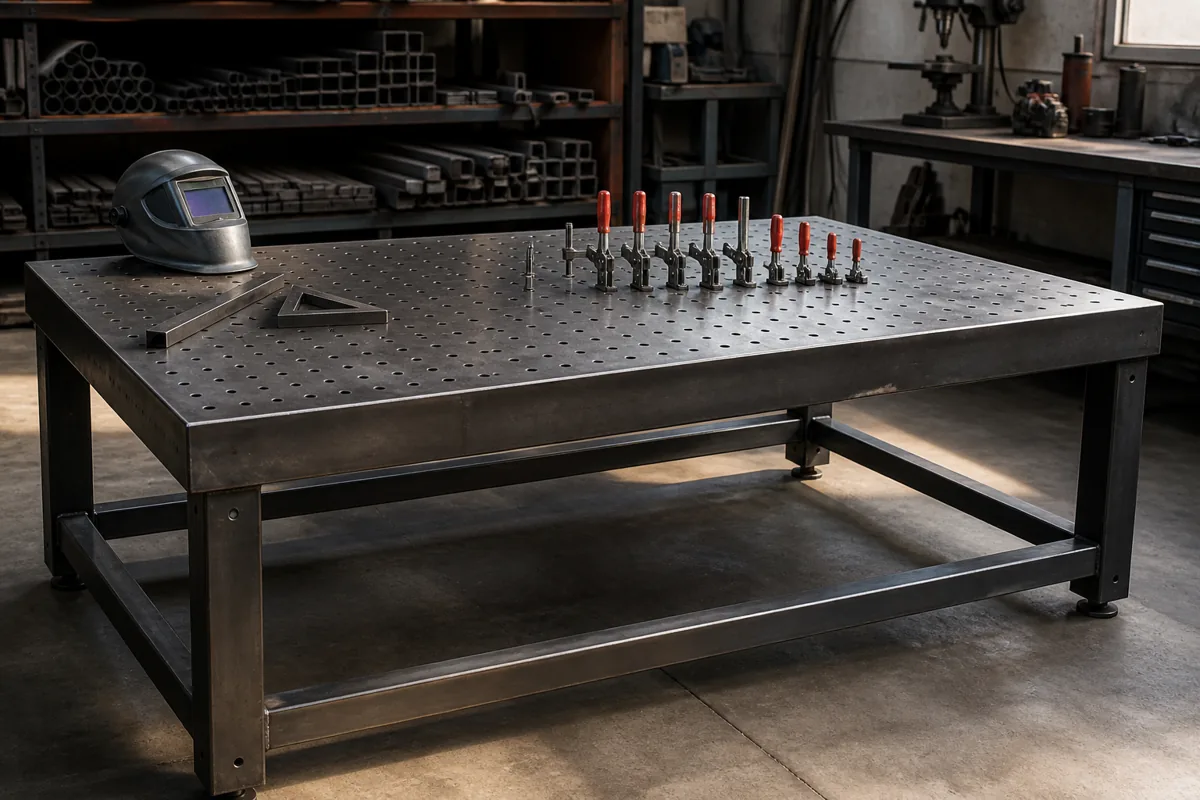
Machine. Auto-darkening helmet. Leather gauntlet gloves. Leather or flame-resistant jacket. A 4-1/2 inch angle grinder with cutoff wheels, a flap disc and a wire wheel. Two locking C-clamps. Chipping hammer and stiff wire brush. Steel table or a fire blanket. A charged ABC extinguisher within arm’s reach. Safety glasses, a face shield for grinding, and a fan.
That is it. No plasma cutter, no positioner, no third hand. Leftover money goes to consumables. You will burn through wire, discs and rod faster than you expect, and running out mid-job is how projects die.
Auto-Darkening Welding Helmet
Do not buy the cheapest hood on the page. Look for variable shade 9 to 13, a 1/1/1/1 optical rating, grind mode, and a window big enough to see the joint. A slow or patchy lens makes you weld half blind, and that is where bad habits start.
Pick The Process, Then Match Amps To Thickness
Process first. Brand second. Self-shielded flux core is the easiest way to join steel. The wire carries its own shielding, so wind will not ruin the bead, and it tolerates mill scale and light rust. It spatters and leaves slag to chip. Gas MIG with solid wire and a 75/25 argon-CO2 mix runs cleaner and is kinder to thin sheet, but you are hauling a cylinder. Stick is cheap and tolerant of dirty steel. TIG is what everyone wants and nobody should start with.
Amperage, plainly. Amps are heat into the joint. More amps, deeper melt. The shop rule of thumb is roughly one amp per thousandth of an inch of steel. Eighth-inch plate is 0.125 inch, so figure around 125 amps for a single pass. Twenty gauge sheet is about 0.036 inch, so you are near 40 amps and your enemy is burn-through, not penetration. Thickness sets amps. Amps set the machine. The machine sets the outlet.
Duty cycle and power. Thirty percent at 90 amps means three minutes of arc time in ten, then seven minutes of cooling. Ignore it and the overload trips mid-bead. A 120V machine on a dedicated 20 amp circuit covers most work up to about 3/16 inch with good prep. Quarter-inch and up in one pass wants 240V. One more trap: gasless flux core runs electrode negative, solid MIG wire runs electrode positive. Swap the leads or your first bead looks like popcorn.
- ✔ Cheap to start and no gas cylinder
- ✔ Runs on a normal household circuit
- ✔ Handles rust, scale and outdoor wind
- ✔ Plenty for carts, gates, brackets and repairs
- ✘ Slag and spatter mean more grinding
- ✘ Struggles on thick plate in one pass
- ✘ Low duty cycle forces cooling breaks
- ✘ Not the best choice for thin body panels
Dual-Voltage MIG and Flux-Core Welder
Get one that runs 120V and 240V, feeds .030 and .035 wire, and comes from a brand whose contact tips, liners and drive rolls you can still buy in five years. Established welding names cost more up front and stay serviceable. Infinite voltage and wire speed control beats stepped settings.
PPE, Fume And Fire Are Part Of The Kit
Arc light burns skin like a sunlamp and burns corneas faster. Shade 10 to 13 covers most beginner work, and 10 or 11 is a fine default. Go darker as amps climb. A shade 5 cutting lens is not an arc lens, ever. Gloves are heavy cowhide or elkskin for MIG and stick, thin goatskin for TIG. Jacket is leather or FR cotton. No polyester, no fleece; synthetics melt into skin. Pant cuffs go over the boots, or the boot becomes a spark cup. Button the collar.
Fume is the risk people ignore because nothing hurts that day. Galvanized steel releases zinc oxide and metal fume fever, which feels like a hard flu for a night. Stainless releases hexavalent chromium, a carcinogen. Old paint and plating can hide lead and cadmium. Grind coatings back an inch from the joint. Set a fan to pull fume sideways off the bench, never blowing into the arc, since that strips gas shielding. Extraction at the joint beats a fan. A P100 respirator stops particulate, not gases, so ventilation comes first.
Sparks and slag travel. Assume 30 feet, farther off a bench. Sweep, then move gas cans, aerosols, rags and cardboard out of the room. Bare concrete can pop chips when trapped moisture flashes, so work on steel or a fire blanket. Never cut or weld a drum, tank or pipe that held fuel unless you know it was purged; if you have to ask, you do not know. Keep brake cleaner and other chlorinated solvents away from the arc, because UV breaks them into phosgene gas. Stay in the shop 30 minutes after the last cut. Slag smolders.
Fit-Up, Grinding And Torque Beat A Better Machine
Amps do not fix a bad gap. Most ugly welds are fit-up problems. The angle grinder earns its keep: thin cutoff wheels for tube and angle, a 40 to 60 grit flap disc for dressing welds and beveling edges, a knotted wire wheel for scale and slag. Buy discs in bulk. Put the guard back on.
Torque, plainly. Torque is twisting force, rated in inch-pounds or newton-meters. Two places it matters. The grinder flange nut goes snug with the supplied wrench, not gorilla tight, because overtightening cracks wheels and a loose wheel slips. And anything bolted to what you just welded gets a torque wrench if it has a spec. Feel is not a spec. A cordless impact makes far more torque than your arm and will snap a bolt without blinking.
Two locking C-clamps and a pair of F-clamps cover most beginner builds. Magnetic squares hold a tack but they are not precision, so check with a real combination square before you finish the weld. Mark with soapstone; ink burns off and lies. Grind to bare metal where the ground clamp bites, or you get a wandering arc you will blame on the machine.
Welding Gloves And Jacket Set
Bundled glove and jacket sets are usually honest value for a first kit. Check that the jacket is leather or flame-resistant cotton, not plain cotton twill sold as welding wear. Size up so the sleeves still cover your wrists with your arms raised.
What To Skip Until Your Welds Hold
Skip the plasma cutter, the TIG upgrade path, exotic filler, the 250 amp machine you cannot power, and any no-name hood with a skull on it. Buy consumables instead. Practice on scrap the same thickness as the real job, then cut your practice welds in half with a cutoff wheel and look at the penetration. That is the only test that counts, and it costs nothing.
Beginner Welding Questions
Is flux core real welding? Yes. Self-shielded flux core is used on structural steel and heavy equipment repair daily. It leaves slag and it is less pretty than gas MIG, but with clean fit-up and correct settings it is strong. Prep and settings are the limit, not the process.
Do I need a 240V outlet to start? No. A 120V machine on a dedicated 20 amp circuit handles most brackets, frames, carts and repairs up to roughly 3/16 inch steel. Buy dual-voltage if quarter-inch plate is in your future, so the machine grows with the shop.
What do beginners skimp on and regret? The helmet. Second is fume control, and that bill arrives years later instead of the same day. Both cost less than fixing the habits or the lungs.
Buy the short list. Learn one process until your welds survive a hammer. Add tools when a job actually stops you.
Check prices on Amazon →