
Key takeaways
- Find the best rotary laser level for grading, foundations and layout. Compare Topcon, Bosch, DEWALT, Johnson and Spectra picks with specs and tips.
What's inside
As an Amazon Associate I earn from qualifying purchases. This post may contain affiliate links at no extra cost to you.
As an Amazon Associate we earn from qualifying purchases.
A rotary laser turns one person into a full layout crew. Set it on a tripod, let it self-level, and it sweeps a flat, 360-degree reference plane that a receiver can pick up hundreds of feet away, even in bright sun. Pick the wrong one and you fight short range, drifting accuracy, or a housing that quits after the first dusty, wet week. Pick the right one and elevations become a fast, repeatable, one-person job.
This guide compares five proven construction rotaries from Topcon, Spectra Precision, Bosch, DEWALT, and Johnson. Each pick earned its place through accuracy, range, toughness, and kit completeness. Our take focuses on practical notes: how quickly the unit levels, how well the receiver locks on, and how the tool handles bumps, dust, and rain.
Disclosure: This post contains affiliate links. If you buy through links on this page, we may earn a commission at no extra cost to you.
What we cover
Quick picks
- Best overall for grading: Topcon RL-H5A — tightest accuracy, longest reach, very long runtime.
- Toughest housing: Spectra Precision LL300N-1 — built to survive drops and tripod tip-overs.
- Most versatile inside and outside: Bosch REVOLVE1000 GRL1000-20HVK — horizontal and vertical work in one kit.
- Familiar workhorse: DEWALT DW074KD — simple controls, protective cage, detector included.
- Best kit for smaller crews: Johnson 40-6517 — tripod, rod, detector, and case in one box.
Topcon RL-H5A Self-Leveling Rotary Laser

If your work is mostly outdoors — grading pads, setting drainage fall, checking excavation depth, or laying out long foundation runs — the RL-H5A is the benchmark here. It is horizontal-only by design, and that focus pays off. Electronic self-leveling is fast and calm, the height-of-instrument alert warns you if the tripod gets bumped, and manual slope lets you dial in simple single-axis grades for driveways, swales, and pipe runs.
In our practical notes, the LS-80 receiver completes the package. It locks on quickly, gives clear audible guidance at the rod, and holds the signal where lesser receivers hunt and fade. Runtime suits multi-day grading, and the sealed housing shrugs off dust and showers. A tripod and rod come separately.
Specs
- Accuracy: ±1/16 in. at 100 ft
- Range: up to 2,600 ft diameter with LS-80 receiver
- Self-leveling: ±5 degrees, electronic
- Rotation speed: 600 RPM
- Beam: red, Class 2, 635 nm
- Protection: IP66 dust and water protection
- Power: 4 D-cell batteries, up to 100 hours; rechargeable option up to 60 hours
- Includes: laser, LS-80 receiver, sensor holder, carry case
- ASIN: B079V4QCT3
Pros:
– Tightest accuracy for finish grading and formwork
– Longest range for big, open sites
– Height alert helps prevent silent elevation mistakes
Cons:
– Horizontal only, no vertical plane
– Tripod and rod supplied separately
Spectra Precision LL300N-1 Self-Leveling Rotary Laser Kit
Spectra Precision built its name on rotating lasers, and the LL300N shows it. Setup is a single-button affair: place it, switch it on, and fully automatic self-leveling finds level fast. The metal sunshade, sealed housing, and drop-tested build suit sites where tools get knocked, dragged, and rained on.
Our take is that the kit version is genuinely field-ready: laser, HL450 receiver with clamp, tripod, 15 ft grade rod, batteries, and system case, so one person can carry in and shoot elevations without a second trip. Accuracy sits a step behind the Topcon but well ahead of flatwork and foundation needs. The trade-off is a fixed rotation speed and horizontal-only operation.
Specs
- Accuracy: ±3/32 in. at 100 ft
- Range: up to 1,650 ft diameter with HL450 receiver
- Self-leveling: ±5 degrees, fully automatic
- Rotation speed: 600 RPM
- Beam: red
- Protection: IP66 dust and water protection
- Drop performance: drops up to 3 ft onto concrete; tripod tip-overs up to 5 ft
- Power: 4 D-cell batteries, up to 90 hours
- Includes: laser, HL450 receiver with clamp, tripod, 15 ft grade rod, batteries, case
- ASIN: B000ET3QRQ
Pros:
– Exceptionally rugged for daily site abuse
– Fast, one-button automatic setup
– Complete kit with tripod and rod
Cons:
– Horizontal only, no vertical plane
– Fixed speed gives fewer indoor options
Bosch REVOLVE1000 GRL1000-20HVK Rotary Laser Kit
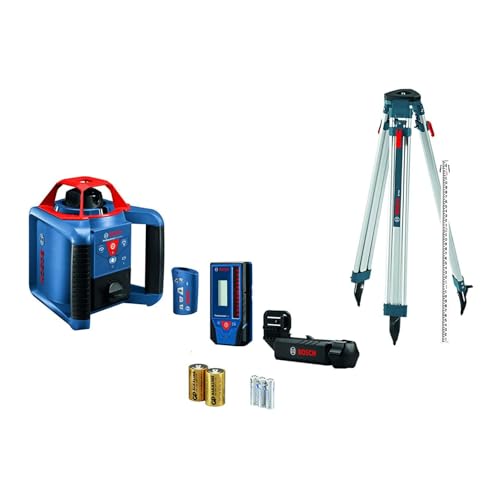
Reach for the Bosch when the same tool must grade outside in the morning and handle layout inside in the afternoon. It self-levels in horizontal and vertical modes, projects a vertical beam with a 90-degree point for squaring and plumb work, and adds scan and variable-speed control so the beam stays visible for ceiling grid, wall layout, and cabinet runs. A disturbance monitor re-checks level if the setup gets knocked.
Practical notes favor the completeness here: laser, receiver, remote, tripod, grade rod, wall mount, glasses, target, batteries, and hard case in one box. The remote earns its keep when the laser sits across a slab. Accuracy suits residential and light commercial work; crews shooting very long runs will prefer the tighter Topcon or Spectra numbers.
Specs
- Accuracy: ±1/8 in. at 100 ft
- Range: up to 1,000 ft with receiver
- Self-leveling: ±5 degrees, horizontal and vertical
- Rotation speed: variable, with scan mode
- Beam: red, Class 3R, 630 to 670 nm
- Protection: IP54 dust and water protection
- Power: 2 D-cell batteries; AA for receiver and remote
- Includes: laser, receiver, tripod, grade rod, remote, wall mount, glasses, target, case
- ASIN: B08LP2HT1P
Pros:
– Horizontal and vertical self-leveling in one tool
– Remote, mount, tripod, and rod included
– Scan mode helps indoors
Cons:
– Shorter range than grading-focused picks
– Lower protection level than IP66 models
DEWALT DW074KD Rotary Laser Level Kit

The DW074KD is the rotary many crews already know: a cage-protected unit that self-levels in horizontal mode and switches to manual leveling with arrow buttons for vertical work. Those buttons are easier with gloves than small knobs, and the protected head leaves fewer blind spots while standing up to knocks as gear moves on and off trucks all week. For houses, shops, and mid-size jobs, it covers core tasks without a steep learning curve.
Indoors, the beam reads clearly across rooms. Outdoors, the included detector and clamp find the beam across open ground for footings, decks, and site leveling. The kit packs into a contractor bag, so it travels light. Accuracy is the loosest in this group, so finish graders should look higher in this list, but for general layout it stays dependable and easy to teach.
Specs
- Accuracy: ±1/4 in. at 100 ft
- Range: up to 100 ft visible indoors; up to 1,200 ft diameter with detector
- Leveling: self-leveling horizontal; manual vertical
- Beam: red
- Housing: weather-resistant with durable rotary cage
- Power: 2 D-cell batteries; 9V for detector
- Includes: laser, DW0742 detector and clamp, wall mount, target card, contractor bag
- ASIN: B001CC8TLW
Pros:
– Simple, glove-friendly controls
– Protective cage helps the head survive bumps
– Detector included for outdoor work
Cons:
– Loosest accuracy spec in this group
– Vertical mode needs manual leveling
Johnson Level & Tool 40-6517 Self-Leveling Rotary Laser System

Johnson packages the 40-6517 as a complete system for smaller jobsites, and completeness is its strongest argument. It self-levels in the horizontal plane, levels manually in the vertical plane with an illuminated vial, and offers three rotation speeds: slow the beam for indoor visibility or spin it up for receiver work outside. Visual and audible alarms flag an out-of-level setup, and the locking compensator protects the pendulum in transit.
Our take: this is a smart first rotary for a small contractor handling foundations, footings, septic work, excavation, and ceiling installs with one tool. Everything arrives together — laser, detector, tripod, grade rod, mount, glasses, target, batteries, and hard-shell case. Range and accuracy land mid-group, plenty for houses and shops, while the tightest grading jobs still belong to Topcon and Spectra.
Specs
- Accuracy: ±1/8 in. at 100 ft
- Range: up to 800 ft diameter with detector
- Leveling: self-leveling horizontal; manual vertical
- Rotation speeds: 200, 400, and 600 RPM
- Beam: red
- Alarms: visual and audible out-of-level alerts; locking compensator
- Power: 4 AA batteries; 2 AAA for detector
- Includes: laser, detector with clamp, tripod, grade rod, mount, glasses, target, case
- ASIN: B003825F0M
Pros:
– Truly complete kit, ready out of the case
– Three speeds cover indoor and outdoor tasks
– Out-of-level alarms prevent bad readings
Cons:
– Shortest outdoor range in this group
– Vertical plane is manual only
How to choose the best rotary laser level for your work
Match range to your sites. Range is quoted as a diameter with a receiver, so a 2,600 ft tool covers about 1,300 ft in any direction. House lots and small pads are well served by 800 to 1,000 ft tools. Long driveways, fields, and drainage runs reward the 1,650 ft and 2,600 ft picks, because fewer setups means fewer chances to introduce error.
Put accuracy first for finish work. Accuracy compounds with distance. A tool at ±1/16 in. at 100 ft holds tighter lines over a long slab than one at ±1/4 in. at 100 ft. Rough excavation tolerates looser accuracy; forms, flatwork, and anything another trade builds on deserve the tightest spec you can justify.
Decide if you need a vertical plane. Horizontal-only rotaries are simpler and often tougher. If you also lay out walls, check plumb, or install ceilings, a horizontal and vertical model saves you a second tool. Also confirm slope control for drainage work: IP66 and drop-tested heads suit daily outdoor crews, while IP54 suits mixed work.
Frequently asked questions
Can one person run a rotary laser alone?
Yes, and that is the main reason to own one. Set the laser on a tripod and let it self-level, then walk the site with the receiver clamped to a grade rod. The receiver beeps and shows arrows as you move the rod, so one operator can check elevations, set forms, and confirm drainage fall alone.
Why can I not see the beam outdoors?
Sunlight washes out any visible beam quickly, and red beams fade fastest. Outdoors you work by receiver, not by eye: clamp it to the rod and follow its tones and display. Indoors, slower speeds, scan mode, and a target card make the beam much easier to follow.
How often should I check calibration?
Check it after any hard drop, before a high-stakes pour or finish grading day, and on a regular schedule if the laser works daily. A simple two-peg check against a known benchmark takes a few minutes and catches drift early. If readings fail, send the unit for service instead of compensating in the field.
Do I need a special tripod and grade rod?
Use a sturdy construction tripod with a 5/8-11 mount, not a light camera tripod that flexes in wind. Match rod units to your work — feet and inches for building layout, tenths for grading — and confirm the receiver clamp fits your rod. Kits with matched gear remove the guesswork.
Conclusion
For most outdoor work, the Topcon RL-H5A is our top take: tightest accuracy, longest reach, and runtime for long grading weeks. Crews that prize toughness should look hard at the Spectra Precision LL300N-1, while anyone splitting time between outdoor elevations and indoor layout will use the Bosch REVOLVE1000 kit most. The DEWALT DW074KD remains a familiar workhorse, and the Johnson 40-6517 gives smaller crews a complete first rotary. Choose by site size, accuracy needs, and whether you need a vertical plane.
Related guides
More from Amazon
Programs that pair well with the guide above. Offers and eligibility are set by Amazon and may change.
A free business account with business pricing and bulk-buying tools for work, shop or home office.
Create a business accountFree shipping on eligible items, Prime Video and more. Eligible new members can start with a free trial.
Start a Prime free trialAudiobooks and podcasts to listen to on the go. Eligible new members can start with a free trial.
Try Audible freeAd-free music streaming. Eligible new subscribers can start with a free trial.
Try Music Unlimited freeAs an Amazon Associate we earn from qualifying purchases.

Write Your Review
No reviews yet. Be the first to share your experience!