
Key takeaways
- Welding terms fall into a handful of groups: the processes (MIG, TIG, stick, flux core), the parts of a weld (bead, puddle, root, toe).
What's inside
As an Amazon Associate I earn from qualifying purchases. This post may contain affiliate links at no extra cost to you.
Welding terms fall into a handful of groups: the processes (MIG, TIG, stick, flux core), the parts of a weld (bead, puddle, root, toe), the settings (amperage, voltage, wire speed, polarity) and the joint types (butt, lap, T, corner). Learn those four groups and most beginner videos, manuals and forum threads start to make sense.
New welders often feel lost because the same idea has two names, such as MIG and GMAW, or because a word like “penetration” sounds obvious until you need to judge it. This glossary explains the vocabulary in plain language, groups it so you can learn it in stages and flags the terms people most often confuse. It is a starting vocabulary rather than a full standard, so check your machine manual and the relevant code for the precise definitions your project uses.
What we cover
Processes and What They Are Called
Stick Welding (SMAW)
Stick welding uses a flux-coated electrode, called a rod, that melts into the joint while the coating forms a shielding gas and slag. It works outdoors and on rusty metal, and it needs no gas bottle. The slag must be chipped off after each pass, and a pass is simply one trip of the electrode along the joint. Thick joints are built from several passes, called a multi-pass weld.
MIG Welding (GMAW) and Flux Core (FCAW)
MIG feeds a continuous wire through a gun and uses a shielding gas to protect the weld. Flux core uses a hollow wire filled with flux, so it can run without bottled gas. Both are popular with beginners because the trigger controls the arc and the wire feeds itself. The flux core version leaves slag, like stick, and tends to throw more spatter than gas-shielded MIG.
TIG Welding (GTAW)
TIG uses a non-consumable tungsten electrode and a separate filler rod, with shielding gas around the arc. It gives precise, clean welds on thin material but takes practice, because you coordinate a torch, a filler rod and often a foot pedal.
Anatomy of a Weld
The weld puddle is the pool of molten metal under the arc. The bead is the solidified weld left behind. The root is where the joint begins at its deepest point, and the toe is where the bead meets the base metal on the surface. Penetration describes how deeply the weld fuses into the base metal, and fusion is the blending of base metal and filler.
Slag is the glassy crust that forms on stick and flux core welds and must be removed. Spatter is the small droplets of molten metal thrown beside the bead, and heat-affected zone describes the area around a weld that was heated but not melted. Distortion is warping caused by heat.
Settings and Machine Terms
Amperage, Voltage and Wire Speed
Amperage controls heat and penetration, while voltage influences arc length and bead shape. In MIG welding, wire feed speed sets the amount of filler delivered. Many beginner machines combine these into a single “synergic” control.
Polarity and Duty Cycle
Polarity refers to the direction of current flow, usually written as DC electrode positive or DC electrode negative, and it changes how heat is distributed. Duty cycle is the portion of a ten-minute period a machine can run at a stated output before it must cool.
Arc Force, Hot Start and Anti-Stick
These are inverter features. Hot start gives a brief surge to help the arc begin, arc force adjusts the arc when the electrode gets close to the work, and anti-stick reduces output if the rod freezes to the metal.
Joints and Positions
A butt joint places two pieces edge to edge, a lap joint overlaps them, a T joint meets at a right angle and a corner joint connects edges at the corner. Position terms describe how the weld is made: flat, horizontal, vertical or overhead, abbreviated as 1G, 2G, 3G, 4G for groove welds and 1F to 4F for fillet welds.
A groove weld fills a prepared gap between pieces, while a fillet weld sits in the corner of two surfaces. A tack weld is a small temporary weld used to hold parts in place before welding the full joint.
Gear and Shop Words
Shade number describes how dark a helmet lens is during welding, with higher numbers blocking more light. An auto-darkening lens switches from light to dark when it senses the arc, so you can see the joint before you start. The ground clamp, also called the work clamp, completes the electrical circuit by attaching to the workpiece or table.
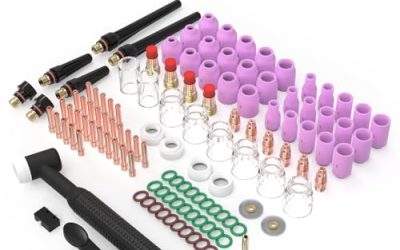
The contact tip is the small copper part at the end of a MIG gun that guides the wire, and the liner is the tube that carries wire through the cable. A regulator controls shielding gas pressure and flow from the cylinder. Knowing these names makes manuals, parts lists and troubleshooting guides much easier to follow.
Consumables are the parts that wear out and need replacing, such as tips, nozzles, rods, wire and lens covers. Preparation words matter too: bevel means an angled edge cut to allow deeper penetration, and fit-up describes how well the pieces line up before welding.
Quick Reference Table
| Term | Plain-language meaning | Why it matters |
|---|---|---|
| Bead | The line of solidified weld metal | Its shape shows how well the settings suit the job |
| Puddle | The pool of molten metal under the arc | Watching it guides travel speed |
| Penetration | How deep the weld fuses into base metal | Affects joint strength |
| Travel speed | How fast you move along the joint | Too fast or too slow ruins the bead |
| Stickout | Length of wire extending past the contact tip | Changes arc stability in MIG |
| Porosity | Gas pockets inside or on the weld | Usually signals contamination or poor shielding |
| Undercut | A groove melted into base metal beside the bead | Can weaken the joint |
| Cold lap | Weld metal sitting on, not fusing with, the base metal | Indicates too little heat or poor technique |
Terms Beginners Mix Up
Many new welders confuse amperage with voltage, thinking both simply mean “hotter.” Amperage mainly sets heat and penetration, while voltage mostly shapes the arc. Another mix-up is “weld” versus “braze” or “solder,” which join metals without melting the base metal and are different processes entirely.
The words “shielding gas” and “flux” also cause confusion. Both protect the molten metal from the air, but gas arrives from a bottle while flux is carried in the wire or coating. Knowing the difference helps you choose a process and troubleshoot porosity.
How to Learn the Vocabulary Faster
Pair each term with a picture or a scrap piece. Weld a bead, then point to the toe, the root and the bead face on a real sample. Reading your own welds with the right words is the quickest way to make the glossary stick, and it will serve you through 2026 and beyond.
Before You Start Learning
- Pick one process to learn first rather than all four.
- Read the manual for your machine and highlight unfamiliar terms.
- Keep a printed glossary at the bench.
- Practice on scrap and name each flaw you see.
- Ask a qualified instructor when a term affects safety.
Related guides
- Auto Darkening Welding Helmet Not Darkening Causes And Fixes
- How To Choose A Welder For Your Garage Circuit Breaker Size
- How To Adjust Welding Helmet Headgear For A Comfortable Fit
Frequently Asked Questions
What is the difference between MIG and TIG?
MIG feeds a consumable wire through a gun and is generally easier to learn. TIG uses a tungsten electrode and a separate filler rod and gives finer control on thin metals.
What does penetration mean in welding?
It is how far the weld metal fuses into the base material beneath the surface. Good penetration is important for joint strength, but the right amount depends on the joint and material.
Is flux core the same as stick welding?
Not quite. Both use flux, but flux core feeds a hollow wire through a gun, while stick uses a coated rod you hold in a clamp.
What is a tack weld?
A short, temporary weld that holds parts in position while you align and plan the full joint. Tacks are usually ground out or incorporated into the final weld, depending on the plan for the joint.
Related guides
More from Amazon
Programs that pair well with the guide above. Offers and eligibility are set by Amazon and may change.
A free business account with business pricing and bulk-buying tools for work, shop or home office.
Create a business accountFree shipping on eligible items, Prime Video and more. Eligible new members can start with a free trial.
Start a Prime free trialAudiobooks and podcasts to listen to on the go. Eligible new members can start with a free trial.
Try Audible freeAd-free music streaming. Eligible new subscribers can start with a free trial.
Try Music Unlimited freeAs an Amazon Associate we earn from qualifying purchases.
Write Your Review
No reviews yet. Be the first to share your experience!