
What's inside
- Top 3 Picks
- Quick Comparison
- How We Chose
- 1. Sceptre 22-Inch 144Hz FHD – Best for Small Desks and First Builds
- 2. Samsung 27″ Essential S3 (S36GD) – Best for Mixed Work and Casual Gaming
- 3. SANSUI 32-Inch Curved 240Hz – Best for Big-Screen Immersion
- 4. SANSUI 27-Inch Curved 240Hz (1500R) – Best for Curved 1080p Competitive Play
- 5. ASUS TUF Gaming VG27AQM5A – Best Overall for High-End GPUs
- 6. msi PRO MP243L E14 – Best Budget All-Rounder for Work and Play
- Related Guides
- Top 3 Picks
- Quick Comparison
- How We Chose
- 1. Sceptre 22-Inch 144Hz FHD – Best for Small Desks and First Builds
- 2. Samsung 27″ Essential S3 (S36GD) – Best for Mixed Work and Casual Gaming
- 3. SANSUI 32-Inch Curved 240Hz – Best for Big-Screen Immersion
- 4. SANSUI 27-Inch Curved 240Hz (1500R) – Best for Curved 1080p Competitive Play
- 5. ASUS TUF Gaming VG27AQM5A – Best Overall for High-End GPUs
- 6. msi PRO MP243L E14 – Best Budget All-Rounder for Work and Play
- Related Guides
As an Amazon Associate I earn from qualifying purchases. This post may contain affiliate links at no extra cost to you.
The best gaming monitor deal for most people right now is the ASUS TUF Gaming VG27AQM5A 27-inch 1440p 300Hz G-SYNC monitor. It suits anyone whose graphics card can hold high frame rates at 1440p — broadly, a current mid-tier card or better — because it is the only panel on this shortlist that pairs a genuinely sharp 1440p desktop with a refresh ceiling high enough that you will not outgrow it in two or three years. If your budget is tighter or your desk is shallow, the msi PRO MP243L E14 is the value answer: 24 inches, 1080p, IPS, 144Hz, and it asks almost nothing of your GPU. If what you want is the largest picture for the money, the SANSUI 32-inch curved 240Hz gives you the biggest physical screen here, traded against pixel density. Everything below maps a discount to the desk, the graphics card and the games it actually fits.
What we cover
- Top 3 Picks
- Quick Comparison
- How We Chose
- 1. Sceptre 22-Inch 144Hz FHD – Best for Small Desks and First Builds
- 2. Samsung 27″ Essential S3 (S36GD) – Best for Mixed Work and Casual Gaming
- 3. SANSUI 32-Inch Curved 240Hz – Best for Big-Screen Immersion
- 4. SANSUI 27-Inch Curved 240Hz (1500R) – Best for Curved 1080p Competitive Play
- 5. ASUS TUF Gaming VG27AQM5A – Best Overall for High-End GPUs
- 6. msi PRO MP243L E14 – Best Budget All-Rounder for Work and Play
- Related Guides
Our Top Picks
 SANSUI 32 Inch Curved 240Hz Gaming Monitor High32 inch24.19 x 8.06 x 17.75 inches11.9 poundsCheck on Amazon
 SANSUI 27 Inch Curved 240Hz Gaming Monitor FHD27.017.66 x 24.13 x 17.84 inches7.26 poundsCheck on Amazon


Top 3 Picks
Best overall: ASUS TUF Gaming VG27AQM5A 27-Inch 1440p 300Hz G-SYNC
This is the pick that covers the most ground: 1440p resolution at 27 inches lands at roughly 109 pixels per inch, which is the sweet spot where text stays crisp for work and in-game detail is a clear step above 1080p. The 300Hz ceiling and G-SYNC support mean it rewards a strong card now and still has headroom if you upgrade the GPU before the monitor. It costs more than everything else here, so it only makes sense if your system can actually feed it.
Best budget: msi PRO MP243L E14 24-Inch IPS 144Hz
IPS at 24 inches with a 144Hz refresh is the most sensible combination in the budget bracket, and this is the one that hits it. At 24 inches, 1080p resolves to about 92 pixels per inch — noticeably cleaner than the same resolution stretched across 27 or 32 inches — and 144Hz is the point of diminishing returns for most players. FreeSync support and HDR-ready handling round it out for mixed work and play.
Best for big-screen immersion: SANSUI 32-Inch Curved 240Hz
Nothing else here occupies as much of your field of view. A 32-inch panel is roughly 27.9 inches wide and 15.7 inches tall, so it reads as a small TV on a desk — excellent for sim racing, flight and couch-distance play. The trade is pixel density at 1080p, which drops to about 69 PPI, so sit back rather than lean in.
Quick Comparison
| Product | Best for | Key specs | Price tier |
|---|---|---|---|
| Sceptre New 22-Inch Gaming Monitor | Small desks, first builds, secondary screens | 22″ FHD 1080p, up to 144Hz, HDMI + DisplayPort, built-in speakers, ~100 PPI | Budget |
| Samsung 27″ Essential S3 (S36GD) | Mixed work and light gaming | 27″ FHD 1080p, 1800R curve (~71 in radius), comfort-oriented home/office design, ~82 PPI | Mid-range |
| SANSUI 32-Inch Curved 240Hz | Big-screen immersion, sim and couch-distance play | 32″ FHD 1080p, 240Hz, curved, ~69 PPI, ~27.9 in wide | Premium |
| SANSUI 27-Inch Curved 240Hz (1500R) | Curved 1080p competitive play | 27″ FHD 1080p, 240Hz, 1500R curve (~59 in radius), 130% sRGB, 4000:1 contrast | Mid-range |
| ASUS TUF Gaming VG27AQM5A | High-end GPUs, 1440p esports and work | 27″ 1440p, 300Hz, G-SYNC, ~109 PPI | Premium |
| msi PRO MP243L E14 | Budget all-rounder for work plus play | 24″ FHD 1080p IPS, 144Hz, FreeSync, HDR ready, HDMI + VGA, ~92 PPI | Budget |
| Sceptre Curved 24-Inch R1500 | Dual-input desks and older consoles | 24″ FHD 1080p, 1500R curve, 2× HDMI + VGA, 98% sRGB, VESA-ready, built-in speakers | Budget |
| Amzfast 27-Inch 240Hz Curved | Curved 240Hz on a value budget | 27″ FHD 1080p, 240Hz, MPRT 1ms, FreeSync, 130% sRGB, built-in speakers | Premium |
| Samsung 27″ Odyssey G3 (G30D) | Mid-range all-rounder with long brand support | 27″ FHD 1080p, gaming-tuned refresh in the G3 class, ~82 PPI | Mid-range |
How We Chose
This shortlist was assembled from published listing specifications, brand documentation and category data — not from studio measurement. Every panel here had to clear four filters. First, the advertised specification had to be internally consistent: a 240Hz claim on a panel whose listed inputs cannot carry the bandwidth at that resolution is a red flag, so port type was checked against refresh rate for each model. Second, the panel had to fit a real use case rather than just look good on a spec sheet, which is why the list spans a 22-inch desk-saver, a 24-inch IPS all-rounder, several curved 240Hz options, and one true 1440p high-refresh display. Third, upgrade path mattered: a monitor with a 300Hz ceiling and a modern interface standard stays useful across at least one GPU generation, while a 1080p 75Hz panel does not. Fourth, we weighed ownership realities — stand adjustability, VESA compatibility, built-in speakers, and how many inputs you get — because those determine whether a cheap monitor stays cheap after you buy a mount or a speaker set. Where a listing did not state an exact figure, we describe the spec class rather than guessing a number.
1. Sceptre 22-Inch 144Hz FHD – Best for Small Desks and First Builds
As an Amazon Associate we earn from qualifying purchases at no extra cost to you.

The 22-inch Sceptre is the monitor you buy when the desk is genuinely small, the budget is genuinely tight, or the screen is going to be a second display rather than the main event. At 22 inches diagonal with a 1920 × 1080 panel, it measures roughly 19.2 inches wide and 10.8 inches tall before bezels — small enough to sit beside a laptop on a dorm desk or squeeze into a shallow bedroom setup where a 27-inch panel would dominate the surface. The listing advertises “up to 144Hz,” HDMI and DisplayPort inputs, and built-in speakers, which is a more complete package than most panels at this size and price.
Key specifications as listed
- Panel size: 22 inches, 16:9
- Resolution: 1920 × 1080 (FHD 1080p)
- Refresh rate: up to 144Hz
- Inputs: HDMI, DisplayPort
- Audio: built-in speakers
- Finish: machine black
- Approximate pixel density: 100 PPI
The strongest argument for this panel is pixel density. A 22-inch 1080p screen works out to roughly 100 pixels per inch, which is the highest figure on this entire list — higher than the 27-inch 1080p models at about 82 PPI and dramatically higher than the 32-inch 1080p at about 69 PPI. That means small text, HUD elements and minimaps render with noticeably cleaner edges. If you play competitive shooters where you need to spot a distant silhouette, or you spend as much time reading documents as gaming, that density matters more than raw screen area.
The 144Hz ceiling is the other headline. Going from 60Hz to 144Hz is the single largest perceptible upgrade in this price bracket, and the jump from 144Hz to 240Hz is far smaller for most players — which is why a 22-inch 144Hz panel can feel more responsive in practice than a larger, slower display. Because the resolution is only 1080p, the frame-rate target is also the easiest to hit: a mid-tier card from the last several generations will happily push competitive titles past 100 frames per second at this resolution, and older or integrated graphics still produce a playable image. The DisplayPort input is the one to use for the full 144Hz, since that is where the bandwidth is most reliably available.
Where this monitor shows its price point is in everything surrounding the panel. A 22-inch display will not deliver the same sense of immersion as a curved 27- or 32-inch screen, and the built-in speakers on budget panels are adequate for system sounds and voice chat but thin for anything with bass. Stand adjustability on compact budget models is usually limited to tilt, so if you want the screen at eye level you should plan on a VESA arm — check the listing for the mounting pattern, since compact panels sometimes use 75 × 75 mm rather than the 100 × 100 mm pattern common on 24-inch-and-up models. The curvature question does not apply here: this is a flat panel, which is the right call at 22 inches anyway.
Pros
- About 100 PPI — the sharpest pixel density on this list, which keeps text and fine detail clean
- Up to 144Hz without demanding a powerful graphics card
- Both HDMI and DisplayPort, so you are not stuck with a single input
- Built-in speakers mean no immediate add-on purchase
- Small footprint suits dorm rooms, shallow desks and dual-screen arrangements
Cons
- 22 inches is small for immersive single-player games and for split-screen or multitasking
- No curve, and no advertised wide-gamut colour coverage
- Stand is likely tilt-only, so ergonomic height adjustment may require a VESA arm
- Speakers are basic; a headset or dedicated speakers will sound better
Compared with the msi PRO MP243L E14, this Sceptre trades two inches of diagonal for a slightly higher pixel density and a smaller footprint. The msi adds an IPS panel with wide viewing angles and FreeSync. If your desk can fit 24 inches, the msi is the better long-term buy; if it cannot, the 22-inch Sceptre is the compromise that keeps the image sharp rather than stretching 1080p across a bigger panel.
2. Samsung 27″ Essential S3 (S36GD) – Best for Mixed Work and Casual Gaming

The Samsung Essential S3 is not marketed as a gaming monitor, and that is exactly why it belongs on a deals list. It is a 27-inch 1080p curved display with an 1800R arc, aimed at home and office buyers who want a comfortable screen for long sessions rather than a competitive edge. If your day is eight hours of spreadsheets, documents and video calls followed by a couple of hours of casual games, this is a more sensible purchase than a 240Hz panel whose refresh rate you would never use.
Key specifications as listed
- Panel size: 27 inches, 16:9, curved
- Curve: 1800R — a radius of about 1,800 mm, or roughly 71 inches
- Resolution: 1920 × 1080 (FHD 1080p)
- Approximate pixel density: 82 PPI
- Approximate panel dimensions: 23.5 inches wide, 13.2 inches tall
- Series positioning: Samsung Essential S3, home and office line
The curve is the defining feature, and it is a gentle one. An 1800R radius is the mildest curvature commonly used on desktop monitors — noticeably flatter than the 1500R panels elsewhere on this list, and far flatter than the 1000R curves found on some premium ultrawides. On a 27-inch 16:9 screen, 1800R produces a subtle wrap that reduces the feeling of the far corners being turned away from you without introducing the distortion that aggressive curves can cause on straight lines and grids. For document work, spreadsheets and CAD-style content, that gentleness is an advantage.
Pixel density is the trade-off you accept. At 27 inches, 1080p resolves to about 82 PPI, which is meaningfully coarser than the 92 PPI of a 24-inch 1080p screen or the 100 PPI of a 22-inch. Text remains perfectly legible, but fine fonts look slightly softer and you may find yourself zooming documents. The upside is that 1080p is easy to drive: almost any graphics card from the past several generations will run casual and mid-tier games at this resolution without strain, and the monitor will not force a GPU upgrade the way a 1440p or 4K panel would.
Note what the listing does not advertise. There is no high refresh rate figure attached to the Essential S3 name, and panels in this class typically sit in the 75–100Hz band — perfectly smooth for desktop use and light gaming, but well below the 144Hz-plus tier that competitive players want. Treat it as a comfort-first display that happens to game acceptably, not as an esports monitor. Check the exact refresh rate on the listing before you buy if high frame rates are a priority.
What the Samsung name buys you is the supporting details: a slim, understated design that does not look like a gaming peripheral, a well-established brand with broad service coverage, and a build that tends to hold up over years of daily office use. The trade is adjustability — home and office panels often ship with tilt-only stands, so confirm whether height adjustment is included if ergonomics matter.
Pros
- Gentle 1800R curve is comfortable for long work sessions and does not distort straight lines
- 27 inches of screen area at a mid-range price tier
- 1080p is undemanding on the graphics card, so no upgrade is required
- Slim, professional-looking chassis that suits a home office
- Strong brand support and wide availability of service options
Cons
- About 82 PPI at 27 inches is coarse compared with smaller 1080p panels
- No advertised high refresh rate — not a competitive-gaming display
- No wide-gamut colour claim in the listing
- Likely tilt-only stand; check before assuming height adjustment
The nearest alternative here is the Samsung Odyssey G3 (G30D), which shares the 27-inch 1080p format but is tuned for gaming with a higher refresh ceiling. If you play fast-paced titles, the Odyssey G3 is the better match; if your priority is a comfortable curved screen for work that can also game casually, the Essential S3 costs less and asks less of your hardware.
3. SANSUI 32-Inch Curved 240Hz – Best for Big-Screen Immersion

This is the largest monitor on the list, and it is priced in the premium tier despite running at 1080p — which tells you exactly what you are paying for. A 32-inch 16:9 panel measures roughly 27.9 inches wide and 15.7 inches tall, so it occupies a serious amount of desk. In exchange, it fills your peripheral vision in a way no 24- or 27-inch screen can, and it pairs a 240Hz refresh rate with that scale. For sim racing, flight simulators, third-person adventures and anything you play leaning back rather than leaning in, this is the most cinematic option here.
Key specifications as listed
- Panel size: 32 inches, 16:9, curved
- Resolution: 1920 × 1080 (FHD 1080p)
- Refresh rate: 240Hz
- Approximate pixel density: 69 PPI
- Approximate panel dimensions: 27.9 inches wide, 15.7 inches tall
- Recommended viewing distance: roughly 30–36 inches for comfortable viewing at this density
The 240Hz refresh rate is genuinely useful even at this size, but only if your system can feed it. Running 1080p at 240 frames per second requires a fast CPU as much as a fast GPU — in competitive titles the processor becomes the bottleneck well before the graphics card does. If your machine tops out around 100 frames per second, you are paying for refresh headroom you cannot use, and a cheaper 144Hz or 165Hz panel would deliver the same visible result.
Pixel density is the honest weakness. At 32 inches, 1080p works out to roughly 69 PPI, the lowest figure on this list and low enough that individual pixels are visible at close range. Text has a soft edge, fine interface elements look slightly fuzzy, and desktop work feels less crisp than on any 24- or 27-inch panel here. The mitigation is distance: at 30–36 inches, the eye resolves less of that coarseness, and for controller-based play from a chair, the trade is reasonable. If you plan to sit 20 inches away and read documents, this is the wrong monitor regardless of the discount.
The curve helps at this scale more than it does at 27 inches. A wide, flat 32-inch panel puts its far corners at a noticeable angle, and curvature brings them back toward the viewer. Combined with the screen area, the effect is closer to a small television than a desktop display — which is why this model suits a room where the monitor doubles as a media screen.
Practical planning matters more here than with any other pick. Budget roughly 28 inches of width plus clearance for the stand or arm, and check your desk depth: a 32-inch panel at 20 inches of viewing distance is uncomfortable, and you want at least 30 inches between your eyes and the glass. If your desk is 24 inches deep, you will end up too close. Wall mounting or a heavy-duty arm solves this, so confirm the VESA pattern on the listing before you buy.
Pros
- Largest screen area on this list — roughly 27.9 × 15.7 inches of panel
- 240Hz refresh rate with real headroom for fast titles
- Curvature genuinely improves the far-corner viewing angle at this size
- Doubles convincingly as a media and console screen
- 1080p keeps the GPU load lighter than 1440p at the same frame rate
Cons
- About 69 PPI — the coarsest image here; desktop text looks soft
- Requires a deep desk or a mounting arm to be comfortable
- 240Hz is wasted unless your CPU and GPU can sustain the frame rate
- Premium price tier for a 1080p panel
Against the SANSUI 27-inch curved 240Hz, this model buys five diagonal inches and loses a meaningful amount of sharpness — 69 PPI versus roughly 82 at 27 inches. The 27-inch version is the better desktop monitor; the 32-inch is the better entertainment screen. Choose based on your viewing distance, not on the spec sheet.
4. SANSUI 27-Inch Curved 240Hz (1500R) – Best for Curved 1080p Competitive Play
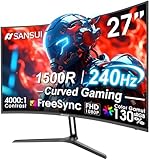
This is the middle path: 27 inches, 1080p, 240Hz and a 1500R curve, at a mid-range price tier. It is the panel to consider if you want the wrap of a curved display and the responsiveness of a high refresh rate, but you are not ready to move to 1440p and the GPU upgrade that comes with it. The listed colour and contrast figures — 130% sRGB and a 4000:1 contrast ratio — put it ahead of the budget panels on this list for image depth.
Key specifications as listed
- Panel size: 27 inches, 16:9, curved
- Curve: 1500R — a radius of about 1,500 mm, roughly 59 inches
- Resolution: 1920 × 1080 (FHD 1080p)
- Refresh rate: 240Hz
- Colour coverage: 130% sRGB as listed
- Contrast ratio: 4000:1 as listed
- Approximate pixel density: 82 PPI
The 1500R radius is a firmer curve than the 1800R Samsung above. At a 59-inch radius on a 27-inch panel, the sides angle toward you more visibly, which many players find immersive in first-person games and mildly distracting in document work. That is the standard trade for curved gaming displays, and 1500R is the most common choice in this category because it splits the difference between subtle and aggressive.
The contrast figure is the interesting number. A listed 4000:1 ratio is typical of VA-type panels rather than IPS, and it translates into deeper blacks and better shadow detail in dark scenes — useful in horror games and night maps where an IPS panel at roughly 1000:1 can look grey. The cost of that contrast class is usually response behaviour in the darkest transitions, where some VA panels show smearing. If you play very fast competitive shooters at a high level, that is a consideration; if you play a broad mix, the deeper blacks are the more noticeable benefit.
The 130% sRGB coverage claim means the panel renders more than the standard sRGB colour space, which produces a punchier, more saturated image. It is not the same as factory-calibrated accuracy, so if colour-critical work is your priority, this is not the panel for it — but for games, video and general use, the extra saturation is a plus rather than a problem.
At 240Hz and 1080p, the frame-rate target is achievable with a strong mid-tier card in esports titles and a high-end card in more demanding games. The 27-inch 1080p format means about 82 PPI, so the desktop is usable but not razor sharp; you will notice the difference if you are coming from a 24-inch 1080p screen. That is the central compromise of the entire 27-inch 1080p category, not a flaw specific to this model.
Pros
- 240Hz refresh rate at a mid-range price tier
- 1500R curve delivers noticeable immersion without extreme distortion
- 4000:1 listed contrast points to strong black levels for dark scenes
- 130% sRGB coverage produces a saturated, vivid image
- 1080p keeps the graphics-card requirement lower than 1440p
Cons
- About 82 PPI at 27 inches — softer desktop text than a 24-inch 1080p panel
- VA-class contrast often comes with slower dark transitions than IPS
- Extra colour saturation is not the same as calibrated accuracy
- 240Hz demands a fast CPU to be fully used
Its closest rival in this list is the Amzfast 27-inch 240Hz curved, which matches the size, refresh rate and 130% sRGB claim almost exactly. The differences come down to contrast and support: this SANSUI advertises a 4000:1 ratio, which is the stronger dark-scene specification, while the Amzfast advertises MPRT 1ms motion handling. If shadow detail matters most, this is the pick; if you want the fastest advertised motion response, look at the Amzfast below.
5. ASUS TUF Gaming VG27AQM5A – Best Overall for High-End GPUs

The TUF Gaming VG27AQM5A is the only monitor here that steps up to 1440p, and it is the only one with a 300Hz refresh ceiling and G-SYNC support. That combination makes it the best overall pick for anyone whose graphics card is genuinely fast — the tier of card that can push well past 144 frames per second at 2560 × 1440. If you own that hardware, this is the panel that will not hold you back for years. If you do not, it is an expensive way to run games at 90 frames per second.
Key specifications as listed
- Panel size: 27 inches, 16:9, flat
- Resolution: 2560 × 1440 (1440p / QHD)
- Refresh rate: up to 300Hz
- Adaptive sync: G-SYNC support as listed
- Approximate pixel density: 109 PPI
- Approximate panel dimensions: 23.5 inches wide, 13.2 inches tall
The resolution jump is the biggest single upgrade on this list. At 27 inches, 1440p delivers about 109 PPI versus roughly 82 PPI for 1080p at the same size — a 33% increase in pixel density, which shows up as cleaner text, finer in-game detail and less visible aliasing along edges. It is the difference between a monitor that feels like a compromise and one that feels correct at this size. It also gives you more usable desktop space, which matters if you keep a browser, a chat window and a game open at once.
The 300Hz ceiling is headroom rather than a target. Very few systems sustain 300 frames per second at 1440p in modern titles; what the high ceiling buys you is that the monitor never becomes the limiting factor, and that competitive titles with light rendering loads — the esports staples — can genuinely run in the high hundreds of frames per second. G-SYNC support smooths the frame delivery when your rate fluctuates, which is the situation most players are actually in. Confirm the exact adaptive-sync implementation on the listing, since some models pair a full hardware module with the G-SYNC name and others use the compatible tier.
Driving 1440p at high refresh rates also changes your bandwidth requirements. At 1440p and 240Hz or above, DisplayPort 1.4 or HDMI 2.1 is the practical interface; older HDMI 2.0 connections top out lower at this resolution. Use the cable that ships with the monitor, or a certified DisplayPort 1.4 cable, and connect to the correct port on your graphics card rather than a motherboard output.
Build quality is where the TUF line differentiates itself from the budget panels here. TUF Gaming monitors in this class typically include a stand with height, tilt, swivel and pivot adjustment, plus a 100 × 100 mm VESA pattern for arm mounting — check the specific listing to confirm what is included. Height adjustment alone is worth real money, because it saves you from buying an arm to get the screen to eye level. A monitor that pivots to portrait is also useful for reading, code and long documents.
Pros
- 1440p at 27 inches — about 109 PPI, the sharpest desktop experience here
- 300Hz ceiling means the monitor will not limit a future GPU upgrade
- G-SYNC support smooths variable frame rates
- TUF-class build typically includes a fully adjustable stand and VESA mounting
- More usable desktop area for work and multitasking than any 1080p panel here
Cons
- Premium price tier — the most expensive option on this list
- Demands a genuinely fast graphics card to be worthwhile
- 1440p at high refresh rates requires DisplayPort 1.4 or HDMI 2.1
- Overkill if you play mostly casual or older titles
The comparison that matters is against the Samsung Odyssey G3 (G30D). Both are 27-inch gaming displays, but the Odyssey G3 stays at 1080p while this ASUS moves to 1440p and roughly doubles the refresh ceiling. The Odyssey is the sensible mid-range choice for a modest GPU; the TUF is the choice for a system that can use it. If your card is more than one generation old and mid-tier, buy the Odyssey and put the difference toward a GPU.
6. msi PRO MP243L E14 – Best Budget All-Rounder for Work and Play
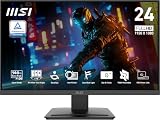
If you want one monitor that handles a full working day and a few hours of gaming without embarrassing itself, this is the value pick on the list. The msi PRO MP243L E14 is a 24-inch 1080p IPS panel running at 144Hz with FreeSync and HDR-ready handling, plus HDMI and VGA inputs. It is a productivity monitor with a gaming-grade refresh rate, which is a more useful combination for most people than a gaming monitor that is mediocre at everything else.
Key specifications as listed
- Panel size: 24 inches, 16:9, flat
- Panel type: IPS
- Resolution: 1920 × 1080 (FHD 1080p)
- Refresh rate: 144Hz
- Adaptive sync: FreeSync
- HDR: HDR ready as listed
- Inputs: HDMI, VGA
- Approximate pixel density: 92 PPI
IPS is the reason this panel stands out at its price tier. IPS panels deliver consistent colour and brightness across wide viewing angles, so the image does not wash out or shift when you move your head — the failure mode of cheaper VA and TN panels, particularly on a screen you share or watch from an angle
Related guides
More from Amazon
Programs that pair well with the guide above. Offers and eligibility are set by Amazon and may change.
A free business account with business pricing and bulk-buying tools for work, shop or home office.
Create a business accountFree shipping on eligible items, Prime Video and more. Eligible new members can start with a free trial.
Start a Prime free trialAudiobooks and podcasts to listen to on the go. Eligible new members can start with a free trial.
Try Audible freeAd-free music streaming. Eligible new subscribers can start with a free trial.
Try Music Unlimited freeAs an Amazon Associate we earn from qualifying purchases.




Write Your Review
No reviews yet. Be the first to share your experience!