What's inside
- Quick picks by room and budget
- Material comparison: what actually changes performance?
- Head-to-head: the strongest practical options
- How much panel area does an entertainment room need?
- Decision matrix for choosing the best soundproofing panel for entertainment room use
- Installation details that change the result
- Ownership, cleaning, and common mistakes
- Bottom line
- Quick picks by room and budget
- Material comparison: what actually changes performance?
- Head-to-head: the strongest practical options
- How much panel area does an entertainment room need?
- Decision matrix for choosing the best soundproofing panel for entertainment room use
- Installation details that change the result
- Ownership, cleaning, and common mistakes
- Bottom line
As an Amazon Associate I earn from qualifying purchases. This post may contain affiliate links at no extra cost to you.
The best soundproofing panel for an entertainment room is usually a 2-inch mineral-wool or fiberglass acoustic panel for controlling echo, combined with heavier construction measures—such as door seals, mass-loaded vinyl, or decoupled walls—if your goal is to stop sound escaping.
That distinction matters: porous panels absorb reflections inside a room, but they do not make a thin wall substantially soundproof. For a home theater, gaming room, music room, or media room, choose panels according to the noise problem first, then compare material, thickness, coverage, installation, and appearance.
As an Amazon Associate we earn from qualifying purchases at no extra cost to you.
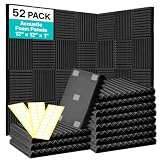

What we cover
- Quick picks by room and budget
- Material comparison: what actually changes performance?
- Head-to-head: the strongest practical options
- How much panel area does an entertainment room need?
- Decision matrix for choosing the best soundproofing panel for entertainment room use
- Installation details that change the result
- Ownership, cleaning, and common mistakes
- Bottom line
Quick picks by room and budget
- Best all-purpose choice: 2-inch mineral-wool or fiberglass panels with an NRC around 0.85–1.00, installed at first-reflection points and on the rear wall.
- Best for bass-heavy home theaters: 4-inch broadband panels or 4-inch panels mounted with a 2-inch air gap. Thin foam panels will not provide comparable low-frequency absorption.
- Best low-cost approach: DIY fabric-wrapped panels made from 2-inch Owens Corning 703 fiberglass or a comparable rigid acoustic board.
- Best for renters: Lightweight fabric-wrapped panels using picture-hanging strips, removable hooks, or freestanding screens.
- Best for sound leakage: acoustic panels plus door gasketing, a door sweep, sealed cable penetrations, and added wall or ceiling mass. Panels alone are not a sound-isolation system.
Material comparison: what actually changes performance?
| Panel type | Common thickness | Typical acoustic behavior | Typical coverage format | Best use |
|---|---|---|---|---|
| Polyester fiber | 0.5–1.2 in | Good speech and mid/high-frequency control; limited bass absorption | Individual panels, often 12–24 sq ft per pack | Offices, gaming rooms, decorative wall treatment |
| Acoustic foam | 1–3 in | Useful for high-frequency reflections; performance varies widely | 12–48 sq ft per pack | Budget echo control and small recording spaces |
| Fiberglass board | 1–4 in | Strong broadband absorption when thick enough; often excellent through the midrange | Usually 4 panels measuring 2 × 4 ft | Home theaters, music rooms, serious reflection control |
| Mineral wool | 2–4 in | Broadband absorption with useful low-mid performance at greater thickness | Batts or wrapped panels, commonly 16–48 sq ft per package | DIY panels, bass traps, wall cavities |
| Wood slat panel with acoustic backing | 0.75–1.5 in | Diffusion plus absorption; depends heavily on the felt and air gap | Panels commonly around 8–12 sq ft each | Visible feature walls and balanced media rooms |
Fiberglass and mineral wool are usually the strongest choices when the objective is broad frequency control. Foam is easy to cut and install, but many inexpensive wedges mainly reduce treble. That can leave a room sounding dull while bass remains boomy.
Head-to-head: the strongest practical options
DIY 2-inch fiberglass panels
Rigid fiberglass boards such as Owens Corning 703 are widely used for fabric-wrapped acoustic panels. A common panel is 2 × 4 feet, or 8 square feet, with a 2-inch core. Four panels therefore cover 32 square feet before allowing for gaps or layout changes.
This approach offers a favorable cost-to-performance ratio, particularly if you already have basic woodworking tools. Build a shallow timber frame, place the board inside, wrap it in acoustically transparent fabric, and secure the fabric on the rear. Do not seal the front with plastic or vinyl, because the covering must allow sound to reach the absorber.
Mineral-wool panels
Mineral-wool insulation products, including Rockwool Safe’n’Sound for suitable interior applications, are commonly adapted into broadband absorbers. A 3- or 4-inch panel generally performs better at lower frequencies than a 1-inch decorative panel, especially when spaced away from the wall.
Mineral wool is heavier and can be more awkward to handle than polyester fiber. Use a rigid frame, protective gloves, eye protection, and a fully enclosed fabric cover. Keep exposed fibers out of occupied areas and follow the product’s installation instructions.
Commercial fabric-wrapped panels
Commercial panels from manufacturers such as GIK Acoustics and ATS Acoustics offer finished edges, hanging hardware, selectable fabric, and published acoustic data for particular assemblies. Their main advantage is predictable installation rather than a radically different physical principle.
Many 2-inch commercial panels are sold in 2 × 4-foot sizes, so each covers about 8 square feet. A published NRC near 0.90 or above is useful evidence of strong average absorption, but NRC is not a complete description of bass performance. Check frequency-specific data when available.
Decorative slat panels
Wood slat products such as Vicoustic’s decorative acoustic systems can improve visual appearance while combining reflection and absorption. They are attractive for media rooms that double as living spaces, but they usually cost more per square foot than DIY fabric panels. Confirm whether the stated rating applies to the complete wall assembly, including its backing and air gap.
How much panel area does an entertainment room need?
A useful starting target is treatment equal to roughly 20–35% of the room’s floor area, adjusted for furniture, curtains, carpet, and existing absorption. This is not a soundproofing formula; it is a practical planning range for controlling reflections.
For example, consider a 12 × 16-foot room:
- Floor area: 12 × 16 = 192 square feet.
- At 25% treatment: 192 × 0.25 = 48 square feet.
- Each 2 × 4-foot panel covers 8 square feet.
- 48 ÷ 8 = six panels.
Six panels need not cover one continuous wall. Place two at the left and right first-reflection points, two on the rear wall, and two on the ceiling or side walls. If the room has bare floors and hard furniture, eight or more panels may produce a more controlled result. If it already has carpet, curtains, and upholstered seating, begin with four to six.
Decision matrix for choosing the best soundproofing panel for entertainment room use
| Situation | Recommended construction | Thickness | Why |
|---|---|---|---|
| Small room, occasional movies | Polyester or fabric-wrapped fiberglass | 1–2 in | Controls harsh reflections without using much space |
| Dedicated home theater | Fiberglass or mineral wool | 2–4 in | Improves dialogue clarity and reduces repeated reflections |
| Music playback with strong subwoofer | Thick broadband panels plus corner bass traps | 4 in or more | Provides more useful low-frequency absorption |
| Rental property | Lightweight polyester panels or freestanding absorbers | 0.5–2 in | Lower wall load and easier removal |
| DIY project with woodworking tools | Rigid fiberglass or mineral wool in timber frames | 2–4 in | Best control over size, fabric, cost, and mounting depth |
| Noise must not reach adjacent rooms | Panels plus construction upgrades | Panels are supplementary | Isolation requires mass, airtightness, and often decoupling |
Installation details that change the result
Mounting a 2-inch panel directly against a wall is useful, but leaving a 2-inch air gap can improve absorption at lower frequencies. The gap effectively increases the absorber’s working depth to about 4 inches. Use secure cleats, Z-clips, or rated picture-hanging hardware rather than relying on a single small adhesive strip for a heavy mineral-wool panel.
For first-reflection points, sit in the main listening position while another person slides a mirror along each side wall. Wherever you can see a speaker in the mirror is a high-value location for a panel. Place a panel there on each side, then address the wall behind the listeners. Avoid covering every surface immediately; excessive absorption can make a room sound unnaturally dead.
Ownership, cleaning, and common mistakes
- Fabric gets dirty first: Vacuum gently with a brush attachment. Avoid saturating porous cores with liquid.
- Frames loosen before cores fail: Inspect hanging hardware and corner joints periodically, especially on ceiling-mounted panels.
- Exposed insulation is a mistake: Fully enclose fiberglass or mineral wool in suitable fabric and frame it securely.
- Too many thin foam tiles create an uneven result: Treat key reflection points before adding decorative coverage.
- NRC can mislead: It is an average rating, not a guarantee of subwoofer control or wall-to-wall sound isolation.
- Do not block ventilation or lights: Leave required clearances and use fire-rated materials where local regulations require them.
Bottom line
For most entertainment rooms, choose six to eight 2-inch fabric-wrapped fiberglass or mineral-wool panels with an NRC around 0.85–1.00, then install them at reflection points with an air gap where practical. Choose 4-inch panels and corner traps when bass is the dominant problem. If the priority is preventing sound from disturbing neighbors or family members, spend part of the budget on sealing doors and upgrading the room’s construction, because no wall-mounted acoustic panel can substitute for sound isolation.