What's inside
As an Amazon Associate I earn from qualifying purchases. This post may contain affiliate links at no extra cost to you.
What we cover
The best cleaner for a stainless steel refrigerator
For most households, the best cleaner for a stainless steel refrigerator is a fragrance-free, water-based cleaner labeled for stainless steel, paired with a clean microfiber cloth; for everyday fingerprints, a little dish soap diluted in warm water is the lower-cost choice. Pick an oil-based polish only if you specifically want extra shine and are willing to buff away residue.
The right choice depends less on a “stainless steel” label than on how the formula handles grease without streaking, whether its instructions suit your refrigerator’s finish, and whether you can apply it without spraying nearby food, floors, or appliance openings. Check the refrigerator manual first: some manufacturers advise against polish, abrasive cleaners, or products containing chlorine.
As an Amazon Associate we earn from qualifying purchases at no extra cost to you.

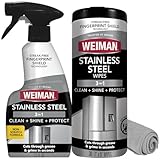


Cleaner types compared
| Option | Typical package size | Grease and fingerprints | Streak risk | Best for |
|---|---|---|---|---|
| Warm water and a few drops of dish soap | About 500 mL prepared in a bowl | Good on ordinary fingerprints and food smears | Low if rinsed and dried; higher if soap is left behind | Routine cleaning and ingredient-conscious households |
| Dedicated stainless steel cleaner, water-based | Commonly 300–500 mL spray bottle | Good on fingerprints and light grease | Low to moderate; depends on dose and buffing | Frequent cleaning without an oily finish |
| Oil-based stainless steel polish | Commonly 250–500 mL spray or aerosol | Fair; can mask light marks rather than lift heavy grease | Moderate to high if overapplied | Adding shine after the surface is already clean |
| Microfiber cloth dampened with water | One cloth, often about 30 × 30 cm | Fair on fresh fingerprints; limited on greasy buildup | Low when the cloth is clean | Quick touch-ups between deeper cleans |
These are common package and cloth sizes, not performance guarantees. Concentration, spray pattern, surface texture, and the cloth’s condition all affect results. A larger bottle is not automatically better value if the formula leaves residue that requires repeated buffing.
Choose by the problem you actually have
- Mostly fingerprints: Start with a damp microfiber cloth. If marks remain, use diluted dish soap or a water-based stainless steel cleaner.
- Greasy handprints near the handle: Use a small amount of dish-soap solution or a dedicated cleaner labeled for grease. Wipe with the grain, then follow the product’s directions for rinsing or buffing.
- You want a polished look: Clean first, then apply a small amount of stainless steel polish if the manual allows it. Polishes can leave a slick film that attracts dust or shows uneven patches when applied too heavily.
- You prefer simpler ingredients: Use water and a few drops of mild dish soap. This avoids buying a separate fragrance- or solvent-containing spray, though it still needs a clean-water wipe and thorough drying.
- You have a fingerprint-resistant or coated finish: Follow the manufacturer’s care instructions rather than assuming ordinary stainless steel advice applies. Some coatings can be dulled or marked by polish.
Named products and what to check on the label
Established options include Weiman Stainless Steel Cleaner & Polish, Therapy Stainless Steel Cleaner & Polish, and Sprayway Stainless Steel Cleaner. Formulas and packaging can change, so check the current label before buying; a brand name alone does not tell you whether a particular version is water-based, scented, aerosol, or suitable for your refrigerator’s finish.
For a low-residue option, look for a cleaner specifically labeled for stainless steel that does not promise an oily coating, and confirm whether it requires rinsing. For polish, check for application directions that call for a thin layer and buffing. If fragrance, solvents, or other ingredients are a concern, consult the product’s ingredient information or safety data sheet rather than relying on terms such as “natural” or “green.”
Spray control matters more than bottle size in a kitchen. A trigger spray lets you apply cleaner to a cloth instead of directly to the door, reducing overspray around handles, displays, seals, and nearby surfaces. Aerosols can be harder to control in a small kitchen; use them only as directed and keep spray away from food and ignition sources where the label requires it.
How to clean without streaks
- Check the manual and identify the grain. Stainless finishes usually show a brushed direction. Wiping with it helps avoid visible crosswise marks.
- Remove loose grit first. Use a clean, dry microfiber cloth. Grit trapped in a cloth can scratch the finish when you rub.
- Apply sparingly. Spray the cloth, not the refrigerator, especially near controls, seams, and door seals. For soap solution, dampen rather than soak the cloth.
- Wipe with the grain. Use light, overlapping passes. On sticky grease, let the damp cloth sit on the spot briefly instead of scrubbing with an abrasive pad.
- Rinse if needed, then dry. If you used soap or the cleaner label calls for rinsing, wipe with a second cloth dampened with clean water. Finish with a dry microfiber cloth to remove water marks.
- Use polish only as a finishing step. Add a small amount to the cloth and buff evenly. Don’t layer polish over fingerprints or cleaner residue.
For regular use, reserve one microfiber cloth for applying cleaner and another for drying. Wash them without fabric softener, which can leave a film that transfers to the refrigerator and undermines streak resistance. Replace or rewash a cloth when it looks grey, feels greasy, or leaves lint; a contaminated cloth is a common reason a cleaner appears to streak.
Common finish and ingredient pitfalls
Avoid steel wool, abrasive scouring pads, powdered cleansers, and rough scrubbers: they can scratch or alter the appearance of the finish. Avoid chlorine bleach and cleaners containing chlorides unless the appliance manufacturer specifically approves them; these can damage stainless steel under some conditions. Don’t mix cleaning products.
“Stainless steel cleaner” does not mean every formula is safe for every surface. Test an unfamiliar product in a small, inconspicuous area, especially on colored, coated, or fingerprint-resistant panels. Keep liquid out of seams and controls, and follow the label’s ventilation and contact instructions.
Bottom line
Choose diluted dish soap for an inexpensive, low-complexity clean; a water-based stainless steel spray for frequent fingerprint cleanup; or a polish when shine is the priority and the refrigerator’s care instructions permit it. The biggest practical improvements usually come from using less product, wiping with the grain, and finishing with a clean, dry microfiber cloth—not from buying the strongest formula.