What's inside
As an Amazon Associate I earn from qualifying purchases. This post may contain affiliate links at no extra cost to you.
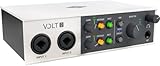
The best 2 channel audio interfaces for most home studios are the MOTU M2 for low-latency recording, the Focusrite Scarlett 2i2 4th Gen for the easiest all-round setup, and the Audient iD14 MkII when preamp quality and expansion matter more than portability.
As an Amazon Associate we earn from qualifying purchases at no extra cost to you.



What we cover
Quick comparison
| Interface | Mic inputs | Maximum sample rate | Approx. size and weight | Typical market range | Best suited to |
|---|---|---|---|---|---|
| Focusrite Scarlett 2i2 4th Gen | 2 XLR/TRS combo inputs | 192 kHz / 24-bit | 192 × 118 × 47 mm; about 0.6 kg | $190–$230 | First home studio and general recording |
| MOTU M2 | 2 XLR/TRS combo inputs | 192 kHz / 24-bit | 190 × 108 × 45 mm; about 0.6 kg | $190–$250 | Low-latency monitoring and desktop production |
| Audient iD14 MkII | 2 XLR/TRS mic/line inputs | 96 kHz / 24-bit | 173 × 120 × 67 mm; about 0.7 kg | $250–$320 | Serious vocal recording and future expansion |
| SSL 2 | 2 XLR/TRS combo inputs | 192 kHz / 24-bit | 234 × 157 × 70 mm; about 1.2 kg | $230–$300 | Musicians wanting a larger desktop control layout |
| Arturia MiniFuse 2 | 2 XLR/TRS combo inputs | 192 kHz / 24-bit | 200 × 100 × 40 mm; about 0.5 kg | $140–$180 | Budget setups and mobile recording |
| Steinberg UR22C | 2 XLR/TRS combo inputs | 192 kHz / 32-bit integer | 159 × 159 × 47 mm; about 1.0 kg | $170–$230 | Rugged two-input recording and iOS-compatible workflows |
Dimensions and prices are approximate and can vary by region or revision. Every model above provides two simultaneous analog inputs, but “two channel” does not mean every input behaves identically: some prioritize microphone recording, while others offer better expansion, monitoring, or portability.
Best choices by recording situation
| Your situation | Best choice | Why | Trade-off |
|---|---|---|---|
| First interface, simple vocal and guitar recording | Scarlett 2i2 4th Gen | Clear controls, automatic gain assistance, strong software support, and flexible combo inputs | Less expandable than the Audient |
| Software instruments or live monitoring at low buffer sizes | MOTU M2 | Very efficient USB drivers and a useful front-panel color display for input and output levels | Less bundled software than some rivals |
| One high-quality vocal chain now, more inputs later | Audient iD14 MkII | High-headroom preamps, strong headphone output, and ADAT optical expansion | Only 96 kHz maximum and a slightly more involved setup |
| Portable or low-cost bedroom setup | Arturia MiniFuse 2 | Small, light, bus-powered, and equipped with MIDI as well as two analog inputs | Monitoring and driver features are less sophisticated |
| Hardware-focused desk with large knobs and simple routing | SSL 2 | Excellent physical layout, dual headphone outputs, and useful 4K enhancement switches | It takes more desk space and costs more than entry-level models |
Preamp quality: what matters in a home studio
All of these interfaces have enough clean gain for ordinary dynamic and condenser microphones, but their practical differences appear in gain range, noise performance, headroom, and monitoring controls. The Scarlett 2i2 4th Gen adds Auto Gain and Clip Safe features that can help inexperienced users avoid clipped takes. That convenience is more valuable than a small theoretical specification advantage when recording alone.
The MOTU M2 is a strong choice when you want transparent preamps and precise level feedback. Its front-panel display makes it easier to see whether a singer or guitarist is approaching clipping than a simple ring of LEDs. The SSL 2 offers a slightly more characterful workflow through its 4K buttons, which add a high-frequency enhancement rather than acting as a substitute for a microphone preamp.
Audient’s iD14 MkII is particularly attractive for a good condenser or studio microphone. Its preamps provide substantial clean gain, while the JFET instrument input is designed to suit electric guitar and bass pickups. The important ownership advantage is ADAT: a compatible eight-channel microphone converter can later expand the system without replacing the interface.
Inputs, outputs, and expansion
For a singer-songwriter, two combo inputs cover the usual stereo keyboard, vocal-and-guitar, or two-microphone sessions. Check the output layout before buying, however. The Scarlett 2i2, MOTU M2, SSL 2, and MiniFuse 2 provide balanced line outputs for powered monitors and a front headphone output. The SSL 2 also has two headphone outputs, useful when an artist and engineer need separate monitoring.
The iD14 MkII has two analog preamp inputs, an additional ADAT optical input, balanced monitor outputs, and two headphone connections through its output system. It is the best option here if “two channel” describes your current need rather than your eventual studio size.
The MiniFuse 2 and UR22C include MIDI connectivity, which can be important for a hardware synthesizer or controller. The UR22C also has a practical loopback function for streaming and software playback. By contrast, users who only record microphones should prioritize preamp controls and headphone performance over MIDI.
Latency and driver stability
Latency depends on the computer, operating system, sample rate, buffer size, USB connection, and audio software. No interface can guarantee one universal millisecond figure. At 48 kHz with a 64-sample buffer, a capable modern computer may achieve roughly 4–8 ms round-trip latency with a well-optimized interface, while older systems may need 128 or 256 samples for stable playback.
The MOTU M2 is usually the strongest pick for software instruments and amp simulators because its drivers are efficient and its direct-monitoring control is easy to understand. The Scarlett 2i2 4th Gen is also a dependable mainstream choice, particularly on supported Windows and macOS systems, but users should install the current manufacturer driver rather than relying on generic operating-system audio.
The SSL 2, MiniFuse 2, and UR22C can all work well at modest buffer sizes, although results vary more noticeably between computers. Direct monitoring avoids input latency by routing the incoming signal straight to the headphones, but it does not let you hear computer effects such as reverb or amp simulation in real time. The iD14 MkII provides flexible mixer-based monitoring, which is useful once you understand its routing software.
Setup simplicity: the differences you notice on day one
For the simplest start
Connect the interface, install the current driver or control software when required, select it as the input and output device in your DAW, and set the project to 24-bit recording at 44.1 or 48 kHz. Choose a 64- or 128-sample buffer while recording, then increase it to 256 or 512 samples when mixing large projects.
The Scarlett 2i2 has the clearest beginner-oriented workflow: connect a microphone, enable phantom power only when appropriate, raise the gain until the meter is healthy, and use direct monitoring if the performer hears delay. The MiniFuse 2 is similarly approachable and takes up less space.
For more advanced routing
The iD14 MkII and UR22C reward users who need custom headphone mixes, loopback, or additional digital equipment. They require more time with the mixer application and routing controls, but that extra complexity prevents the need for an upgrade when the studio grows.
Ownership realities and common mistakes
- Protect the USB connection. Repeatedly pulling a cable sideways can loosen the port. Keep the interface stationary and use a short, properly shielded cable.
- Do not leave phantom power on blindly. Most modern condenser microphones require 48-volt phantom power, but some vintage or unusual microphones and external devices may not. Turn it off before changing uncertain connections.
- Leave recording headroom. Aim for peaks around -12 to -6 dBFS rather than recording as close to 0 dBFS as possible. Digital clipping cannot be repaired by a plug-in later.
- Clean controls gently. Dust and skin oils affect knobs and jacks before the electronics normally fail. Use a dry microfiber cloth and never spray cleaner directly into the interface.
- Expect headphones to reveal limitations. A weak or high-impedance pair may sound quiet even when the interface is working correctly. Compare headphone requirements before blaming the driver or preamp.
- Plan for the first upgrade. If you expect drum microphones, multiple outboard devices, or several headphone mixes, ADAT expansion on the iD14 MkII may be worth paying for now.
Final verdict
Choose the Focusrite Scarlett 2i2 4th Gen if you want the safest all-round recommendation and the least intimidating setup. Choose the MOTU M2 if latency, metering, and software-instrument responsiveness are your priorities. Choose the Audient iD14 MkII for the best long-term studio path, particularly if you expect to add an ADAT converter. The SSL 2 is the appealing desk-centered alternative, while the Arturia MiniFuse 2 delivers the smallest sensible package at the lower end of the market.
For most home studios, recording at 24-bit/48 kHz, using a 64–128 sample buffer, and leaving sensible headroom will matter more than chasing the highest advertised sample rate. A stable driver, comfortable monitoring, and controls you can operate without interrupting a performance are the features that make an interface useful every day.