What's inside
As an Amazon Associate I earn from qualifying purchases. This post may contain affiliate links at no extra cost to you.
The best document scanners for most buyers in 2026 are the Fujitsu ScanSnap iX1600 for mixed home-and-office use, the Brother ADS-4900W for offices pushing 60+ pages a day, and the Canon imageFORMULA R40 for tight budgets — but the right pick depends on how many pages you scan daily and whether you need single-pass duplexing. Below, we sort the top models by page volume, duplex speed, paper handling, OCR quality, and desk footprint so you can match a scanner to your actual workflow instead of marketing claims.
As an Amazon Associate we earn from qualifying purchases at no extra cost to you.


What we cover
How We Sorted These Scanners
Spec sheets list dozens of numbers, but five determine whether a scanner fits your workflow:
- Daily duty cycle — the manufacturer’s rated pages per day. Exceed it regularly and rollers wear out early.
- Duplex speed — measured in images per minute (ipm). Single-pass duplex scanners capture both sides at once; anything slower scans one side, flips, and rescans.
- ADF capacity — how many sheets the feeder holds. A 50-page stack in a 20-sheet feeder means babysitting the machine.
- OCR quality — whether the bundled software produces searchable PDFs accurately, especially on faded receipts or mixed fonts.
- Footprint — closed and open dimensions matter in a home office where the scanner shares a desk.
Quick Spec Comparison
| Model | Duplex Speed | Daily Duty Cycle | ADF Capacity | Footprint (closed) | Price Range |
|---|---|---|---|---|---|
| Fujitsu ScanSnap iX1600 | 40 ppm / 80 ipm | ~500 pages | 50 sheets | 11.5″ × 6.3″ × 6.0″ | $300–$400 |
| Brother ADS-4900W | 60 ppm / 120 ipm | ~6,000 pages | 100 sheets | 11.8″ × 8.5″ × 7.4″ | $600–$800 |
| Canon imageFORMULA R40 | 40 ppm / 80 ipm | ~4,000 pages | 60 sheets | 11.5″ × 4.5″ × 3.8″ | $250–$330 |
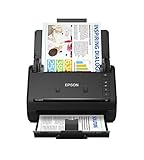
| Epson WorkForce DS-530 II | 35 ppm / 70 ipm | ~4,000 pages | 50 sheets | 11.7″ × 6.7″ × 6.9″ | $300–$400 |
| Raven Pro Document Scanner | 60 ppm / 120 ipm | ~6,000 pages | 100 sheets | 12.4″ × 7.0″ × 7.0″ | $600–$700 |
| Canon imageFORMULA P-208II | 8 ppm / 16 ipm | ~100 pages | 10 sheets | 12.3″ × 2.2″ × 1.6″ | $150–$200 |
Match the Scanner to Your Workload
Under 30 pages a day — home office and occasional batching
The Fujitsu ScanSnap iX1600 remains the default recommendation here, and not just for its speed. Its touchscreen profiles let different family members send scans to different folders or cloud services without touching a computer. ScanSnap Home’s OCR is among the better bundled packages for receipts and business cards. The honest caveat: its rated duty cycle is far lower than “workgroup” machines, and the output tray flimsy feel means it’s best for burst scanning rather than all-day queues.
If you travel or have almost no desk space, the Canon P-208II portable scanner runs off USB power and weighs about 1.3 pounds — realistic for scanning contracts at a client’s office, not for digitizing a filing cabinet.
30–200 pages a day — small business, paperless conversion
The Canon imageFORMULA R40 hits a sweet spot: 80 ipm duplex, a 60-sheet feeder, and a footprint smaller than most laptops. Its CaptureOnTouch software handles OCR and job presets well, though it’s Windows/Mac only with no wireless — the R50 version adds Wi-Fi if that matters.
The Epson DS-530 II is the alternative pick, particularly for mixed paper thickness. It feeds ID cards and receipts more forgivingly than most in this class, and Epson’s Document Capture Pro software is stronger on batch separation and barcode routing than Canon’s entry offering.
200+ pages a day — shared office or production scanning
Above this volume, duty cycle stops being a spec-sheet number and starts predicting hardware life. The Brother ADS-4900W and Raven Pro both handle roughly 6,000 pages daily with 100-sheet feeders and ultrasonic multi-feed detection — important, because a missed double-feed at page 300 of a legal file means rescanning everything.
The Raven Pro differentiates with its built-in touchscreen and direct-to-cloud scanning (no PC required), which suits offices where the scanner sits in a shared space. The Brother integrates better into existing TWAIN/ISIS workflows and tends to run quieter. Neither is portable — both demand a permanent desk spot.
Decision Matrix
| Your situation | Recommended pick | Why |
|---|---|---|
| Budget under $300, light use | Canon R40 | Cheapest path to real 80 ipm duplex |
| Family/shared use, receipts and cards | ScanSnap iX1600 | Best consumer OCR and dead-simple profiles |
| Thick stock, ID cards, odd sizes | Epson DS-530 II | Most forgiving paper path in class |
| Shared office, no dedicated PC | Raven Pro | Touchscreen + direct cloud upload |
| Heavy volume, TWAIN integration | Brother ADS-4900W | 6,000-page duty cycle, 100-sheet ADF |
| Travel or minimal desk space | Canon P-208II | USB-powered, 1.3 lb |
What the Spec Sheet Won’t Tell You
Feed rollers are a consumable. On most desktop scanners they’re rated for roughly 100,000–200,000 scans. At 50 pages a day, that’s years of service; at 500, it’s months. Replacement roller kits typically run $30–$80 — check availability before buying, since some budget models have no user-replaceable parts.
Quoted speeds assume 200–300 dpi. Jump to 600 dpi for archival work and throughput can drop by half or more. If you’re digitizing photos alongside documents, test speed at your target resolution.
OCR quality varies more by software than hardware. A scanner is just a camera and a feeder — the OCR lives in the bundled app or whatever you pair it with. ScanSnap and Epson packages handle receipts well; if OCR accuracy is critical (tax records, legal discovery), budget for a dedicated tool like ABBYY FineReader rather than relying on bundled software.
Common mistakes that shorten scanner life: scanning stapled or taped documents (scratches the glass and kills rollers), ignoring the cleaning schedule (dust streaks = white lines down every page), and overloading the ADF beyond its rated stack height, which causes the multi-feed jams that crease originals.
Monthly maintenance takes five minutes: wipe the scan glass and rollers with the supplied or isopropyl-based cleaning sheets, and blow dust out of the feed path. Do it on a calendar schedule, not when streaks appear.
FAQ
Do I need duplex if I mostly scan single-sided pages?
Yes — buy it anyway. Nearly every duplex-capable scanner costs the same as its simplex counterpart, and the first time a double-sided contract hits the feeder you’ll be glad you have it.
Flatbed or sheet-fed for old documents?
Fragile, bound, or non-standard documents need a flatbed (or an overhead-style scanner). ADF machines will chew or jam anything brittle. Many offices pair a cheap flatbed under $100 with a sheet-fed unit for this reason.
Is wireless worth paying for?
Only if the scanner won’t live next to a computer. USB connections are faster and more reliable; Wi-Fi adds convenience for shared placement but nothing to scan quality.