
What's inside
As an Amazon Associate I earn from qualifying purchases. This post may contain affiliate links at no extra cost to you.
Low-alloy steel components need more than a welder that can strike an arc. The machine must hold a stable arc at the amperage your electrode requires, provide the correct polarity, and tolerate long welds without overheating. For many brackets, frames, repairs, and structural parts, a DC stick welder is the most practical choice because it works well with low-hydrogen electrodes such as E7018 and higher-strength rods such as E8018.
The best choice depends on material thickness, electrode diameter, available power, and whether you are welding in a shop or at a job site. A compact inverter may be ideal for occasional repairs, while a heavier transformer or engine-driven unit makes more sense for repeated field work.
As an Amazon Associate we earn from qualifying purchases at no extra cost to you.


What we cover
Our Top Picks
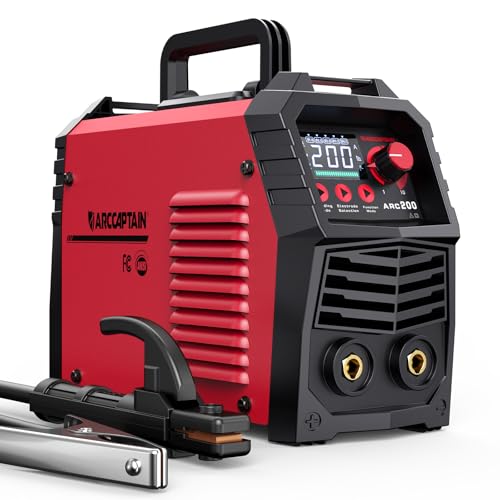
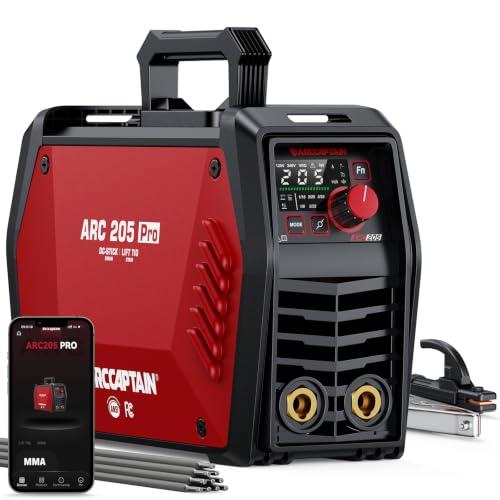
 YESWELDER 205Amp Stick Welder Digital Inverter IGBT ARCARC-205DS15.35 x 13.07 x 7.8 inches8.8 poundsCheck on Amazon

What to Look for in a Stick Welder
For low-alloy steel, prioritize a machine with DC output, adjustable amperage, and a usable duty cycle. AC-only welders can run some electrodes, but they are less versatile and usually a poor match for low-hydrogen rods. DC electrode-positive (DCEP) is the normal starting point for E7018 and many low-alloy electrodes, although the electrode manufacturer’s instructions take priority.
- Amperage range: A useful general-purpose range is roughly 20 to 180 amps. That covers 1/16-inch through 5/32-inch electrodes for most repair and fabrication work.
- Duty cycle: A 20 percent duty cycle at 180 amps means two minutes of welding followed by eight minutes of cooling during a 10-minute test period. Higher duty cycle matters for long structural welds.
- Input power: A 120-volt machine is convenient but limited. A 240-volt unit delivers more stable output and handles 1/8-inch and 5/32-inch rods more comfortably.
- Arc-starting features: Hot start helps ignite the electrode, while arc force helps prevent sticking when the arc length becomes short. These features are useful with E7018.
- Portability: Inverter welders are light and efficient. Transformer machines are heavier but can be simpler and more tolerant of rough job-site conditions.
For a first purchase, a DC inverter stick welder with at least 160 amps of output is usually the best balance. If your work is limited to thin brackets and occasional repairs, a lower-cost 120-volt unit can be perfectly adequate.
Best Welder Types by Job
| Welder type | Best use | Strengths | Limitations |
|---|---|---|---|
| 120V inverter stick welder | Light fabrication and repairs | Low cost, portable, runs from common outlets | Limited output and slower work with thick steel |
| 240V inverter stick welder | General fabrication and structural repairs | Good arc control, efficient, handles 1/8-inch and 5/32-inch rods | Needs a suitable circuit and may be less rugged than a transformer |
| Transformer stick welder | Shop work and occasional heavy welding | Simple, durable, often inexpensive used | Heavy, less efficient, usually fewer arc-control features |
| Engine-driven welder | Remote construction and field repair | Independent of utility power, high output | Expensive, noisy, requires engine maintenance |
A 240-volt MMA stick welding machine is the strongest all-around option if you have a properly wired circuit. The cheaper option is fine when welds are short, material is under about 1/4 inch, and you do not need to run large electrodes continuously.
Electrodes and Starting Settings
E7018 is the usual low-hydrogen choice for low-alloy steel when good ductility and crack resistance are important. It produces a smooth arc and strong weld, but it must be kept dry. Damp E7018 can introduce hydrogen and contribute to delayed cracking, especially in thick, highly restrained parts. Store it in a sealed container or rod oven according to the manufacturer’s instructions.
E6010 and E6011 are useful for root passes, dirty steel, and deep penetration. E6010 generally needs DC electrode-positive, while E6011 can run on AC or DC. They produce more spatter and a rougher bead than E7018. E7018 is often used for the fill and cap passes after the root is sound. For higher-strength components, use a compatible low-hydrogen electrode such as E8018 only when the design, base metal, and welding procedure call for it. Do not assume a higher-number rod automatically makes a better repair.
Typical starting ranges are:
- 1/8-inch E7018: approximately 90 to 130 amps
- 5/32-inch E7018: approximately 120 to 170 amps
- 1/8-inch E6010: approximately 75 to 125 amps
- 3/32-inch E7018: approximately 70 to 100 amps
These are starting points, not universal settings. Use the rod package recommendations and adjust for position, joint fit-up, and machine behavior. Vertical and overhead welding generally require less amperage than flat welding. Excessive amperage causes undercut, a wide flat bead, excessive spatter, and loss of control.
Preparation and Welding Technique
Remove mill scale, paint, oil, and rust from the joint. Low-alloy steel is less forgiving of contamination and restraint than mild steel. For material thicker than roughly 3/8 inch, a bevel and a controlled root gap may be needed to achieve full penetration. Clamp the parts securely, but allow room for shrinkage so the joint does not pull out of alignment.
Preheat requirements depend on alloy, thickness, carbon equivalent, joint restraint, and ambient temperature. Some thin components need no preheat, while thicker or highly restrained parts may require a controlled preheat commonly in the 150°F to 300°F range. Verify the requirement with the material specification or welding procedure; guessing can cause cracking or unwanted changes in heat treatment.
Keep a short, consistent arc with E7018 and use a small drag angle. Avoid excessive weaving. Stringer beads reduce heat input and make it easier to control the weld profile. Chip and wire-brush every pass, and inspect for slag inclusions, undercut, porosity, crater cracks, and incomplete fusion. Fill the crater before breaking the arc instead of snapping away abruptly.
Common Problems and Buying Mistakes
If the electrode keeps sticking, the amperage may be too low, the arc may be too short, or the rod may be damp. If the machine trips the breaker, check the circuit size, extension-cord length, and input voltage before blaming the welder. Long, undersized extension cords cause voltage drop and unstable arcs.
Do not buy solely by the advertised peak amperage. Compare rated output, duty cycle, included leads, input requirements, and warranty support. A welder claiming 200 amps but rated for only a short duty cycle may be less useful than a well-built 160-amp machine. Also budget for a proper electrode holder, work clamp, welding leads, auto-darkening helmet, leather gloves, flame-resistant clothing, and ventilation. A capable welder cannot compensate for poor joint preparation or inadequate protection.
Related guides
More from Amazon
Programs that pair well with the guide above. Offers and eligibility are set by Amazon and may change.
A free business account with business pricing and bulk-buying tools for work, shop or home office.
Create a business accountFree shipping on eligible items, Prime Video and more. Eligible new members can start with a free trial.
Start a Prime free trialAudiobooks and podcasts to listen to on the go. Eligible new members can start with a free trial.
Try Audible freeAd-free music streaming. Eligible new subscribers can start with a free trial.
Try Music Unlimited freeAs an Amazon Associate we earn from qualifying purchases.






Write Your Review
No reviews yet. Be the first to share your experience!