What's inside
As an Amazon Associate I earn from qualifying purchases. This post may contain affiliate links at no extra cost to you.
What we cover
Best Cut-Off Wheels for Clean, Fast, Safe Cuts
The best cut off wheels for most metalworking are thin, reinforced aluminum-oxide wheels matched to your grinder’s diameter and speed rating: choose about 0.045 inch thick for quick cuts in ordinary steel, and a wheel explicitly labeled for stainless when cutting stainless. For a 4½-inch grinder, a quality 4½ × 0.045-inch wheel is the best starting point; use a thicker wheel when durability matters more than speed.
There is no single best wheel for every job. Diameter determines fit and reach, thickness affects cutting speed and stability, and abrasive formulation influences how the wheel behaves on different metals. Always check the tool manual and wheel label: the wheel’s diameter, arbor size, and maximum RPM must be compatible with the grinder.
As an Amazon Associate we earn from qualifying purchases at no extra cost to you.


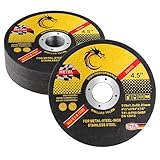
Quick comparison: which wheel suits the job?
| Wheel type and common size | Best fit | Cutting and service-life trade-off | Check before buying |
|---|---|---|---|
| Aluminum oxide, 4½ × 0.045 in | Fast cuts in mild steel, angle iron, and thin-wall tubing | Narrow kerf and relatively quick cutting; thin wheels can wear or break more readily if twisted or side-loaded | Reinforced construction, correct arbor, and RPM rating at least as high as the grinder’s no-load RPM |
| Aluminum oxide, 4½ × ⅛ in | General metal cutting when toughness and handling tolerance matter | More robust, but removes more material and often cuts more slowly than a thin wheel | Confirm it is a cut-off wheel, not a grinding wheel; do not grind with its side |
| Stainless-designated, 4½ × 0.045 in | Stainless sheet, tube, and bar | Thin kerf helps limit heat and material loss; life depends heavily on pressure, workpiece thickness, and technique | Look for stainless suitability and a “free of iron, sulfur, and chlorine” or similar contamination-control marking |
| Aluminum-oxide, 3 × 0.040–0.045 in | Compact-tool access and small metal parts | Useful where a larger wheel cannot reach; smaller diameter means less cutting depth and reach | Tool compatibility, arbor, guard, and RPM rating; a 3-inch wheel is not a substitute for a 4½-inch wheel on a larger grinder |
| Zirconia-alumina or ceramic abrasive, cut-off wheel where available | Frequent, demanding cutting when the product is specifically rated for the material | Potentially longer working life in suitable applications, but higher purchase cost; performance varies by formulation | Verify that it is a cut-off wheel, not a flap disc or grinding wheel, and follow the maker’s material guidance |
Dimensions above are common examples, not universal standards. Wheel thicknesses, arbor sizes, and available formulations vary by brand and tool. A wheel’s label and your grinder’s manual take priority over this comparison.
Choose by metal and cutting frequency
For the best cut-off wheel for steel
For mild or carbon steel, a reinforced aluminum-oxide wheel is a practical, widely available choice. A 0.045-inch wheel suits repeated cuts in tube, angle, and flat stock when fast progress and a narrow kerf matter. If you are cutting thick sections, working in a less controlled position, or prioritize a more forgiving wheel over speed, consider a thicker cut-off wheel that the grinder accepts.
Aluminum oxide is a dependable general-purpose abrasive, but “best” depends on the exact wheel construction. A thin wheel is not automatically longer-lasting: forcing it, twisting it in the cut, or using it on an unstable workpiece can wear it quickly or cause it to fail.
For stainless steel
Choose a wheel labeled for stainless steel rather than assuming a general metal wheel is suitable. Stainless-designated wheels are commonly formulated to reduce iron, sulfur, and chlorine contamination that can contribute to surface problems. Use light, steady pressure and avoid letting the cut area overheat. A thin wheel can reduce the width of the cut and heat generated by material removal, but it cannot compensate for a dull or unsuitable abrasive.
For mixed, occasional metalwork
If you cut a little mild steel, stainless, and miscellaneous metal, separate wheels are often a better choice than one wheel for everything. Keep the stainless wheel clean and reserved for stainless; this reduces the chance of carrying carbon-steel particles onto the stainless surface. For infrequent jobs, standard aluminum-oxide wheels are usually the economical choice. For production work, compare the cost of each wheel with how many equivalent cuts it completes, not just its shelf price.
Diameter, thickness, and tool fit
The best grinder cut off wheel is the one made for that grinder’s size and speed—not simply the one with the highest advertised cutting speed. A 4½-inch wheel is common on handheld angle grinders and gives more cutting depth than a 3-inch wheel. The best 3 inch cut off wheels are therefore those that match a compatible compact tool and provide access in tight spaces; they are not generally the fastest option for deep cuts.
A “4 1 2” or 4½-inch wheel must be used only on a grinder designed for that diameter. Never remove a guard or fit a smaller or larger wheel contrary to the tool manufacturer’s instructions. Check the arbor opening and maximum RPM on both tool and wheel. The wheel’s maximum RPM must meet or exceed the grinder’s no-load speed.
Thickness is a trade-off:
- Thin, around 0.040–0.045 inch: less material removed and a narrower cut; often preferred for speed and thinner stock. It needs careful alignment and minimal side pressure.
- Thicker, around ⅛ inch: more material removed and typically a slower cut, but often more tolerant of rough handling. It remains a cut-off wheel and should still cut with its edge only.
Compare service life by cost per cut
For recurring work, track comparable cuts rather than relying on vague claims of “long life.” For example, suppose a pack costs $12 and the wheels make 60 similar cuts through the same size of mild-steel tube. That is $0.20 per cut. If a $20 pack makes 120 comparable cuts, it costs about $0.17 per cut and may be the better value, despite the higher upfront price.
This calculation is useful only when the cuts are genuinely comparable: same material, section size, grinder, and technique. Wheel life falls when the wheel is pushed hard, pinched, allowed to overheat, or used on stock that moves during cutting. The abrasive wears away during normal use; damage to the wheel, rather than gradual wear, is a reason to stop using it immediately.
Setup and use for cleaner, safer cuts
- Inspect before mounting. Do not use a wheel that is cracked, chipped, wet, or past any applicable expiry date. Check that it is the correct type, size, and speed rating.
- Secure the workpiece. Clamp it so the cut does not close and pinch the wheel. Support long stock on both sides while allowing the cutoff piece to fall clear.
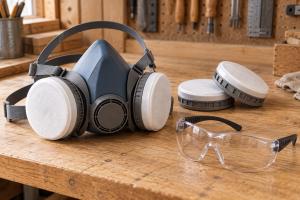
- Use the guard and appropriate protection. Wear eye and hearing protection and follow the grinder maker’s instructions. Keep bystanders out of the spark path and remove flammable material from the area.
- Let the wheel reach operating speed. Hold the grinder with both hands where possible and enter the cut steadily. Do not force the wheel or twist it to widen the kerf.
- Cut with the edge only. A cut-off wheel is not a substitute for a grinding wheel. Side-loading can damage it; use a suitable grinding or flap product for deburring and surface work.
- Wait for a complete stop. Set the tool down only after the wheel stops, then check it again before the next use.
For a clean result, mark the cut clearly and keep the wheel aligned with the cut line. Excessive pressure often makes a wheel cut more slowly, increases heat, and shortens its useful life. If it begins to bind, stop, switch off, and correct the workpiece support rather than wrenching the grinder free.
Bottom line
For most DIY and shop cutting in ordinary steel, start with a reinforced 4½ × 0.045-inch aluminum-oxide wheel that matches your grinder’s arbor and RPM. Choose a stainless-designated version for stainless, a thicker wheel when durability and handling tolerance outweigh speed, and a compatible 3-inch wheel when access—not cutting depth—is the main constraint. Fit, material rating, and careful technique matter more than a broad “long-life” claim.